Blog

Gentlemen’s Agreements: Business Deals in Morocco

There is something right about making gumbo in Africa. Sure, we learned how to make a good gumbo back when we lived in Louisiana. And gumbo is about as common in Morocco as jambalaya was when we lived in Ohio. (For the record, when a tavern-owning alumnus of the school in Cleveland where Brian was President learned that Brian had accepted a new Head of School position in Louisiana, he told Brian that his tavern had the best jambalaya in Cleveland. Brian, who held both the alumnus and his tavern in high regard, responded in an eastside Cleveland context, saying, “No offense, but that is like saying a place in Baton Rouge has the best Slovenian sausage in all Louisiana.”) But the roots of Louisiana gumbo trace back to Africa, where the green vegetable okra, used to thicken gumbo, is actually called gombo. Slaves brought gombo from Africa to the New World centuries ago, and African slaves in the New World used it to make a soupy goodness that nourished them. Gombo in the pot became gumbo, the dish. So even though Morocco has no real tie of its own to gumbo, now that we live in Africa it just seemed right that Brian cooked a gumbo last week.

Plans for the gumbo began nearly two months ago when we made a big trip to Rabat for supplies at the Commissary of the U.S. Embassy. Just in time for Mardi Gras we found andouille sausage stacked in the Commissary’s freezer with pork chops and bacon and pork tenderloins. Overjoyed to find the Porkfest, we returned with a fair supply of each to squirrel away in our own small freezer. We planned to make a Mardi Gras gumbo, but time got away from us and it did not happen. Among other reasons, while we had the andouille we figured would prove difficult to obtain, we discovered that the okra we had seen previously in our souks had gone out of season. In Morocco, out of season usually means out of luck. No problem, we thought. We will find it in the limited selection of frozen vegetables at Marjane or Carrefour supermarkets. After all, we figured, we are in Africa; we ought at least to find frozen okra here. Nope, no go for gombo. The longer the andouille sat in our small freezer, the more room it seemed to take up. So, presuming we had nothing to lose by seeking okra-shopping advice from local merchants, Brian suggested we ask Youssef if he knew where we could find okra. Thus begins our story of high commerce in Morocco.

Youssef is one of the guys from whom we buy vegetables each week in the CIL neighborhood of Casablanca. An amiable man in his mid-forties, with excellent English developed during several years living in England, and a friendly demeanor that edges on solicitous, he builds his business by building relationships with the European and American expats who predominate in the CIL because they know they can find pieces of European and American comfort for sale there. Youssef harbors the entrepreneurial spirit that drives the pure capitalism prevalent in Morocco, and found a niche in hocking ready-to-use produce. From a table at the entrance of the courtyard housing the souks in the CIL, Youssef sells bags of shelled peas, peeled potatoes and carrots, artichoke hearts he whittles down from whole chokes, and more. Because he hocks his goods as semi-prepared foods, he charges considerably more for them than what we pay a few meters away at Zwil’s souk for regular produce. Because he always greets us as we enter the CIL’s souks, and because he remembers details about us like any good businessperson remembers how to flatter customers with small talk about their personal lives, Audrey insists on buying a few things from him that do not appear on her weekly shopping list. Over time, his prices have gone up, so that we spend almost as much for a couple items from Youssef as we pay Zwil for our week’s worth of fruits and vegetables.

He also keeps a well-attuned ear to the ground, providing good information about culture and events and happenings domestically and internationally, delivered easily to us with his strong English. So Brian thought that Youssef might provide some good leads on where to find out-of-season okra in Casablanca in March. Two weekends ago, after collecting our weekly produce from Zwil and shopping for meat from our happy Berber butcher a few meters away, on our way out of the souks and before we picked up wine from the Israeli-owned alcohol Hanout, we stopped at Youssef’s table to ask about okra. Youssef had no idea what okra or gombo was. (We have since learned from Abdeljalil, our tutor in the Moroccan Arabic dialect called Darija, that the Darija word for okra is mlokheyya, and its season is NOT in March.) But Youssef did recognize a photo okra when we pulled it up in Google images on a phone.

Yes, I know this vegetable, and I know where you can get it,” Youssef said while beaming with pride in his ability to help us. He continued, “You need to go to the Black souks. Do you know where they are? That is where the Black Africans go to shop. They have lots of places where the Black women can get their hair put into styles, and they have all kinds of things the Black people who come up from the countries below the desert want to buy. This is where you can find this vegetable you want. You need to go to the Black souks.”

When we asked where in Casablanca we could find the Black souks, Youssef offered, “You know, I can go there for you and get this…this…

…Okra.

Yes, this okra. I will go to the Black souks this week and you can get it from me next week when you come to the CIL. I am happy to do this for you.”

We walked right into it: What a great idea, we thought. Brian, calculating how much okra he would need for his gumbo, pulled out a 50 Dirham note – roughly $5 – and gave it to Youssef saying, “If you can get one kilo of okra, we will get it from you next weekend.” Audrey followed him up by promising excitedly, “If it costs more than 50 Dirham, we will pay you the rest when we get it from you next weekend.”

Through the next week, Brian kept thinking of the gumbo he would get to make, waiting impatiently for the weekend to come when we would pick up our okra from Youssef. Finally our shopping day arrived and we headed for the CIL. With our first stop at Zwil’s souk, Brian put the celery, peppers, and onions (the “Holy Trinity” of Louisiana cuisine) he needed for gumbo into our big wicker weave shopping basket. Next we went to our happy Berber butcher for a chicken to complement the andouille waiting in our freezer (and to make a roux for the gumbo’s base). Finally we stopped at Youssef’s table on our way out of the souks.

Youssef greeted us warmly as he always does, then his demeanor changed dramatically. Looking forlorn, he said, “I went to the Black souks to get your vegetable for you, but they did not have it. I looked everywhere, but there is no okra anywhere in Morocco.” Our hopes sank.

After a dramatic pause to read our disappointment, Youssef brightened again as he reached under his table, grabbed a paper bag, and drew from it four small plastic bags stuffed with okra. Our dashed hopes rose again as he explained, “I have a friend from Sudan who comes to Morocco every two days to bring things to sell. I called him up and told him about my American friend who needs this gombo, and I asked him if they had it in Sudan. He said they have it all over Sudan, but it would be too long a way to bring it to Morocco. I told him my friend needs it because his wife is pregnant and demanding it to satisfy her craving; otherwise she would scratch her arms and her neck and get a rash.”

At this Audrey jumped: Pregnant?!!!

Youssef grinned sheepishly as he maintained, “I had to tell him this so he would bring it, because you cannot refuse a pregnant woman when she craves something. You have to get it, whatever it is, or they scratch themselves on the neck and arms and get a rash.” Youssef pretended to scratch his forearms and his neck for visual effect. “My wife, this is what she did, and so I got her what she craved. And I told my friend in Sudan that he must help me so I can help my American friend with his pregnant wife.”

So Youssef told us how, to help the American satisfy his wife’s craving and stop her from scratching her arms and neck into a rash, his trader friend brought okra from Sudan, where there is plenty of okra right now. These okra were picked just two days before, and Youssef’s friend had brought okra to him in the CIL just one day before. The okra looked very large, very green, very fresh. Despite being bigger than one usually would want to cook with, they would make a very good gumbo!

Then Youssef’s countenance changed once more as he cast his eyes down and dropped his voice to an apologetic level. Like a nine year old digging his toe into the ground as he confessed to breaking a window with his new baseball, Youssef said, “When my friend brought this from Sudan, he said it cost 80 Dirhams.” No problem, we figured. We had paid him 50 Dirhams the week before; we would give him another 30 Dirhams now. Another pause…then, “He told me 80 Dirhams EACH.” Whoah, four quarter-kilo bags at 80 Dirhams each? Making it 320 Dirhams, or about $32 for a kilo of okra! Brian’s eyes popped out of his head.

In Morocco, business gets done on a word, and once you enter into a deal you become committed to see it through. Not considering The Sudan Scenario, Audrey had told Youssef a week earlier that we would appreciate whatever he could do to get okra for us, and we would pay him whatever extra it cost beyond the 50 Dirham. He found us okra; we had to pay him. Brian reluctantly pulled out 300 Dirham, thinking that amount, plus the 50 Dirham from the week before, covered it with a little more for his trouble. Youssef looked at the 300 Dirham, looked at Brian, scrunched his face pleadingly, and said, “It was so much time to go to the Black souks to look for it and then to get my friend to bring it from Sudan when it was not anywhere in Morocco.” In other words, “Couldn’t you give me a little more?” Brian sighed and pulled out another 20 Dirham note, giving Youssef the equivalent of a $5 okra finders fee.

If that seems very little, consider first that $5 goes much farther here than in the U.S. Second, truth be told, we do not really know if the okra actually came from Sudan. How intriguing, we thought, that Youssef’s Sudanese friend apparently brought the four 80 Dirham quarter-kilo bags of okra from Sudan in the very same unusually long and thin plastic bags Youssef uses to package the vegetables for sale on his table. Hmmm. Yet, despite that mystery, we also do not know that the okra did not come from Sudan, and to suggest to Youssef we thought he might be lying in order to gouge us would insult his honor – a big no-no in Moroccan culture. So, having laid out the parameters of our deal so loosely that he could reasonably offer the wild Sudan scenario – shame on us for being sloppy and naïve in our business dealings – we paid about $37 for two pounds of okra.

In the end, we learned three important lessons.

Lesson One: When negotiating a business deal in Morocco, be absolutely explicit about any expectations, limitations, or caveats in order to avoid creating loopholes someone can exploit to your financial peril.

Lesson Two: If we really want something here in Casablanca, resourceful Youssef will pull out all stops and find it for us somewhere and somehow.

Lesson Three: Unless we REALLY want it – like pregnant-woman-craving level of wanting it – do not ask Youssef to find it for us because we will pay quite dearly for it.

POSTSCRIPT – Brian made a really good gumbo that we ate and shared with friends over a few days. If it was not a $37 gumbo, it was close.

On your mark…get set…here we go!

Moroccan Bureaucracy: More “Inshallah” than Weber or Kafka

More than a century ago, German sociologist Max Weber launched his legal-rational theory of bureaucracy, establishing the characteristics he believed made a bureaucracy good. Weber liked bureaucracy. Weber REALLY liked bureaucracy. Weber liked bureaucracy so much that he considered it of vital importance to the success of the modern state. For context, though, consider that Weber, who died in 1920, never had to renew his driver’s license at the Department of Motor Vehicles. He also never moved to Morocco. Anyone who has done either of those things more likely associates the reality of modern government bureaucracy – especially in Morocco – with Czech author Franz Kafka, who died in 1924 four years after Weber. Like Weber, Kafka also never experienced the DMV or moved to Morocco; but, his nightmarish tales elicit knowing nods from readers who have done one, the other, or – in our case – both. Still, even more than seeming Kafkaesque, Moroccan bureaucracy embodies the culture of “Inshallah” (“God willing”) that pervades everything here.

As heads of schools, as well as in other matters of personal and professional life, we have had our share of interactions with bureaucracies of all kinds. In our household, because Brian actually worked in government a lifetime ago (before he became a Government teacher) and because he tends to have more patience for dealing with it, Audrey tends to nominate Brian as the family representative to fill out forms of a pesky nature and go stand in lines to turn in said pesky forms. So Brian experienced an “Inshallah moment” dealing with Moroccan bureaucracy last week in the process of trying to get Charlotte’s residency paperwork approved.

As expats living and working in Morocco, we need residency paperwork to work here, to open a bank account and wire money stateside for bills, to pay daughter Margaret’s college tuition in Arizona, and to do pretty much any other official government or business thing back in the U.S. Fortunately for us, George Washington Academy’s HR office does an exceptional job helping new employees to navigate the startup hurdles by facilitating our obtaining residency paperwork, establishing bank accounts, etc. after we provide the HR folks with multiple passport-type photos (taken with the proper background, or no good); our passports, of which they make multiple copies; original birth certificates; our marriage certificate; criminal background checks from the FBI; medical attestations completed by a Moroccan doctor to certify that we have heartbeats and can breathe; and other required paperwork that HR organizes and submits on our behalf. Granted, it still took a couple months for each of us just to get our Récepissé (receipt) from the neighborhood police headquarters that said officially we had started the residency paperwork process. Until we had our récepissés in hand, we could not open a bank account (which HR again facilitated). Because we could not open a bank account, we could not wire money back to the U.S. and had no place to put our cash here in Morocco. Even after we received our récepissés and opened a bank account, we still had to wait several months longer until we could wire money. Meanwhile, we waited for our Cartes de Séjour (our actual residency cards) to arrive from Rabat, the Capitol of Morocco where our residency application paperwork had gone for processing. Coworkers at GWA who arrived after we did last summer started getting their CDS, but we did not. We asked HR why others who followed our arrival received their cartes before we did. Our first solid dose of the “Inshallah” nature of this process came with the only available well-reasoned explanation: “Because theirs came back from Rabat before yours did.

Since the récepissés expire after three months, we had to go to the Prefecture, the big police headquarters in Casablanca, to renew them before we flew back to the U.S. in December. January came still without the cartes. Brian asked HR when our approved cartes might get sent down from Rabat. He learned that they actually had arrived from Rabat, but now sat in a drawer in the Foreigners Office of the Casablanca Prefecture while HR waited for word that we could go pick them up. Finally, in early February, HR told Brian he could pick up his Carte de Séjour. He went to the Prefecture, waited his turn in the Foreigners Office, picked up his CDS, and asked if they also had Audrey’s CDS. Yes, they had it…and she would have to come herself to pick it up. A few weeks later she did. Having finally picked them up nearly eight months after we arrived in Morocco, our new one-year cartes will expire in September, requiring that we go through the whole process again. Yet, after getting our first one-year CDS, we can reapply for another one-year or a five-year or even a ten-year. Assuming we still have the option in September, we definitely will go for the ten-year. For now, with both of us finally holding our Cartes de Séjour, we felt official. We felt like we really belonged. We felt success!…

…Except that Charlotte turned 16 in November, and Morocco requires children age 16 and older to have their own residency paperwork. So four months ago we kicked off the whole process for Charlotte. For whatever reason, rather than having Brian as the parent of record, we initiated paperwork with Audrey as the parent of record. Charlotte’s paperwork got filed in early December, and our wait for her Récepissé began. (Flying at Christmas from Casablanca to Paris to Seattle and back again in reverse, she had only her passport and the small provisional receipt that precedes the official Récepissé but proved sufficient for her to get back after our trip.) We presumed her application moved forward, and that we would get her official Récepissé soon, especially since her small receipt would expire at the end of March.

Nope.

When Brian learned in February that he could pick up his CDS at the Prefecture, he also learned that Charlotte’s application had come back rejected because the last name on her birth certificate (Menard) differed from the last name on Audrey’s birth certificate (Cauley). Imagine that. So we had to amend her file with paperwork that named Brian as the parent of record and certified his status as her father. This began with a trip to The Commune, a neighborhood-based collection of government agencies, including the equivalent of a Notary who could affix the proper seals and stamp the right stamps to certify Brian’s attestation as Charlotte’s father. In Morocco, nothing official happens without a stamp. In an age where the government can track an individual’s currency exchanges by passport number through a nationwide computer database (and does, in order to limit any individual’s currency exchanges to about $4000 a year), getting a notary stamp remains more 1917 than 2017. The Commune’s open air offices have not a single computer to be found.  Instead, it features lots of clerks sitting at aged and worn mid-20th Century desks while waiting to stamp papers – including a one-armed older man reigning as the lightning-fast stamper. A clerk finds the right square seal, licks it, and affixes it to your document. Then he stamps it by hand with a big THUD sound of him punching the stamper down on the paper and seal. Then you sign the register in a thick, leather-bound, oversized ledger. For all the paper-based operations there, the wonder is that you see no shelves lined with filled ledger books and other paper records. Who knows where those get stored. With paperwork duly stamped, though, Brian could take it to the Prefecture to drop it off and have it added to Charlotte’s file.

And this is where “Inshallah” bureaucracy really takes off.

When Brian went to pick up his CDS at the Prefecture, before going to the Foreigners Office he went to the main room to drop off his notarized papers. The room had about a half dozen counter spots with two of them actually staffed by clerks. A large crowd sat waiting their turns to approach and do business. All Brian needed to do was drop off the papers, but when he tried to do that with a clerk she gave him a nasty look and spoke sharply to him in French that he needed to get a number and wait his turn. Asking where he could get a number, she jerked her head right to indicate he should get them from the clerk seated at a table at the far end. Moving to the table, he asked the table clerk how he could get a number. The table clerk told him in French that the numbers had all been given out. Asking him when there would be more numbers, the table clerk told Brian that was all the numbers for that day. In essence, even though he had gone fairly early in the morning to the Prefecture, he would not be allowed to drop off the paperwork that day. Apparently it was not God’s plan for him to drop the paperwork that day.

A week later, he tried again, heading to the Prefecture first thing in the morning. Inshallah, surely he could get a number and execute the simple task of dropping the paperwork. However, despite the early arrival, again the amassed people had already claimed all the numbers for that day. Again, God’s plan did not include dropping the paperwork that day.

Calendars and schedules did not let him return for a third try until last week. With the expiration of Charlotte’s provisional receipt three weeks away, he headed again to the Prefecture. Arriving no earlier than before, this time he found on the end counter a cache of red paper squares with numbers hand-written on them. He grabbed Number 22, then saw the clerks dealing with numbers 1 and 2. GWA’s HR office had told him to get a number if possible, but also to check with the Foreigners Office on the off chance that they had processed Charlotte’s paperwork after all with only Audrey’s parenting information. With plenty of red paper numbers ahead of him, he headed back to the Foreigners Office. Asking if they had Charlotte’s Récepissé, of course they did not. However, in order to explore why they did not, the clerk took his paperwork… Finally, it was his Inshallah moment!

After a few minutes of the clerk conferring in a different room, she returned and asked him to take a seat around the corner outside the office of the chief and wait. So he did, and he waited. And waited. And waited. Could they actually be preparing her Récepissé right there?

No, they could not.

The Inshallah moment had passed. When she finally came back to him after he waited over an hour, she told him that his notarized paperwork had expired after all these weeks. “Why did you not come sooner to drop it off?” she wondered at him in French. Deep breath. Count to ten.

So we still do not have Charlotte’s Récepissé. The clerks at The Prefecture said they will work with our HR folks to get it resolved before Charlotte’s expiration date at the end of March…Inshallah. If not, does anyone want to add a great 16 year old kid to your household? She may be looking real soon for a place to go.

On your mark…get set…here we go!

Finding Culture in Morocco

One naturally would assume, upon reading a blog post title “Finding Culture in Morocco,” that we mean it in the sense of our quest to discover and explore…Moroccan culture. Indeed, as our collection of posts since last July shows, usually that is our focus which has met happily with success as we have settled into our lives here. Yet, in all our moves through Virginia to Ohio to Louisiana to Arizona, we both always felt a need to balance the enjoyment we found in adjusting to new circumstances with some measure of familiarity. Culture shock can impact more strongly, even critically so, when new surroundings seem so completely foreign that you lose your sense of you. Our school, George Washington Academy, does a superb job orienting new faculty and administrators to GWA, to Casablanca, to Morocco, and to this blend of passion and pitfalls when adjusting to new surroundings overseas. Our COO, Danielle, created an orientation program that is especially good at launching GWA newbies toward success in their new lives here. As a result, our move to Casablanca and to GWA has enriched our lives – including that of our teenage daughter, Charlotte – with the warm and welcoming people of Morocco, fantastic food, centuries of interesting history to explore hands-on, the spiritual beauty of the daily call to prayer, a tolerance of the open practice of other religions in a Muslim land, diverse climates and topography across the country, the freshest and juiciest produce we have ever enjoyed, and no shortage of animal encounters on a daily basis (from donkeys in the streets to dogs and cats that roam freely to sheep grazing in pastures to chickens that slip through our school gate and stroll around within the campus walls. (By the way, teacher friends, we are currently searching for teachers for the 2017-2018 school year. Check us out at http://www.gwa.ac.ma, and apply at http://www.gwa.ac.ma/HR.)

Despite our individual and collective family happiness with our lives here, at times we still yearn for things that we have enjoyed in other places we have lived and traveled. For example, we love going to the symphony, the theater, museums, a foodie-friendly fine dining restaurant, and such. When we told people a year ago that our next step in life’s journey would take us to Morocco, we encountered a variety of responses. “Say hello to Princess Grace for me.” No, that is Monaco on the French Mediterranean, not Morocco on the northwest corner of Africa. “Aren’t you afraid to go to a Middle East country?” Um, Morocco is a continent away from the Persian Gulf. The native Arabic dialect, Darija, is a mix of Arabic, French, Spanish, and sub-Saharan African languages like Louisiana’s Creole is a mix of French, Native American, and African languages. When we told people that Morocco is a very western-friendly country, some cautioned that we could not really know that until we arrived to experience it. Well, we arrived and experienced it, and it is a western-friendly country. Folks here may have a hang up about France – perhaps having to do with that colonialism thing – but America has been A+ on people’s lists. King Mohammed VI has pushed English instruction and fostered good relations with the U.S. for business and other interactions. Families able to travel mark New York, DC, and Florida as key destination spots. Students looking to go to school overseas consider American university options highly. The U.S. Department of State rates Morocco as one of the safer places for Americans to travel and live, as opposed to concerns that have developed about locations in Europe traditionally considered safe spots. Even in the current international political climate, we find less concern about backlash against America in Morocco than we do about whether Moroccan students wanting to go to college in America will be allowed to do so.

All that said, while we did our regular shopping today in the souks to get fresh produce, ground beef that went through the grinder on the spot for us, and freshly made kibi to bring home for dinner tonight, we also enjoyed a rather “western” weekend. Yesterday we drove Charlotte to Chile’s (yes, Casablanca has a Chile’s, as well as McDonald’s, Burger King, KFC, Domino’s, Pizza Hut, and more) to meet up with people for a birthday lunch for a couple of their friends, then we circled back later to shuttle three of them over to the Morocco Mall to hang out for a while. With Charlotte deeply ensconced in teenage social life, we headed back home to get ready for an evening outing of our own. Our friends Abdellah and Najet, who after adopting us last Fall then joined us with their kids for the Thanksgiving dinner covered in a earlier blog post, invited us to their home for dinner and then to a concert by L’Orchestre Philharmique du Maroq (the Morocco Philharmonic Orchestra) in a beautiful 80 year old concert hall in downtown Casablanca. With its ornate finishings, the French Protectorate era concert hall could have been a concert hall in Paris or London or New York. Eighty-five year old Abdellah, an opera lover, told us of his first time coming to this venue at age 18 when he heard Mozart’s Marriage of Figaro. Last night’s Philharmonic concert featured Mozart as well, along with Brahms, Tchaikovsky, Bach, Paganini, and Ysaye, and featured several guest violin soloists from Germany, France, and the U.S. Following last night’s classical music fix, to add to our Moroccan western binge we decided on a whim after our shopping today to lunch at a wonderful Italian restaurant called Ristorante Italiano. (Yes, we could not resist an Italian restaurant named Italian Restaurant in Italian.) The food was spectacular, the atmosphere superb, and the service spot on. Audrey had a burrata anti-pasta and gamberi e zucchine risotto. Brian had a perfectly al dente fresh-made linguini alla bolognese, followed by a pollo scallopini in salsa dI senape with rice and mushrooms sautéed in thyme. The only thing that did not remind us of eating a “fine dining” meal in Rome or back in the States: the check that beat what such a meal would cost elsewhere by at least half! As we spoiled ourselves further with a terrific tiramisu, we considered the merits of bringing our next visitors back for a good Italian meal after giving them a solid introduction to Moroccan culture and life.

Both with last night’s concert and today’s lunch, we reveled in a bit of western culture high brow fun. We love living in Morocco, and part of loving living here is that we can straddle western and Moroccan cultures as we wish. We do not know how many years we will stay in Morocco, nor how much “western” we will retain over time, but for now we find ourselves quite comfortable as Americans living here with an appreciation for our new home and its provision to us of enough other comforts to feel not too far from our old home.

On your mark…get set…here we go!
King Cake: A Taste of Moroccan Diversity

Checking out the FaceBook pages of friends in Louisiana, a state in the U.S. historically and culturally more French than English, we see that the Mardi Gras season has fired up right on schedule. Indeed, from this weekend through Fat Tuesday on February 28, Krewes will lead over 30 Mardi Gras parades in New Orleans alone, to say nothing of the scores and scores more through Baton Rouge, Lafayette, and elsewhere around the state. (Yes, we know that Mardi Gras means Fat Tuesday in French, but we acknowledge that in the U.S. the Mardi Gras season stretches over nearly two months and culminates on Fat Tuesday.) We enjoy such things from across the combined distance of the Atlantic Ocean and Gulf of Mexico vicariously through the Internet. Digital imagery goes only so far, through, in satisfying our desire for deeper levels of engagement.

Hamdullah (“Praise be to God”), we live in a Muslim country that welcomes the free practice (but not proselytizing) of other religions. Among the various Christian denominations represented in Casablanca, we have several Catholic parishes from which to choose, including Eglise Christ Roi’s weekly English-language Mass celebrated in a strong accent by a French priest with a predominantly Filipino choir and Filipino parishioners crowded into a large room on the ground floor of a larger building. As close as we have come to planting in a home parish, though, is at the monolithic cement and stained glass Eglise Notre Dame de Lourdes, with its French-language Mass in which the clergy, choir, and over 90 percent of the parishioners hail from former French colonies in sub-Saharan Africa. Casablanca diversity and Catholic diversity intersect here, one manifestation of the tension with French influence that exists broadly in Moroccan culture – at once resenting the history of French domination that ended officially in 1956 with Morocco’s Independence, and perpetuating through cultural inertia its impact on things like bureaucracy, urban planning, education systems, and more.

Neither the French influence nor the diversity living here around us brings Mardi Gras parades to the streets of Casablanca. Nonetheless, we can enjoy more of the season than provided by vicarious digital imagery and a forehead of ashes on Ash Wednesday. Brian loves to make gumbo, having sold gallons of it from a food truck in Arizona and having catered a Bishop’s lunch for 300 with it at our parish in Scottsdale. Last Fall, the U.S. Consul General in Casablanca (a New Orleans native) told Brian that she asks for the Commissary in Rabat to stock andouille sausage around this time so that she can make jambalaya for Mardi Gras. Lo and behold, when we shopped at the Commissary last weekend we brought back several packs of andouille (as well as a generous supply of other port products!) so that Brian can make a good Mardi Gras chicken and andouille gumbo.

We discovered another piece of Mardi Gras culture available in King cakes. Back in Lafayette, Louisiana, you could find no better King cake than at Meche’s Donut King. Throughout the season leading up to Lent, Meche’s deep fries thousands of their gigantic cinnamon twist ovals stuffed with chocolate or cream cheese or Bavarian cream, glazed, painted with icing in vivid Mardi Gras colors of green (for faith), yellow (for power), and purple (for royalty), and finished with Mardi Gras beads. King cakes become ubiquitous at schools, offices, parties, and just around the house for weeks. The irony is that while King cakes have become a staple of Mardi Gras, they originated in France (brought to the U.S. in 1870) to celebrate Epiphany, also known as Twelfth Night (on January 6, the twelfth day of Christmas), when the Three Wise Men arrived at the stable to pay homage to the baby Jesus as the King, and to offer him gifts of gold, frankincense, and myrrh. Over time, the practice of hiding coins, nuts, or other gifts inside King cakes as gifts for people to find morphed into hiding a little plastic baby Jesus inside. Traditionally, whoever finds the baby Jesus in their piece shares the resulting good luck by bringing the next King cake. Epiphany kicks off both the Mardi Gras season (New Orleans’ has its first parade of the season on January 6), and the King Cake season.

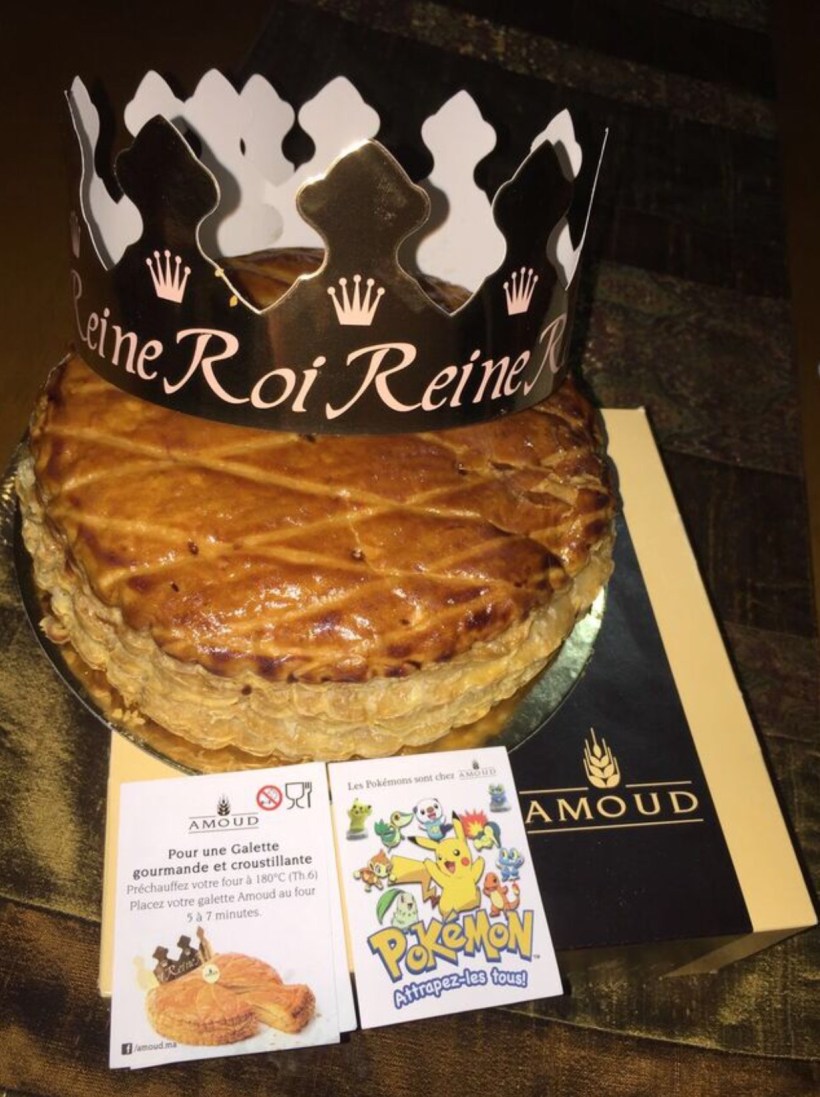
So it was with great cultural interest and culinary excitement that in the week before Epiphany, we walked into the French bakery Amoud Patisserie & Boulangerie to procure our weekly bread and treats, and walked out with a King Cake. While Meche’s King cakes in Louisiana are basically humongous donuts, Amoud’s King cakes are like giant French pastries with flakey layers and custard-like fillings of almond, lemon, or other flavors. The variation of tradition did not end there, though. Amoud still called them King cakes, but in a concession to cultural sensitivity in a Muslim nation (and, presumably, wise marketing), rather than hiding a small baby Jesus inside, the Moroccan King cake actually had a small plastic Pokémon figure. Pokémon? Yes, Pokémon. It seems strangely fitting that, in this cosmopolitan city with people from around the globe living together in this Muslim nation, like Santa Claus becoming a sectarian face of Christmas in the U.S., a small plastic Japanese toy would get stuffed into a pastry celebrating Epiphany.

Following instructions, we warmed it in the oven for about 10 minutes, then devoured it warm and satisfying. Next weekend, just before the Fat Tuesday of Mardi Gras (again, we know: Fat Tuesday…Mardi Gras), we hope that Amoud sells King cakes again. In addition to wanting that French pastry goodness, Charlotte wants to get another Pokémon.

On your mark…get set…here we go!
Winter: The Growing Season

As January has rolled into February, we have enjoyed seeing postings on Facebook and elsewhere by stateside friends in snowy Winterlands. Having lived in Cleveland for a number of years, we have a fondness for the beauty of snowscapes, and enjoy their reminder in the posts. At the same time, these images bring to mind the Proem of Book II in De Rerum Natura, when Lucretius creates a scene to describe pleasure as the absence of pain:

‘Tis sweet, when, down the mighty main, the winds
Roll up its waste of waters from the land
To watch another’s laboring anguish far,
Not that we joyously delight that man
Should thus be smitten, but because ’tis sweet
To mark what evils we ourselves be spared.

In other words, looking upon these wintry scenes from afar, we think happily, “Such a pretty snowfall…How glad we are not to have to shovel it!”

Morocco has Winter cold and snow in the towns and villages of the Atlas Mountain band that stretches across the country from northeast to southwest and separates the Sahara from the Atlantic coast; not so in Casablanca. Casablanca’s Winter begins wet and muddy, when the rainy season comes and turns the dusty, packed ground to a slippery mess of clay. We arrived last summer to narrow hues of red and brown – bare land, dusty roads, concrete buildings. “Casablanca is not a beautiful city,” we heard often and came to understand quickly ourselves. “Its merit to Morocco comes as the financial and commercial center, not as a place of beauty.” Yet, we also heard that all the red dirt fields in which animals pawed at sparse dried-up plants in search of enough food to keep from starving, not to mention the bare dirt landscaping of our campus, would become lush with green grasses, tender succulents, and colorful wildflowers come Winter. It seemed too much transformation for which to hope; yet, over the last couple months, precisely that has happened. The Moroccan translation of “April showers bring May flowers” would read something like, “December and January rained to bring February colors uncontained.”

Agriculture drives Morocco’s economy, accounting for 40 percent of employment nationwide and significant exports of produce to Europe. Traveling north toward Tangier last Fall we saw countless farms growing melons of all kinds and colors (especially the honey-like yellow Moroccan melon), bananas, beans, potatoes, squash, cabbages, citrus, and more. In Casablanca, though, most of the farms around us either grew prickly pear cactus fruit (available for about 10 cents each from street vendors) or were empty fields without crops.

As still-hot Autumn made way for Winter’s cooler temperature and rains, we noticed a change in the farms. The farms seemed to wake up from their Summer/Fall hibernation as packed dirt got turned over (by hoes more often than by plows). By the time we headed stateside for Christmas with family we saw green sprouting in the dirt fields on the hillside leading up to our school: not much, but significant by comparison to the absence of anything but reddish brown beforehand. Each week as Winter has progressed, so has the greening of Casablanca. Crops of local artichokes, eggplants, cauliflower, broccoli, radishes, strawberries, and oranges flood the souks. Roadside vendors have shifted from pomegranates and onions to oranges and strawberries that they hock from truck beds and donkey carts. Fields of dirt have become pastures of tall grass and wildflowers. Cows and goats and sheep who struggled to find food in the Summer and Fall could not be happier as they eat their fill in Winter, for in Casablanca Winter is the growing season.

With the Earth coming alive, the draw to pull over to a roadside vendor as we drive around town is strong. Recently we could not resist while on the highway returning home from a day of errands. With Brian behind the wheel, Audrey said, “When we get to the guy with the donkey at the traffic circle where we turn left before we go up the hill, let’s stop to get some oranges.” [NOTE: After nearly seven months in Morocco, we have started giving directions by landmarks. Not only is that how people here give directions, they do so because that is the most effective way when street signs are rare and GPS is unreliable.] So we stopped when we wheeled around the traffic circle before we headed up the hill. The guy there with the donkey every day had company from several others with trucks and carts, everyone’s trucks and carts overflowing with orange and strawberries. In this environment of purest capitalism, as soon as we exited our vehicle we were hailed with a cacophony of “Monsieur!…Madame!” Before we could shuffle over to the guy with the donkey, a truck vendor ran up to us while cutting an orange into wedges and falling over himself to give us tastes of what he sold. Imagine the best citrus ever produced in Florida or California. Now imagine that by comparison it seems relatively tasteless and warehouse-ripened. With off-the-trees freshness and unmatched flavor and juiciness, Moroccan citrus is incomparable. Those delicious Moroccan clementines you find in Safeway and Albertsons? Yeah, they are ten times better here; and, instead of $5 for a small box we pay about $1 for twice that amount.

After they guy gave us wedges of orange dripping with juiciness, he headed to our car and gave more to Charlotte and her friend that was traveling with us. All in agreement: Sold! We grabbed a bag from the back of the CRV. Noticing that he also had strawberries that looked just as juicy on the berry spectrum, we grabbed another bag for some strawberries as well.

We moved too quickly without sufficient forethought. The bags we grabbed were not small. Vendors here are not restrained. As Brian turned over the bags and the guys began to pour oranges into the larger one, he said, “Wahed kilo” or “One kilo” (about two pounds) to keep the purchase reasonable. These guys do not operate according to limits beyond what they can fit into whatever vessel of portability you provide to them. Big bag equals lots of oranges…actually, lots and lots and lots of oranges. Twenty kilos, to be exact. Almost 45 pounsd. That is a lot of oranges. Oh, and while Brian failed miserably at controlling the procurement of oranges, Audrey busied herself with the guy’s partner getting strawberries as well, with the same applicable principle of purchase equaling bag size: in this case, a smaller large bag meant only five kilos (11 pounds) of strawberries. So how much does one pay for 45 pounds of the freshest and juiciest oranges and 11 pounds of the freshest and juiciest strawberries? In Casablanca you pay 100 Dirham, about $10. We love living in Morocco!

After getting home we schlepped our citrus up to our third floor apartment. What does one do with so much fruit? You eat it and you share it, reveling in the dual blessing of good food and good friends, both of which sustain you. Two weeks later, we have two oranges left, and need to make another roadside stop. This time, regardless of who else is there, we will make sure to buy from the guy with the donkey who is there every day.

On your mark…get set…here we go!
Proclamation of Independence: Audrey Drives

Being at an international school overseas, we have a lot of holidays. In addition to school being closed during major American holidays, we also are closed for the more numerous Moroccan holidays that fall during the school year. One this week, on January 11, marked Moroccan Proclamation Day, or Takdim Watikat Al-Istiqlal. Morocco celebrates Independence Day each year two months prior on November 18, commemorating the day in 1956 when Morocco secured its independence from Spain and France. Moroccan Proclamation Day, by contrast, commemorates the day in 1944 that began the 12 year long struggle for that independence with the Istiqlal (Independence) Party’s presentation of a manifesto seeking full independence from foreign powers; national reunification after centuries of foreign intervention had carved Morocco into pieces; and a democratic constitution to govern the nation. In our household, though, it also seemed an apt occasion to proclaim independence of a different kind.

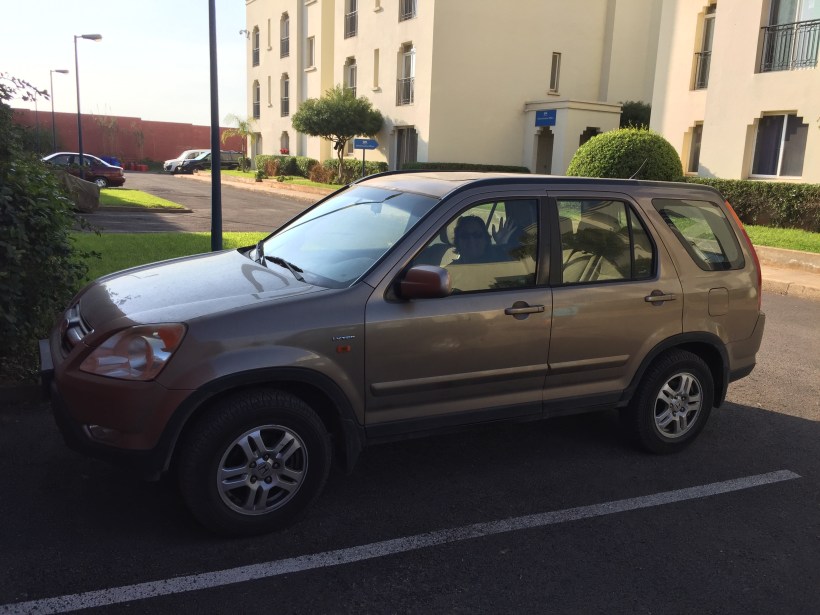
Six months after arriving, Audrey finally got behind the wheel of our Honda CRV and took to the streets of Casablanca. With Brian preparing for a solo trip to Dubai in the United Arab Emirates for a workshop this weekend, Audrey needed transport that would let her do our weekly shopping back home despite the absence of her regular chauffeur-husband. Because the celebration of Proclamation Day meant we did not have school, this seemed the ideal occasion to test her driving acumen against our manual transmission vehicle and the Moroccan roadway challenge.

Should we do a post on this?” Brian asked as we got underway.

Hopefully it will be uneventful enough that it is not worth posting,” Audrey replied. Yet we find, time and again, the most post-worthy curious things in our uneventful daily lives here.

Tooling around on campus, Audrey quickly and easily remastered the art of driving with a clutch. As expected, it is like riding a bike.

And so we hit the streets to run some errands. With one car drifting in front of us from the right and another car drifting in front of us from the left simultaneously, Brian asked, “Do you want me to point out dangers or would that be annoying?” Audrey assured him that his calling out bogies was a good thing. “Watch out for left turners,” he cautioned as we approached a break in the median with a driver from the other side nosing his car through the gap to obstruct ½ of our left lane. Audrey responded calmly and with no hesitation, “I am watching out for everything: cows, goats, scooters, donkeys, people just walking out in front of me…EVERYTHING!

Our first intended destination was the pharmacy to pick up some OTC meds that would be available as prescription-only in the U.S. We found traffic on Boulevard Abdelhadi Boutaleb, the main drag from our school past the King’s summer palace and into town, fairly light and (as Charlotte would say) organized. With a green light at the traffic circle leading toward the pharmacy, Audrey asked, “Should I go into the right lane to turn left?” Brian recommended, “No, stay in the left lane and use the right lane people turning left as blockers for you against oncoming traffic.” Audrey made her first left turn in Morocco without major incident, and without too many cars in the right lane trying to turn left in front of her. Two blocks from the pharmacy, the driver of a Jaguar honked obnoxiously as he tried unsuccessfully to pass us on a residential street with cars parked on both sides. Then, after a sixth month driving hiatus, Audrey exclaimed proudly, “I drove to the Pharmacy!

But it was closed. After all, it was Moroccan Proclamation Day.

Our next stop was the Morocco Mall to get cash from an ATM at a local branch of our bank. Along the way, Audrey almost took out a parking guardian who jumped into the road to stop traffic for someone pulling out from the curb. We encountered traffic so busy that after creeping past the mall to a traffic circle where we normally turn around and work back toward the two mall parking entrances, police had placed a barricade to keep people from making U-turns. We had to drive another kilometer down the road and turn around at the entrance to the Sindibad (not Sinbad: same guy, different spelling) amusement park. Reverse direction accomplished, heading back toward the mall alongside the beach and boardwalk of Boulevard de l’Océan Atlantique – with all manner of obstacles and dangers from pedestrians and parked/parking cars and parking guardians and vendors and goats and donkeys and more spilling over from the curb into the right lane – provided Audrey an experiential opportunity to learn why Brian always drives this road in the left lane. Finally we made it back to the Morocco Mall. Our pharmacy may have been closed, but the mall was so busy with people that could not go to the closed pharmacy that all parking lot entrances were blocked. “So sorry, no parking. The mall is too full.” After all, it was Moroccan Proclamation Day. Next stop?

Unable to get to the mall, we backtracked past what we call Snail Corner – the collection of over three dozen snail soup stands that come alive each evening – to Boulevard Abdelhadi Boutaleb, and turned left toward town. We drove past the place on the road that always smells like an outhouse, and Audrey – forgetting we were passing by the place on the road that always smells like an outhouse and thinking instead that the aroma inside had come from her passenger and not some external nastiness – rolled down her window to flood the car with the olfactory stimulus. Eww.

Everyone who rides in a car in Casablanca knows the infamy of its drivers for their multi-lane driving (among other things). When we hit an almost-finished section of replaced road, the smooth new asphalt having no white lane lines painted to pretend they would organize cars into distinct lanes, Brian commented, “This may be Morocco’s most honest and accurate segment of road.”

Continuing on, Audrey came to a stop at a red light intersection. In an instant, scooter gnats swarmed around our car, then whined away with their 2-cycle lawn mower engines carrying them into traffic. Of course, no sooner did the light turn green than cars behind us began to honk their impatience. Further along we went, with Audrey’s interjections streaming as we did, “Hey, Buddy, pick a lane!…There’s no room for you to turn…Oh, my Lord!” Finally we came upon another bank branch for our ATM stop, and – like a Moroccan Bonnie and Clyde – Brian hopped out to get a wad of Dirham while Audrey kept the car running. Audrey would have cash to shop this weekend and the wheels to get her there, while Brian practiced curriculum mapping software in Dubai. Pulling a U-turn on the tram road, sitting on the tram tracks and actively not thinking of the tram a few blocks away, waiting for oncoming traffic to clear so she could complete a U-turn and start toward home, Audrey said, “Oh, look at the donkey,” followed by a more focused, “I hope this is an uneventful trip.

And it was, relatively speaking. Commenting on her surroundings as we worked our way back, Audrey sounded schizophrenic as she blurted out, “Scooters going the wrong way diagonally across the road…Donkeys…Here’s a horse.” All just another day driving in Casablanca. She capped our arrival back home with a triumphant, “Alright, I made it through my maiden voyage!” to signal her readiness for the task ahead.

Epilogue: Today Audrey found success and freedom driving to the CIL to shop at our produce and meat Souks and at O’Self French Market while Brian attended his workshop far away on the Persian Gulf in Dubai. After finishing her shopping, she then found her freedom dashed as she discovered our car got a wheel boot for failing to pay for parking at the parking machine. No worries: She found the guy who booted her, and our car was set free after she paid a nominal fine. Hamdulillah!

On your mark…get set…here we go!

Reverse Culture Shock

Prepping for the 9 ½ hour flight from SeaTac Airport in Seattle to Charles De Gaul Airport in Paris last week – following 10 days stateside over the holidays – included packing snacks to combat mid-flight hunger. Since we were en route ultimately to Casablanca, that meant a goodie bag with a fabulous Washington State honeycrisp apple complemented by leftover pepperoni and sausage pizza from our last stateside meal, leftover bbq pork ribs from dinner the night before, and leftover bacon from the prior morning. Do we detect a theme here?

During our visit with three generations of Brian’s extended family, we pursued a culinary bucket list that, admittedly, tended to favor pork products like pork chops and apple sauce that we (i.e., carnivores Brian and Audrey, not vegetarian Charlotte) cannot easily procure and enjoy in Muslim Morocco. The list also included things like thick ribeye steaks grilled to perfection, baked potatoes, American ice cream, Taco Bell black bean burritos for Charlotte, and good Pacific Northwest seafood for Audrey. Flying back to the U.S. a couple weeks ago, we had every expectation that checking off items on our culinary bucket list would make us happy. We also expected to enjoy spending time with family and telling them about life in Morocco. Beyond that, we did not know what to expect as we experienced stateside life for the first time in five months.

Having heard from multiple sources that we would likely experience reverse culture shock upon our first trip back to the U.S., we had set our expectations blankly. Yet, re-acclimation proved fairly simple as we slipped right into American routine with little trouble. Perhaps our greatest controversy was over whether we preferred American or Moroccan shopping. Audrey prefers her small souks and hanouts; Brian enjoys these for Moroccan shopping, but likes the reliability, consistency, and variety of American stores. Still, we had several interesting epiphanies as our American days ticked off on the calendar.

First, upon landing in Paris for an overnight layover at the front end of our trip, Charlotte captured by comparison Moroccan roadways by saying of our taxi ride from CDG to our hotel off the Champs Elysèes that “driving here is so…ORGANIZED!” – a sentiment that applied stateside as well. Likewise, Audrey noted that, compared to Morocco, both France and America had gigantic parking spaces. Brian, so far the only one of us to drive in Morocco, found great contentment with not having to watch for scooters buzzing around like gnats and right lane drivers suddenly veering in front to turn left at an intersection.

Second, we missed the quiet of our Casablanca home. We do not have a television in Morocco, and so have no ubiquitous background of CNN or FOX or other cable news common in the States. We thought we would feel more plugged in and informed by having t.v. access again; instead, we just missed sitting quietly in the evening by the fireplace with a book or working on a computer.

Third, whereas upon arrival in Morocco everything here seemed so cheap, upon returning to the States everything back there seemed so expensive. (We have not yet hit the point of mentally converting American prices into Dirham – we still do the reverse to convert Dirham prices into USD values – but we understand from an expat friend that will mark a next step in our local adjustment.)  We took notice when one bag of groceries stateside cost almost as much as our weekly groceries in Morocco.

Fourth, reemphasizing what we learned prior to our departure last summer, many Americans know very little about Morocco. No, it is not the city-state on the French Riviera where Grace Kelly married Prince Rainier III to become Princess Grace after her Hollywood starlet years. No, it is not an Arab country on the Persian Gulf by Iraq. It is an open and friendly Muslim country in the northwest corner of Africa. Unlike in Paris, where we were evacuated temporarily from our terminal at Charles De Gaul Airport due to a security breach after we checked our bags to come home, we feel very safe in Morocco. As a side note, while family were happy to see us and asked how things were going, their interest was much more in us than in the details of what life in Morocco was like. That took us by surprise, since we were set to share the nitty gritty of Moroccan life, but it is good that they like us for US and not just for what we do or where we live.

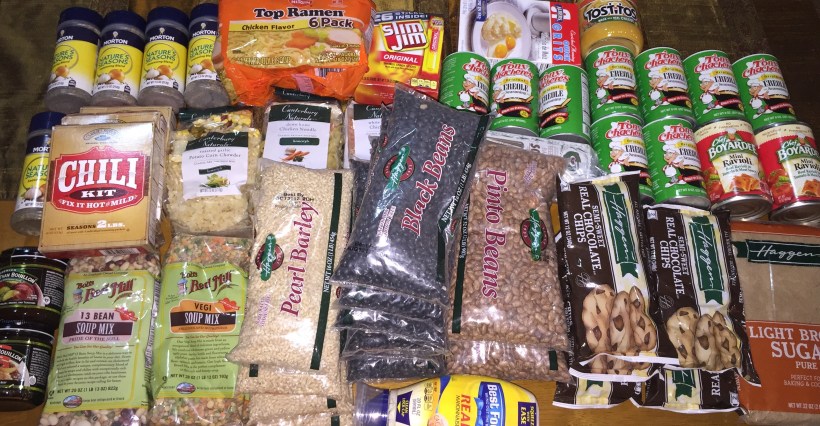
Fifth, back to food, we discovered that things on our “Bring back from the U.S.” list that started taking form in our first week here last July shifted from need items to want items. Make no mistake, we brought back an entire suitcase of foodstuffs, meds, and vitamins that we cannot find in Morocco: Tony’s Cajun Seasoning, Morton’s Seasoning, chocolate chips, Shelby’s Chili Mix, Top Ramen, black beans, pinto beans, barley, Tostito’s cheese crack, Better Than Boullion, chili powder, crushed red pepper, brown sugar, and more. Yet, the urgency with which each went onto the list over five months dissipated between arriving back in Washington and departing 10 days later, so we did not fret when our list went incomplete. We do not need these things to survive – or even to thrive – they are just nice things to have. Likewise, we could not locate several things we had planned to bring back from our storage units – initially disappointing to note, but they are only things, and we will find them when we have time on another trip to sort through our entire storage space.

Sixth, it took nearly half the trip before we could let go of school and really enjoy our vacation. Once we did, we had a marvelous time.

Finally, and most importantly, as we approached the end of our busy stay, we looked at each other and agreed that the visit was very nice…but we missed Morocco and were ready to go home. Developmentally, it is similar to a college freshman who goes back “home” to mom and dad during Fall Break or Thanksgiving Break, then after returning for Winter Break cannot wait to go “home” to his or her dorm room and school community.

We had a wonderful vacation. We got to spend a few days with Charlotte’s older sister, Margaret, who headed north from college and jobs in Arizona to join family festivities. Brian got to introduce Charlotte and Margaret to the multigenerational family tradition of singing Handel’s “Messiah” oratorio on the day after Christmas at the long-running (since 1971) Messiah Sing-along & Play-along in Northeast Seattle. Charlotte reconnected with her “adopted” family from Arizona that was also visiting in Seattle at the same time. We shared a Christmas feast for 24 people covering three generations of siblings, cousins, aunts, and uncles in Brian’s extended family from Washington, California, Arizona, and Morocco. We reveled in the beauty of God’s creation as we enjoyed a white Christmas and snow-covered mountains. We explored Paris during overnight layovers both heading to America and over New Year’s Eve. It was a great trip, and a much-needed relaxing time after turbo-burning at school throughout the Fall and Winter.

And then it was great to come home.

On your mark…get set…here we go!

Christmas in Morocco

It’s beginning to look a lot like Christmas…in Morocco! With red and green displayed prominently 365 days a year, we have reminded ourselves regularly since arriving last summer that those are national colors, not a perpetual national state of Christmas. Yet, as in the U.S. and elsewhere that Yuletide commercialism makes a cultural mark, we have found the Casablanca march toward Christmas intriguing.

Today we fly to Paris for an overnight (a layover long enough for Charlotte to say she’s been to France) en route to the Pacific Northwest and Christmas with family. We began our travel prep yesterday at the Morocco Mall. Brian sat for an hour in Starbucks listening to piano jazz muzak and sipping Thé à la Menthe from a candy cane-festooned red Starbucks cup, waiting for the bank next door to open so we could exchange Moroccan Dirham for U.S. Dollars to fund our trip. Then, after it opened, he returned to his Starbucks seat for another half hour while the bank prepared further to exchange Dirham for Dollars. Morocco is a country that teaches patience. It is a country of inshallah.

The day before, Brian had gone to the downtown branch of our bank to withdraw Dirham that we could exchange to Dollars for our trip. Asking if he could exchange them for Dollars right there, he was told that the money exchange people had gone for the day and would return on Monday. But, the teller added, he could get Dollars at the Morocco Mall branch. So Brian went to Morocco Mall, much closer to our school and home and where he knows several tellers, and plunked down the stack of Dirham to exchange. “I’m sorry,” Aesha the teller told him, “I cannot give you Dollars.” When he shared that the main branch had said he could exchange for Dollars there, she clarified, “Sometimes…Not always.” Then, to explain a bit further after recognizing Brian’s befuddled look, “We have already sent our Dollars back for today.” Asking if he could return on Saturday to get Dollars, she said, “Oh, yes, we’ll have Dollars tomorrow…Inshallah.

While Brian waited at Starbucks yesterday morning to see if God willed that the Morocco Mall bank branch would have Dollars available upon his return, Audrey and Charlotte shopped to outfit Charlotte with winter attire befitting a visit to winter in the Cascade Mountains of Washington State. While the Christmas impact in the mall was less intense than in any random commercial spot in the U.S. right now, we were still amazed at how Christmassy it was in this Muslim country. Moroccan elves had erected a number of thematic pens roughly five meters square bordered by picket fences amid the palm trees and other year-round décor of the mall: polar bears, Christmas trees, and signs (in French) pointing to the North Pole from inside a cheerful snow scene all invited mall rats to let the Season of Giving encourage a bit more spending on behalf of their fellow mankind. Lots of stores even had their own displays featuring Christmas trees, tinsel, wrapped packages, and more.

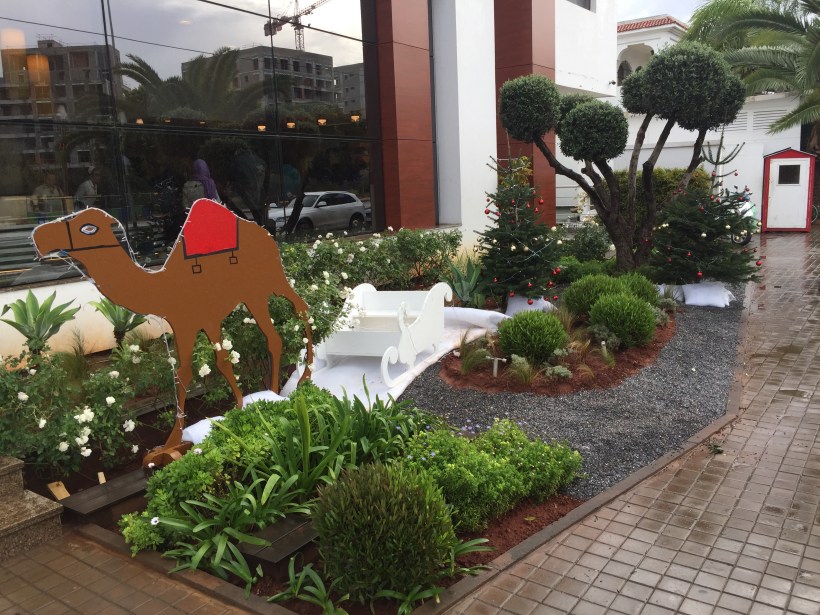
Just like used to be the case in the U.S. (before the start of the commercial Christmas season moved up to sometime around the Fourth of July), this Moroccan Christmas thing all started creeping up on us around Thanksgiving when we saw the first store decorated with a couple Christmas trees. Our favorite doff to the Season appeared a couple weeks ago when we made our weekly French bakery stop at Amoud Boulangerie to pick up m’semen for Charlotte. Parking on the curb outside Amoud and waving to the parking guardian who greets us with a smile every week, we turned toward the storefront and saw outside the store a very Moroccan Christmas display that featured a snowscape with a couple Christmas trees and Santa’s present-laden sleigh being pulled (of course) by a camel.

We have had our own share of Christmas prep to get ready for the holiday. Charlotte, who typically switches her daily music to Christmas carols in early October at the latest did not disappoint. By Thanksgiving, Brian was in the Christmas carol mood with the online AccuRadio channel for Holidays providing morning background music while getting ready for each day. A couple weekends ago we went to a Christmas party for expats at our school. Everyone wore holiday attire, we played Christmas games, and a makeshift chamber orchestra played Christmas carols for us all to sing. Driving home that night from Dar Bouazza, a suburb 15 minutes south of us, we saw lit up in one of the roundabouts of the main road a tall Christmas tree with big Moroccan stars on it. And there has been much anticipation for a major coming-of-age event on December 26 when Charlotte and her older sister, Margaret (who is flying up to Washington after her first semester of college in Arizona), will be the first of their generation in the extended family to sing in Seattle’s annual all-volunteer/Overture-to-Amen Messiah sing-a-long. Three generations singing together…Hallelujah!

We did not know when we began our adventure what Christmas would be like here. We have found it very familiar, and a good preparation for heading back to the U.S. Tomorrow. After we exchanged money, we headed to the Habbous neighborhood of Casablanca to buy Christmas presents for family Stateside. Visiting Ahmed, a merchant whose talent with languages approaches the broad array of things available in his Hanout, he recognized Brian instantly from the previous trips he has made to shop there for gifts or knick knacks. Brian explained that we were headed today back to the U.S., and Ahmed jumped in to say, “Oh, so you must buy Christmas presents and come to see your friend.” He then pulled three chairs and a serving table up into the main space of his cramped floor and, sitting on the floor himself, poured mint tea for us. After tea, he showed us his wares and settled on a very good price for gifts covering Brian’s extended family, then wrapped each gift in newspaper and wished us, “Have a Happy Christmas and be safe traveling.” With our bags packed, with presents stowed safely in luggage, indeed we shall.

On your mark…get set…here we go!

Ifrane: Finally Feeling Winter in Morocco

We have heard since before arriving in Morocco about the cold Moroccan winters. So far in Casablanca, though, winter seems to have been scripted by Pacific Northwest screenwriters back in the U.S.: lots of rain, so that the mild cold cuts through walls and clothes in ways that a good old sub-zero Midwestern winter does not.

Because all the buildings are made of concrete walls and tile floors, you cannot escape the dank chill. Towels and wet clothes do not dry, and mold is not the friend of things in your closet. With no central heating, last month we ordered two tons of firewood to minimize the chill during this winter rainy season. Of course, because we live on the top floor of our building, the wood got hauled up four stories to the roof by men carrying large and awkward 30 kilo plastic weave bags of firewood on their backs with no more than a thin layer of cardboard as padding. Brian first had to figure out a way to cover the 10 ft long x 5 ft wide x 5 ft high stack – lest the ample rain turn our supply of well-dried wood into a useless wet and moldy mess – and now has to carry the awkwardly heavy bags down to our apartment in order to make fires.

Still, while the expected rainy season has come to Casablanca, it pales in comparison to our concept of winter honed through our years living in Cleveland. Cleveland, where they do not close school for snow; they close it for COLD, and “cold” does not exist until the temperature drops to -20°F (-29°C). Cleveland, where our house’s poor old furnace at times could not keep up with the biting wind chill, so that running nonstop it could get our inside temperature up only to 50°F (10°C).

Yet, having spent the last several years in Louisiana and Arizona, we miss having REAL winter. In both those locations, winter is when you sit outside in shorts and tees with friends and refreshing beverages to enjoy the evening and ruminate on how that is what justifies enduring the summers there. So when we volunteered to chaperone our school’s Speech & Debate team at a weekend competition in Ifrane, four hours northeast of Casablanca through the mountains, we thought we might even get to enjoy snow. Such thoughts tantalized us as we sat on the bus outside our school’s gate waiting for the last of our students to board. With Casablanca’s afternoon sun beating down on the charter (schools cannot take their own buses outside the city), it felt like a furnace – likely over 100°F (38°C) – when Mohammed, our driver, finally turned on the a/c.

That roasting start served as a stark contrast to what we had in store for our weekend. We noticed a little chill in the air by the time we stopped at a gas station outside Khemisset to give kids a bathroom and snack break – 26 high school kids packed into a mini mart at the same time as a similarly-stopped busload of uniformed military, all vying to check out through one cashier. Twenty-five minutes after starting the 15-minute break, we had shooed the last of the kids back to the bus, but no one could get on because our driver Mohammed was still absent with the bus locked. Finally he came out of the bushes next to the parking lot. Apparently that was a better location to take care of business than the bathrooms inside.

Getting back on the bus, we tried checking with Mohammed to make sure he knew our hotel destination in Ifrane. After five minutes of not finding the right click between our broken language skills and his, we decided to wait until we got to Ifrane to pilot him to our spot. As we rolled through the mountains, ears popping from the changing pressure with our ascent, after the last hues of the sunset fell into the horizon, we realized that the bus felt COLD. While the temperature of our new environs had dropped, Mohammed’s blasting a/c had not. One of our students worked her icicled self brittley toward the front and asked Mohammed in Darija (the Moroccan Arabic dialect) if he would please turn off the a/c. He did, and we started to thaw as we passed through the open, broad streets of El Hajeb sporting trees with actual leaves, not frons. We could tell that autumn had come here, with leaves having changed color before dropping off.

Finally we rolled into Ifrane later than we had expected. Rather than check in at our hotel, we had to go straight to the restaurant where we had a reservation for our large group. As we disembarked from the bus we were greeted with a temperature below freezing…but, to our great disappointment, no snow. After The Forest restaurant impressed us at their ability to feed 26 high school students, three chaperones, and one bus driver in an hour’s time, dressed imperfectly for the cold we shivered back to the bus and headed for our hotel.

Fifteen minute later we arrived at our hotel, a sprawling resort that looked in the dark as if it had seen its best days 20 years ago. In Morocco, though, even new construction can look that way. Audrey and the Speech & Debate coach went inside to register the group and get keys, while Brian waited patiently with the students back at the bus. And waited longer. And still waited longer. While he and the students shivered, he could see Audrey across the street and through the glass doors, and wondered why she did not emerge with keys to end the night standing in the cold. Meanwhile, Audrey was inside arguing with the front desk people about how to pay for the rooms. Our reservation had been made for a certain number of rooms; yet, this being Morocco, they decided upon our checking in that now they wanted to charge us by the person. After more than an hour, Audrey finally got it resolved and led kids to their toasty rooms waiting for them.

Taking 26 kids from freezing temps to toasty rooms led Audrey to look forward to settling into our toasty room as well. As they say here: “La la la.” (No, no, no.) The other rooms were warm. Ours, which actually was a cavernous apartment that could sleep up to 10 people in various rooms, was stone cold…maybe 40°F (4°C) at most. Thinking systematically, first we closed the doors to the kitchen and other extra rooms so their cold would stay there. Then we turned on the wall heaters in the three remaining rooms (including our bedroom), and prayed they would warm things up quickly. The did not. We piled every blanket we could find onto our bed, and slept not only in our clothes, but in our coats as well, hoping that by morning the room would be warm. Yet, as cold as we were, we appreciated our good fortune for having a space indoors to sleep. Mohammed the bus driver slept on the bus.

In the morning, we discovered a few things. First, the buildings we thought looked dilapidated from the outside the previous night looked even more so in daylight. The setting could have worked for a Moroccan horror film. Much of Morocco could learn that a coat of paint makes a big difference. Second, despite this, Ifrane truly is a beautiful town: full of pine trees and broad-leafed maples and other deciduous tress with actual leaves that drop for winter to crunch when you trod upon them, and beautiful houses lining winding roads through rolling hills as you drive from one neighborhood to the next. Frost covered the ground, so that everything glistened in morning light and had a refreshing crispness. If municipalities could have parents, Ifrane’s cement chalets would result from a fling between Morocco and a village in the Swiss Alps.

So we got up in our still-not-warm flat and prepared for a day chaperoning and judging Speech & Debate events. At least we no longer could see our breath inside our sleeping quarters. Brian, who elsewhere is always warm, opted for Old Man fashion by wearing a pullover sweater underneath his suit coat and bow tie. While he is only 49, Audrey noted the Old Man thing more as an actual condition than merely as a visual image when she helped him pull his sweater all the way down instead of resting as a knotted mass bunched up around his midsection.

Off through the weekend, with two days of judging and overseeing our great kids, we were not as cold as we had been that first night. Still, warm never entered our minds as an apt concept. We had wanted winter, and we got it. Jack Frost did not nip at or noses; he was too busy laughing heartily at us for getting exactly what we asked for.

Back in Casablanca on Sunday night, nursing the colds we have fought since before Ifrane but accepted post-Ifrane as unavoidable, we did not feel the pre-furnace bus chill we felt when we left school on Friday afternoon. Having seasons for a weekend was mostly good. Expanding our appreciation for the diversity this country offers we liked even more. And then it was very good to come home. Our drizzly Casablancan winter chill has never felt so good.

On your mark…get set…here we go!
Sent from my iPhone

Rfissa: One Plate Joins People Together

We have many things we like about our school:  the kids; our colleagues who have become friends; being one of five schools in Morocco that is recognized by both the U.S. Department of State and the Moroccan government; waking up to the sound of donkeys braying in the morning from adjacent land; the school’s ideal position for growth and improvement over the next few years; the beautiful ocean view that also overlooks the King’s summer palace; the chickens that waltz freely along the entry road and around the parking lot after slipping through the bars of the front gate; the chemistry of the new leadership team that our Head of Schools built with us and a handful of other key admin folks; and lots more. One simple thing that we like especially: working in the same school so that we get paid to lunch together regularly.

No longer mild competitors in schools across town, we now work happily on the same team with offices 10 feet apart. (That will change in April when the administrative offices will move into the new Library/Media/Technology Center edifice our school is completing this Spring. When that move occurs our offices will be about 40 feet apart, but with glass office walls we can wave to each other from opposite sides of the building wing.) It is quite easy for one of us to pop a head into the office of the other and ask, “Have you eaten yet?…Wanna go now?” And so we do, not every day, but usually three or four days a week as our schedules allow. Better still is that our food service is led by a person who spent years running restaurants and cafeterias in NYC before he brought his Vermont farm girl wife and their kids back home to Morocco. Poor us: In addition to lunching together, we have to suffer through meals like grilled swordfish, Rosemary chicken with a balsamic glaze, and lamb tagine with couscous.

Last Friday, after a long and busy week, we had planned to lunch together at noon. Then Badiaa, the high school coordinator, appeared around 11:30 am to tell us urgently, “Come now, there is rfissa!” Having no idea what that meant, we each dropped what we were doing to see what dire problem we needed to help her solve. Walking out from our offices into a common area, we saw a table laden with a huge clay tagine more than two feet in diameter filled with a culinary masterpiece. This was a really good problem to help solve.

Seven days ago our school received the joyous news that Aziz, Charlotte’s fabulous Arabic teacher and one of the nicest people we have met in Morocco, had welcomed into his family a new son. Badiaa explained that Aziz had brought in a tagine of rfissa that his mother had made for him to share in celebration on the seventh day after his son’s birth. (In fact, we learned, Aziz brought in not one but two tagines, one in our office area and one in the teacher lounge.) Unlike in the West, where people load gifts upon new parents and the biggest gift back is passing out cigars, in Morocco the seventh day after the birth marks a time for new parents to celebrate their healthy child and recognize their friends and family by providing rfissa. As we sat enjoying the feast, we learned that there is not unanimity on when to serve rfissa, with some families actually serving it on the third day after a birth, then slaughtering and roasting a sheep on the seventh day. We also learned that direct gifts to the family are often discouraged, but deftly slipping some paper currency into the clothes of a baby while holding him or her is perfectly acceptable. Still learning so much about Moroccan culture, and whatever the details such learning brings, we could not wait to dive into the tagine and start pulling golden pieces off the chicken and scooping up the accompanying goodness. As we approached the table, others gathered around as well, trying not to drool too much at the sight.

The tagine was loaded with a base of m’semmen (a sort of Moroccan layered flat bread that Charlotte has for breakfast most mornings) shredded into paper-thin noodles; cooked lentils piled on top of that; two golden-brown boiled-then-roasted chickens in the center surrounded by a ring of hard-boiled quail eggs; topped by scrumptious and ubiquitous tfaya (caramelized onions, cinnamon, ginger, saffron, honey, and raisins); with whole almonds scattered across everything. Some rfissa recipes we have seen online since Friday have the chickens boiled with the lentils and other ingredients, so that the result is a visual hodgepodge with flavors shared throughout. Our rfissa appeared to have each element of the dish prepared separately, then constructed into the magnificent presentation we saw and cooked in the tagine a bit longer to let the chickens brown and the flavors start to blend.

Badiaa and Rim, her middle school coordinator counterpart, had set up Aziz’s tagine with plastic forks stuck into the m’semmem noodles around the perimeter. This, Rim told us later, was so that the expats would not be grossed out by eating rfissa the real Moroccan way: grabbing handfuls of m’semmen and chicken and tfaya and lentils and almonds and eggs and putting them into your mouth before grabbing more handfuls for more mouthfuls, everyone gathered around the tagine reaching in and eating together. With the addition of forks for western comfort, that is what we did.

It was good. It was really good. It was really, really, really good. People would come into the upper school office because they smelled food, and they would grab a fork. Those who had never seen rfissa would eat in awe. Those who knew it would say, upon seeing the tagine, “RFISSA!!!” and then tear into the tagine. With each person who came to eat rfissa, there was more conversation: reminiscences of other times eating rfissa and who makes good rfissa; recollections of celebrating babies; special things about family, here in Morocco and elsewhere in the world. It was warm community time, spoken in English, French, and Darija (Moroccan Arabic). In the end, the tagine was decimated, our bellies were more full than even our school lunches could fill, and our hearts were flavored with Moroccan spices.

After celebrating Aziz’s new son by gorging on the rfissa made by Aziz’s mother, three things are clear.

First, we need to learn how to make rfissa.

Second, from perusing online recipes and their photos, none of which came close to measuring up to our feast celebrating Aziz’s new son, to learn how to do it correctly we will have to find a Moroccan mother or grandmother willing to school us in her kitchen on how to do it properly.

Third, and most importantly, rfissa is a metaphor for Morocco, a celebration of life and family full of rich flavors and health and passion. There is generous sharing, as there is also fighting over who gets the last quail egg or bit of tfaya. In the end there is satisfaction not only for having eaten, but for having spent time together in community and knowing you are better for being part of that community.

On your mark…get set…here we go!