The Commissary: A Thanksgiving Blessing

This weekend we celebrated our first Thanksgiving in Casablanca. Having invited our friends the Chbany family to join us for their first Thanksgiving ever, we wanted to give them a good, down-home, traditional American Thanksgiving experience. But how to do that in Morocco? Lots of planning, good research, a bit of luck, and membership at THE COMMISSARY!

When we first arrived in Casablanca last summer, we heard from veterans at our school about “The Commissary” as a if it were a wonderland of delicacies. Images of a Moroccan Wonkaland, where every fantasy about food you miss from back in the States comes true, began to form in our heads.

[Cue Gene Wilder: Hold your breath / Make a wish / Count to three / Come with me / And you’ll be / In a world of / Pure imagination / Take a look / And you’ll see / Into your imagination…]

Because our school is one of five in Morocco affiliated with the U.S. Department of State, U.S. employees have the opportunity to join The Commissary connected to the U.S. Embassy in Rabat. Just an hour’s drive north from Casablanca, we envisioned a Costco-like membership that would let us wheel a pallet through warehouse aisles and get industrial-sized containers of all our American hearts could desire that we cannot otherwise find in our daily Moroccan life. While at the residence of Casablanca’s U.S. Consul General in August for an American school mixer, after Brian lamented to the CG – who hails from New Orleans – that he would miss making gumbo with Tasso and andouille sausage, she told him she can special order them through The Commissary when she makes jambalaya. Hope, hope. Drool, drool.

But then we started getting a more realistic scoop that dashed our culinary dreams. One administrator told us, “Yeah, The Commissary is good to have, but it is really not Sam’s Club or Costco…more like an over-glorified 7-Eleven.”

Hmmm, should we join? Is it worth it? Driving all the way to Rabat just for 7-Eleven?

Ultimately, we decided to give it a try for a year and then decide whether to renew. If nothing else, we thought, at least we might be able to get Thanksgiving supplies.

And so began our wait. We submitted our application back in September and were told we would get our membership card in a few weeks. September went, October followed, and we had no card. October went, November followed, and still we had no card. With Thanksgiving approaching quickly, we asked the person in charge of sending our application to The Commissary when we might finally get to start using our membership. In early-November we went to Rabat for Charlotte’s MASAC (Morocco American Schools Athletic Conference) volleyball tournament – which her team won, becoming national champs! – and had no membership card to get us into The Commissary while we were in town.

Like so many things in Morocco, like getting a bank account and obtaining residency papers, this was a test of patience. As Thanksgiving drew nearer on the calendar, we were able to build our menu. We ordered a hefty 8.5 kilo turkey through the school kitchen (to be picked up fresh the day before Thanksgiving). Of all unlikelihoods, we found Rome apples (that Brian likes to use for pies) with Zwil, the proprietor of our favorite Souk in the CIL. Potatoes, sweet potatoes, green beans, fresh bread from Amoud Patisserie, all no problem. But Audrey had to search for some way to mimic Campbell’s Cream of Mushroom soup and French’s Onions for the Green Bean Casserole that Charlotte demanded, we had no idea how we would roast our huge turkey, and staples like stuffing and cranberry sauce did not seem likely to make it to the table. We had plans to make Thanksgiving happen, just not as completely as we would have liked.

Then, finally, a week before Thanksgiving, we got word that our membership card was ready for us to pick up in Rabat. The timing could not have been better, as we were abandoning Charlotte on her “Sweet 16” birthday weekend to attend the U.S. Embassy’s 241st Marine Corps Birthday Ball.

If only it were that easy.

Asking at school for The Commissary’s address, we were told folks did not have the actual address, but they could show us where it was on a Google map. So it was, and we starred the spot for easy location once we got a to Rabat. Sure enough, despite having a spot starred on a Google map, it was impossible to find. Buildings all around, and nothing looking like a commissary, a Costco, or even a 7-Eleven. About to give up, and figuring the star had been misplaced on the map, we made a final desperation call to the friend who had marked our map. She walked us around by phone until we found the unmarked gate, and she told us what to tell the guard to gain entry. Going through the gate with a burst of excitement, sounds of Gene Wilder floated through the air again while walking across the compound toward the entrance.

[We’ll begin / With a spin / Traveling in / The world of my creation / What we’ll see / Will defy / Explanation]

And then, going through the door, at long last, with no Oompa-Loompas, THERE IT WAS…an über 7-Eleven. A 7-Eleven to beat all 7-Elevens. Not merely because it had a few more aisles than a regular 7-Eleven would have, but because the stocking selection was almost exactly what we were looking for. Coasting with a shopping cart easily, not hurriedly, through the aisles allowed for genuine discernment over what would have the most positive impact on our limited budget, limited car space to transport back to Casablanca, and limited storage space in our apartment once we got back home.

We picked up some staples we cannot find in Casablanca’s stores (brown sugar, 409 cleaner, Log Cabin syrup, black beans, Sweet Baby Ray’s BBQ sauce, and NyQuil tabs); some general splurgee things (Rold Gold pretzel sticks, maraschino cherries, Pop Secret microwave popcorn, Tostitos, and CHEESE CRACK – aka Tostitos Salsa con Queso); and some Charlotte splurgee things as supplemental birthday presents for her (several four-box packs of Kraft Mac&Cheese, Hot Cheetos, Fritos, various Classico pasta sauces, and more) since we were returning home on her actual 16th birthday.

But the real jackpot was the seasonal supply of Thanksgiving items. On one end cap there were cans of Campbell’s Cream of Mushroom soup. Down the next aisle was a stack of French’s Onions canisters. Next to that, boxes of Stovetop Stuffing. On another end cap, Ocean Spray Cranberry Sauce. Further on, a large disposable aluminum turkey roasting pan and more baking pans perfect for Green Bean Casserole and sweet potatoes. They even had Crisco sticks for Brian’s pie crust so that he did not have to substitute butter for it in the traditional family pie crust recipe. After a 2500 MAD ($250) shopping spree, in Moroccan style a clerk wheeled our cart out to the car and loaded up our bounty. It was a good day.

That good day then helped make possible another good day as we celebrated Thanksgiving with our friends. The Chbanys have adopted us into their family, hosting us for the wonderful cultural experience of a traditional Moroccan dinner a couple times and inviting us to attend a Moroccan wedding with them. We were happy to reciprocate with a traditional American Thanksgiving to return the cultural exchange favor. Welcoming them into our apartment, we explained our extended family tradition of laying out the food and having everyone fix their own plates buffet style. We told them how we had considered serving them at the table as honored guests, but instead opted for the more informal style befitting family, and they were touched. Before eating, Brian gave a brief telling of how the first Thanksgiving came to be. Then we kept another family tradition of going around the table so that everyone could share something about which he or she is thankful, with Brian noting that though we brought two different branches of religion to our table, our prayers went to the same God. The Commissary was a Thanksgiving blessing, but one that paled in comparison to the blessing of sharing our first Thanksgiving in Morocco with good friends.

On your mark…get set…here we go!

Heading off to Rome

Education conferences provide educators with the ability to practice continuous improvement and model lifelong learning for their students, as well as to bring best practices and research back to their campuses to share with peers in professional development. While conferences are myriad in the United States, Morocco offers a sliiiiiiiightly smaller number of conference opportunities. Fortunately, our school belongs to the Mediterranean Association of Independent Schools (MAIS), with schools in 16 countries from Lebanon to Portugal and Britain to Morocco, which leads the region with an annual conference we both attended a couple weeks ago in Rome. Suffice it to say, having attended conferences large and small in the U.S. and internationally, we both were quite impressed with the conference quality and look forward to returning to future MAIS conferences. The focus of this post is not the conference itself, though, but our experience flying to Rome for it is yet another hallmark of our new Moroccan life.

We have flown lots in our lives, traveling domestically and internationally, so our trip from Casablanca to Rome offered us good comparative perspective. First, with our most recent conference before moving to Morocco in Atlanta for the annual Association for Supervision & Curriculum Development (ASCD) gathering, our MAIS trip reminded us again just how easy it is to get around here. Morocco is roughly the size of California, and Italy is a relatively short northeastern hop across the Mediterranean. So the jaunt from Casablanca to Rome took less time than when we traveled to Atlanta from out west in the U.S. last spring. Oh yeah, and when we landed, instead of being in Atlanta we were in Rome.

While the flight was a cool 2 hours 50 minutes, getting through the airport to board the plane was not your typical American airport experience. Waiting in security lines at U.S. airports does not hold a candle to the process here. Anyone at the airport to drop off or pick up someone cannot even go into the airport at all. That is a privilege for passengers only. So our queueing activity began in a very, very, very long line outside the airport doors to go through the first of what ultimately became six different checks of our passports and tickets before we finally got seated on our flight. Moroccans are both very good at waiting in lines because they are used to much bureaucracy with lines for many things, and very bad at waiting in lines because they look for any chance to cut ahead (to minimize their time in line).

Outside the airport one woman had paid a porter to handle her bags for her, and he led her past the back half of the line of people to slip in just ahead of us. A policeman saw them cut in, came over to scold them, pulled the porter out of line and banished him from the airport, but left the woman in her spot burdened with having to roll her own bag along. As we snaked slowly along though various stages of the line to get in, go through check-in, pass through security and passport control, and other checkpoints along the way, there was a constant push from people trying to worm their way ahead. With four people from our school traveling together, we formed a human barrier amid the crush of people channeled Disney-line fashion through stanchions and ropes, so that not even the 4 ½ foot tall grandmotherly woman who kept testing the strength of our wall could slip past on a hairpin turn.

At one point, security officers questioned people randomly – including Audrey – about how much money they had with them. The Moroccan Dirham is a closed currency, so it is illegal to take Dirham out of the country. We have heard of folks having to turn over significant sums of Dirham at the airport when they forgot to exchange it or leave it at home. But exchanging Dirham for Euros (or Dollars or some other currency) can be a complicated affair. While Brian exchanged ours for Euros we could spend in Italy, a fellow traveler did not have her flight ticket to show at the exchange kiosk and had to double back after getting her boarding pass…which meant getting out of the regular sequence of queues and worried the rest of us that she would miss the final boarding call. It ended up fine, but was a lesson and reminder to us all to have all the paperwork we needed handy at all times.

Making us feel a bit like Victor Laszlo and Ilsa Lund searching for letters of transit so they can fly out of Casablanca, another bureaucratic paperwork element of leaving Morocco was filling out the quarter-sheet slips for passport control with name/Moroccan address/passport information/destination/reason for travel/etc. not only to enter Morocco, but even to leave. This, like all things paper in Morocco, must be stamped and written upon by a government official. The task requires writing on a little piece of paper (after finding or borrowing a pen) while shuttling baggage forward in line, and holding any carry-on bags, all while continuing to block line-jumpers in their nonstop efforts to slip ahead. Another member of our party told us she keeps a stack of them at home almost completely filled out and just adds the date to one she brings to the airport when she flies out.

Finally we got on board – no chance of sitting anywhere close to each other – and we were pleased to find the plane was clean, not trashy like our flight from JFK to Muhammed VI Airport last July. That put the summer flight into perspective, leading us to think now that it was less people coming to Casablanca that trashed that transatlantic plane than people connecting through Casablanca to other locations. But while the plane was clean and untrashed, there was an interesting human odor in the cabin, a condition remedied – or at least suppressed – when flight attendants walked down the aisles spraying air freshener (not pesticides, as I have seen alleged in some places). Intercom announcements were made first in Arabic, then in French, and lastly in English. Likewise, interactions with the flight crew could be in any of the three languages: “Monsieur, quelque chose à boisson?”Coca s’il vous plaît.

We took off heading northeast over Meknes, Moulay Idriss, Fez, the Atlas Mountains, across the northern tip of Africa past Oran and Algiers, out across the Mediterranean, over Sardinia, and on toward Rome. Descending through the clouds, we saw the red and brown ground of Morocco was replaced by farms and villages surrounded by the green grass and trees of the Italian coast, sparking flashbacks to leaving behind Arizona desert on flights out of Phoenix’s Sky Harbor Airport and landing amid the lush green of the Pacific Northwest around SeaTac Airport in Seattle. Throughout our flight, the flight map on the video display showed a compass that showed not only the direction back to Casablanca from which we had come, but also to Mecca. The meal on board: chicken or fish (we both had chicken with saffron and cumin), broccoli, rotini with olives, bread with cream cheese instead of butter, and some sort of cake that we assumed was made with almonds (which would have been good) but which instead seems to have been made with hazelnut or some other nut that made Brian’s allergy alarm start bleeping before he put it in his mouth. The big disappointment of the flight was that we have become quite used to Moroccan mint tea when someone offers us tea, so we were sad that what they poured out was basic Lipton-type stuff.

We landed just shy of three hours after takeoff, and coasted easily through the open, spacious Leonardo da Vinci-Fiumicino Airport instead of Casablanca’s comparatively small, crowded Mohammed VI. Still a long way from being local language proficient in Morocco, it was refreshing to see English as the second language on signs, not the third or fourth (if you are lucky) back home in Morocco. A driver had been set up to shuttle us to our hotel and conference location at the Crown Plaza-St. Peter’s five minutes west of the Vatican, and we set out for what proved an impressive conference with excellent sessions on assessments, grading, service learning, PD, school culture, integrating technology into the curriculum, and many more topics.

Oh yeah, and did we mention we were in Rome? As with our September trip to Spain, we consumed much ham and bacon, and we enjoyed an array of Italian wines. Both of us enjoyed greatly Brian taking Audrey to dinner at Il Sorpasso (where Brian and Charlotte had a New Year’s toast of Prosecco last December 31 when they were in Rome for Charlotte to sing for Pope Francis in St. Peter’s Basilica for the New Year Papal Mass of Peace). Even better was enjoying it with the company of new friend Jocelyn Cortese, the Rome-based wine consultant friend shared with us by Brian’s goddaughter Grace Castro’s father (and our daughter Margaret’s godfather) Bob Castro. Even more betterer was Jocelyn leading our Italian wine shopping spree at Enoteca Costantini across from Piazza Cavour the next night. MAIS then brought everything to a grand crescendo with a gala dinner – never been to an education conference with a closing gala dinner for all participants, let alone one like this! – in a private palace a few blocks from the Capitoline Hill that houses the largest private art collection in Rome. Not a bad way to wrap it all up before heading home to Casblanca.

On your mark…get set…here we go!

“I am Policeman!”

Brian NEVER leaves home without his International Driver’s License and Moroccan residency paperwork. Except today. Of all days, these rather significant documents did not make the transition into a change of clothes before we headed out for a shopping trip today. That will not happen again.

Today was among the worst traffic days we have seen since we first started driving. A half-marathon had roads closed all over, so that our intended quick jaunt for this week’s groceries became a chapter of Kafka. After trying in vain to reach our close-to-home shopping spots, we changed plans and decided we would get everything we needed at Carrefour, the Walmart-like Hypermarche across town from our home and school.

Had we gone straight there from home, we would have taken the highway around town and gotten there within half an hour. Instead, we spent a while longer rerouting from a spot in town and Google Mapped our way there. Finally getting close, but still with a few final turns to make through Casablanca’s labyrinth of streets, we turned right onto a divided arterial and started toward an intersection where we could pull a u-turn and shoot back to the Carrefour entrance.

Then we saw a policeman walking out into the street and indicating that we should pull over. We know an American expat who claims to have been pulled over nearly 200 times during his eight years in Morocco, with the inference that profiling happens here. Not sure why he pulled us over, and not knowing how his English would be, Brian rolled down the window as the cop approached and asked him, “May I help you?”

The cop made a sour a face and replied, “May you help me?…I am POLICEMAN!!! (as if that is his DC Comics superhero name). “Why you ask me if you can help me? I am Policeman! I am Policeman! You know Policeman?” Yes, volume IV, issue 7 of the Hall Of Justice series. “I am Policeman. You do not help me. I help YOU! You understand me? You do not help me. I HELP YOU. I am Policeman!”

Yes, we understand. And we are glad that you are here to help us.

“You understand, because I speak very good English. I studied English four years at university. My English very good and you understand. So why you say, ‘May I help you?’”

Yes, your English is very excellent. I just want to be helpful to you, and I did not know why you wanted me to stop.

“I am Policeman. I make you stop because you make mistake. Back there where you turn there is stop, but you not stop. You make mistake because you stop. And you cannot stop when you make turn. You make mistake. You cannot make mistake.”

Despite Policeman’s very good English, Brian was getting confused as to whether he should have stopped but did not, or should not have stopped but did. Because Policeman has very good English, though, Brian tried feebly to hide his confusion.

“You understand? You make mistake because you not stop when you turn but there is sign to stop.”

Ah, got it now.

Brian apologized, explaining he was just tying to get to Carrefour in our friend’s car to shop, and he did not see the sign.

“You MUST see sign. It tells you to stop. But you made mistake. You cannot make mistake!” He pulled out his well-thumbed centimeter thick book of laws with one hand and pointed to it with the other, saying again, “You cannot make mistake.”

So Policeman asked for Brian’s license. As Brian reached for his pocket, Audrey saw a nanosecond of consternation wash across his face. His license was not there.

Brilliantly, Audrey reached into the glove compartment and pulled out various pieces of official-looking paperwork as Brian told Policeman that the car belongs to a friend. In his orientation to renting the car in the summer, the friend from whom we are renting the car said if we ever get pulled over just say that our friend let us borrow his car (rather than try to explain that we are renting the car without any official auto rental paperwork). Brian fumbled with the documents that Audrey handed him, and Policeman – tired of waiting – finally reached in and grabbed the one he wanted to see for auto registration. Pulling out the registration card, he asked if the name on the card was that of our friend. Yes, that is our friend.

Being American can be an asset here. Being French, not so much. (It has something to do with that whole French colony thing in the first half of the 20th Century before independence in 1956). Policeman asked if we speak French in addition to English. Brian said no. Audrey said, “Un petit peu.” Then he asked how long we have been in Morocco, and we told him that we moved here in July to work at our school. What school? We told him, and the name registered.

“American school…Is very, very good school.” His inclination to hold Brian accountable for his mistake fell off his face like a loose mask, and suddenly he smiled and asked, “From what town in America you come?”

Arizona.

Somehow, that was a good town to name, and Policeman brightened even more. Then it started getting REALLY interesting. “There is big river there.”

Brian nodded. Sure, the Colorado River and the Grand Canyon. But before Brian could ask if he liked the Grand Canyon, Policeman blurted out, “ANACONDA!”

Brian did a double-take and failed at hiding his synapses refusing to fire on that, while Audrey kept smiling from the passenger seat as she delighted in wondering how Brian would respond.

Policeman said again, “ANACONDA! Arizona has big river.”

Yes, the Colorado River, and the Grand Canyon.

“ANACONDA!”

Uhhhh…

“You know anaconda? In the water, very big.”

The snake?

“YES, yes, snake. Big snake.”

Brian, while impressed by Policeman’s very good English but unclear about the significance of anaconda, said, “Ahhhh, anaconda! The big snake swimming in the water, and it grabs people and wraps around them and squeezes.” Policeman was delighted by this and chortled at Brian’s snakelike anaconda gesticulations.

“Yes, big snake, it grabs you and squeeze!”

There you have it: Anaconda, the big snake swimming and grabbing and squeezing…we have no idea what that has to do with Arizona, but it got us out of a ticket for missing a stop sign, and Policeman never asked again to see Brian’s license that was at home in the pocket of a different pair of pants.

One last piece of business. Policeman said Audrey must punish Brian for his mistake. Audrey seemed to relish that role and started talking excitedly with Policeman across Brian in the driver seat. Policeman pulled on his ear, demonstrating how Audrey should punish Brian. “Yes,” Audrey said with too much excitement, “I will punish him as soon as we get to Carrefour.” Suddenly, Policeman got very serious, while still pulling in his own ear, and said to Audrey, “At home. Punish him at home, not here. Not at Carrefour. At home.” In other words, wives do not punish their husbands in public. That would shame the husband. Policeman truly is here to help Brian, protecting him from being shamed in public by his wife. Audrey realized the cultural faux pas and insisted, “Yes, at home; I will punish him at home, not here and not at Carrefour.” Policeman smiled at this, halfway between another chortle and enjoying the satisfaction of knowing that American Brian who knows anaconda will be punished by his wife…but not shamed in public.

Lastly, Policeman wanted to help further. That is why he was there, you understand. So he gave directions for how to turn around in half a block and find the Carrefour entrance another block behind us. Then he said, “You make mistake not stop at sign again, 1400 dirhams.” Roughly a $140 fine for missing a stop sign, but we did not have to pay it today. We have no idea what sort of fine we would have had to pay for Brian driving without his license.

After an effusive thank you from each of us, we made a u-turn half a block away and started back toward the entrance to Carrefour to shop. As we passed by the spot of our encounter we saw that Policeman had already leapt across the median and three lanes on the other side (presumably in a single bound) and pulled over someone else. Nearly two hours later, after emerging from Carrefour with groceries and a couple new space heaters (because winter is coming to our apartment that has no heat or a/c), we drove down that block again on our way to Amoud Boulangerie et Patisserie, and Policeman was still in that spot pulling people over to tell them of their mistakes.

On your mark…get set…here we go!

October

Beginning when we arrived in Casablanca three months ago, and almost constantly through our first month, we kept hearing in a foreboding way about October in official school orientation sessions, in administrative conversations in the course of our daily jobs, and in casual exchanges with people in our school community.

There are usually spaces that open up in faculty housing in October.”

We really try to keep an eye on people as we get to October.”

And, most directly, “October is really the key month for culture shock to hit, and when people are most likely to leave.” Leave, as in give-no-warning-just-get-your-stuff-and-leave leave? “Yeah, except sometimes it is just leave-your-stuff-behind-and-don’t-come-back-from-Fall-Break leave.”

Our school does one heckuva job helping ameliorate the adverse affects of culture shock. This starts with acknowledging explicitly that culture shock is a perfectly understandable phenomenon that can manifest any time with anyone in many possible ways. One administrator shared during our August orientation that the school used to analyze predictively who had the greatest culture shock difficulties to predict who subsequently was most likely to pulls up stakes and leave before the school year finished (or even barely after it had begun). After considering variables like (1) previous experience with international education, (2) other international experience and international travel, (3) marital status, and (4) age, they eventually concluded these and other variables had absolutely no predictive value in ascertaining which new faculty were more prone to be “runners” who do not finish out the school year.

Unable to foresee the onset of culture shock in those most likely to suffer its effects badly, instead the school leadership determined to forewarn new staff of the reality that culture shock happens. By acknowledging this, and equipping staff with strategies to deal constructively with it, they hoped to reduce the chances of culture shock leading to “runners” that deplete our staff and school morale. During the August orientation for our sizable newbie faculty class we talked as a group about culture, about shaping expectations, and about the culture shock cycle that can devastate the most hardy people. Our school even has a “circle the wagons” support strategy for how to deal with individuals (or families) who come onto the administration’s radar because they are exhibiting signs of difficulty, and we have both been involved with providing support to the small number of people on the radar this year.

The culture shock cycle begins seductively with a Honeymoon Period that lulls people into a false sense of security about how well they are doing and how much they love being in their new international home. Over time, though, the excitement and euphoria of the Honeymoon Period gives way to Hostility born of homesickness, doubt, anxiety, and a sense of crisis. This is the SHOCK of culture shock. Eventually, if the culture shock bottoms out before claiming another “runner” as a victim, people carry on toward a Stability Plateau of adjustments to their new circumstances. This, in turn, leads to Nesting with acceptance and adaptation. The process really tracks very well with the grief process of denial-anger-depression-bargaining-acceptance. One key thing, though, is that the grief comes less from one big loss than from the accumulation of many small things. Moving into a new culture changes some identity elements while others stay the same, with the challenge coming ultimately from a fear of losing one’s identity as this balance shifts. Yet, crucial to remember is while external identifiers may change in new circumstances, intrinsic things like personality and the core of who you are does not change.

And so we have progressed from week to week and month to month well aware that culture shock could be right around the corner for either or both of us (or for Charlotte). As we got closer to October, and some others in our cohort had wagons circling around them, we went on alert to identify any warning signs in ourselves and each other. What has struck us, though, is that with each check-in we have had with each other, as we approached October and then went through it, we both have wondered if maybe we are missing something in ourselves that should jump out as a red flag.

It’s October. You doing OK?”
Yep. How about you?
Actually, I’m doing fine. Still love being here – love the school, and love living in Morocco.”

We do not want to plant firmly in complacency that could lead to denial that could lead to hostility. Yet, with regular intentional checks we keep looking for the little things starting to accumulate in bad ways. So far, we have not seen evidence of that. Quite to the contrary, the longer we are here the more it seems the statement made by a longtime administrator on our first day – “You guys may end up being here a lot longer than you think you will” – may prove prescient.

For years Brian has counseled parents reluctant to see their children head off to colleges far from home that college freshmen typically may head home to mom and dad for Thanksgiving Break, but by Christmas they spend their semester break with their parents before heading home to start the Spring semester. Interestingly, last month when we were driving back from our Eid road trip to Spain, we both thought it was nice to be heading back to Casablanca and to the faculty apartment on campus where we live. Just a month later, as we took a train back from a Fall Break jaunt to Marrakech for a couple days, we talked about how good it would be to get back home. Picking up on that sentiment in a Facebook post by Brian, fellow Claremont McKenna College alumnus Chris Wong asked in a comment, “Did you ever think you’d use the phrase ‘our train home to Casablanca?” Not before we started exploring jobs at our school here a year ago. And since arriving in July? Perhaps, but certainly not this soon.

On your mark…get set…here we go!

Road Trip, Part II: Crossing the Mediterranean

We are enjoying Fall Break at our school, a much-needed hiatus from a very busy first few months. Before we scoot to Marrakech for a couple days later this week, it also provides a much-needed opportunity to share the long-overdue Part II of our “Road Trip” post from our excursion to Spain last month. So, without further ado…

Recapping Part I, we took advantage of the Eid celebration to head north from Casablanca and save vegetarian Charlotte from having to endure the bleating of sheep echoing across the land and the streets literally running with blood in what we dubbed the “Silence of the Lambs” holiday. After five hours heading northeast along the main drag highway that runs parallel to the Atlantic Coast, we reached the northwest coastal city of Tangier as our first stop on the way to Tarifa, Spain.

Driving into Tangier made both of us think it looked like a Moroccan San Francisco, with houses covering the hillsides and a much more appealing artsy atmosphere than Casablanca’s less-attractive commercial thrust. We found our hotel, the beautiful El Minzah, to be an easy trek into the city, just two blocks from an entrance into the old medina and with a lovely view of the port a few blocks further below at the base of a hill. The El Minzah featured ornate Moroccan décor, a grand open-air courtyard in the center of the building, a big tiled fountain on our floor upon exiting the elevator as we headed to our room, and a grand view of the medina and the port outside our big windows that opened to the fresh Mediterranean air and sounds of the city. As we settled in and Brian looked out over the medina and the port, he noticed that on the patio of the room below ours there was also more view than desired of an older gentleman who, in the process of changing from swim trunks to patio attire, had halted the process halfway through and walked 15 feet out to the edge of his room’s patio to stand stark naked next to his clothed wife and admire the late-afternoon city view.

After a long day driving, we opted to save the medina for the next day and headed down to dinner around 8pm. In Morocco, this meant of course that we were the first people in the restaurant that evening. As such, we had great attention from the staff, and enjoyed traditional Moroccan dishes and fresh Moroccan bread. We also received the full entertainment package of live Moroccan music, belly dancers, a fire dancer who spun a platter or flaming bowls on top of his head while he danced around, and a grandfatherly waiter adorned in baggy sirwal pants and a fez who lavished attention on us, especially to tease the vegetarian girls with us in his cigarette-raspy voice that the food he was bringing them had meat in it. After dinner, we headed back upstairs to crash for the night, but not before another look out our windows over the night scene (and without our neighbor below adding his own moon to it).

We started the next morning with breakfast downstairs in the French restaurant, next to our Moroccan dinner restaurant, and found our same waiter there to tease the girls again about having fish for breakfast. They had Nutella crepes made to order at a crepe station, while Audrey and I partook of the amazing France-meets-Spain-meets-Morocco complementary buffet with breads, cheeses, pastries, fruits, eggs, and indescribably good bacon-wrapped apricots…Bacon?…BACON! Our first pork in two months!!! Presumably there is a steady stream of Europeans crossing over from Spain to Tangier for a taste of Morocco that also want a taste of pork while in this Muslim country. Our breakfast climaxed with our waiter-friend serving famous Moroccan mint tea, which to be served properly requires pouring from a kettle held a foot or two above the table into a tiny glass without spilling a drop.

After breakfast, with several hours before we were to catch a ferry to Spain, we walked down to the medina to explore the mix of shops and homes inside the old walls. Tangier traces its history back to 5th Century BC colonists from Carthage. Through the millennia, it has also been ruled by Greeks, Romans, Vandals, Byzantines, Berbers, Muslims, Portuguese, Muslims, English, Muslims, and Spanish, as well as gaining international status in 1923 from European colonial powers, prior to the independence of Morocco in 1956. The walls of the old city go back many hundreds of years, with a maze of streets – some barely wide enough for two people to walk side by side – so twisted and turning that you really need a ball of string or trail of breadcrumbs to find your way out.

We headed in together, going in an entrance through the wall that wound us around past the American Legation building. Morocco is America’s oldest ally in the world, with the Sultan recognizing the brand new United States of America shortly after its Declaration of Independence in 1776, followed by the 1786 Moroccan-American Treaty of Friendship. In 1821, Sultan Moulay Souliman gave the American Legation building to the U.S. as the first American public property outside the U.S., and it served as the American embassy in Morocco until independence in 1956 moved the capital (and thus the U.S. Embassy) to Rabat.

Moving deeper into the medina past rows and rows of houses decorated with flowers and colorful adornments lining the narrow streets, we eventually turned onto the main street filled with shops of all kinds, restaurants, hotels, an old Franciscan monastery, a Catholic Church, a mosque, a madrasah, lots of people, and cats running wild everywhere (a common thing in Morocco). Heading into one artisan shop filled with mirrors, pounded metal crafts, wood crafts, ceramic and earthenware, furniture, and more, the shopkeepers quickly took to us to see what wares would interest us. Learning that we had moved recently to Casablanca, they made clear that they could ship anything to us in Casablanca from there. Then they invited us upstairs to their large rug room warehouse of Berber and Persian rugs draped on walls and stuffed as rolled bundles into stacks. We had been in the market for a runner in the entrance hall of our apartment, and before we knew it we heard the snap of rugs being flung out and unrolled around us.

We will post sometime about Berber rugs. For now, suffice it to say we found a beautiful one that fit perfectly in our hallway, and the bargaining began. In a male-dominated culture where we have witnessed vendors expecting women to pay more for things than men pay, we have had to work out a system for bargaining over prices. The system works this way: Audrey decides she wants something and lets Brian know subtly whether she wants it or she WANTS it. After looking at a few more things, Brian asks the vendor skeptically his asking price for the thing she wants. The vendor gives a price – “For you, a really good price!” – and Brian says it is much too expensive. They go back and forth – “My friend, really this is a very good price,” followed by Brian saying, “But I am not a tourist…I live here and know people who can get this for me for less” – and often at some point they reach an impasse where Brian thanks him while starting to walk away. Meanwhile, Audrey is absolutely dying inside because she REALLY WANTS the thing, but stays out of the negotiation because her participation would interrupt the haggling dance between Brian and the vendor. She has seen it enough times that she knows to be patient and, more often than not, it works out in the end. Eventually the vendor either yields to a mid-range price or lets Brian walk away to buy the same thing from another vendor at a better price. Usually the vendor agrees to a price about half of what he originally asked, and Audrey gets to show great appreciation to the vendor for selling her the beautiful thing as Brian remains hard-nosed while paying. Once the transaction finishes, suddenly everyone becomes best friends, with promises of great prices in the future and promises of sending more customers to shop there. This is how we procured our first Berber rug, and how we made friends in the Tangier medina.

After our rug purchase, Audrey needed to leave for a luxurious appointment at the hammam (Turkish baths) at El Minzah, so Brian walked her out of the medina maze to ensure she would not get lost while the girls went with one of our new shopkeeper friends to find a Meditel phone store where they could add time to the phone of Charlotte’s friend. When Brian returned ten minutes later he found Moroccan hospitality in full swing. The girls had charged the phone, and were back inside the shop sitting at a table that had appeared suddenly, waiting for the shopkeepers to bring them mint tea. The shopkeepers quickly brought another chair for Brian, and three tall steaming glasses of tea with fresh mint stuffed inside arrived soon after. While Brian and the girls drank their tea, one of the shopkeepers told about his family and showed pictures of his daughter’s wedding. He gave Brian the names and contact information of all the shopkeepers in the store to put into his phone, so that he could let them know when he next would come to Tangier and could visit (and shop again).

After many rounds of “thank you” and promises to return, Brian and the girls headed out to explore the rest of the medina. In no time, they had picked up a self-appointed guide who seemed not to hear the repeated statements that they were not interested in buying anything, just in looking around. He kept steering them to the shops where he undoubtedly would get kickbacks for anything purchased by tourists he brought to the shops. Yet, Brian was willing to trade the time to see some shops for the man’s navigation and safe passage through the labyrinthine streets of the medina and back to the main street. After thanking him and giving him 10 Dirham (about $1) for his guide service, they headed out a different gate in the medina wall and headed back toward El Minzah to meet Audrey in her post-hammam scrubbing state. Before leaving the medina, though, a man in his twenties called out to Brian, “Mister, how many camels?” – meaning “How many camels do you want me trade with you for your girls?” Brian’s only answer to that is, “You do not have enough camels.”

So Brian and the girls made it back to El Minzah, found Audrey in her deliriously happy state of being “cleaner than you ever imagine,” and everyone packed up to drive down to the ferry terminal. At the front desk we checked out and exchanged Moroccan Dirham (MAD) for Euros (€), hopped in the car, drove to the ferry terminal, parked the car for three days, bought tickets, boarded the ferry, and headed for Spain. Thirty-five minutes after leaving Tangier and crossing calm Mediterranean waters, we arrived in Tarifa. To the great satisfaction of everyone, Brian no longer had cause to burst into spontaneous episodes of singing Three Dog Night’s hit “Never Been to Spain.”

Having left our car in Tangier, and with Charlotte having walked all around Tangier’s medina with a cast shoe and cast from her calf to her toes, we looked for a taxi to take us and our bags to our hotel. Climbing into a cab, we told the driver our destination. He sad he could not take us because there was a 6€ minimum and the hotel was much too close for us not to walk. We insisted, because we did not want our daughter to have to walk too far with her cast. So he drove us out of the ferry terminal lot and across the street, then pulled over and pointed to the entrance of our hotel. We laughed and gave him 6€ as we climbed out of the most expensive short taxi ride ever. Through our two days in Tarifa we would learn just how silly we must have seemed, because everyone getting off the ferry as foot traffic just walks to their hotels and hostels anywhere in town, rolling their suitcases behind them. Like trickles of water combining into streams into creeks into rivers, we would see isolated people rolling bags over old city cobblestones and on modern concrete sidewalks as they fed into a line marching toward the ferries that left hourly each day.

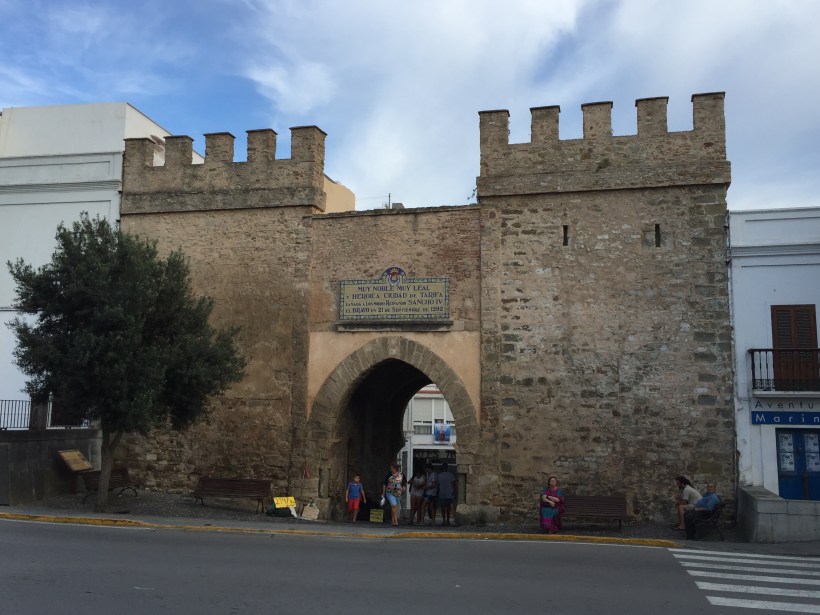
Tarifa got its name after the 710 AD attack by Berber commander Tarif ibn Malik, and was under Islamic control until its Iberian liberation on 21 September 1292 by Sancho IV of Castile, an event commemorated on the Puerta de Jerez, the last remaining grand gate of the old city walls. Our hotel was literally a quaint hole IN the wall – with the front door leading outside the wall, and the back door leading inside the wall to the old city. After we dropped our things in our rooms, the girls headed out along the outside periphery of the wall looking for pizza while we went inside to explore the narrow streets of the old city.

Tarifa is a fairly small town that has become a haven for Northern Europeans (especially Germans) seeking a Mediterranean escape, and for kite surfers from around the world wanting to catch the strong winds whipping through the Straight of Gibraltar. Inside the walls there are restaurants, shops, hostels, and homes in rows of buildings that date back centuries. An anchor of the town architecturally and culturally is the Iglesia de San Mateo, the Church of St. Matthew, built in the early 16th Century on the remains of an old mosque from the Moorish period. Outside the walls there are lots more restaurants, touristy shops, hotels and hostels, stately neighborhoods, modern beach house developments, and many “outdoors” shops with a wind and kite-surfing inclination.

We told the girls we would meet up later, but discovered that the school phones we brought with us did not work in Spain. So while Audrey held an outdoor table at a place where we shared a bottle of wine, Brian shot back three blocks to the hotel to pick up the girls and bring them inside the walls. We all reunited just in time to discover we had come to Tarifa during a festival celebrating Santa Maria, and the townspeople were lining the streets from the Iglesia de San Mateo along a winding route through town in anticipation of a fiesta parade. The parade featured men on horseback, women marching with banners and sashes and magnificent up-do hairstyles covered by veils, traveling platforms with life size religious icon statues carried by teams of men hidden behind curtains wrapped underneath the platforms, and bands behind each statue playing somber music as the statues made their way through the old city streets. As if the iconography and other displays we saw around town were not enough evidence, the parade left no doubt that we were now in Catholic Spain, not Muslim Morocco.

The next day, the girls again explored on their own. Meanwhile, we enjoyed ham and cheese crepes (yes, more PORK!) before searching for a farmacia where we could fill prescriptions for drugs not available in Morocco. Walking about a mile up Tarifa’s main road, we found one that would fill the scrip meds we needed without our providing actual prescriptions. (It is a different world of medications here.) All they needed was time until the morning to fill our order, since we wanted six-month supplies. Brian told them that would work, as long as we could get them in time to catch our ferry back to Morocco.

Walking back toward our hotel, we sat outside at a tapas restaurant to lunch on a variety of grilled pork tapas. (Yes, pork again…Seems like a theme developing here.) The vegetarian girls found us and hung out long enough to be disinterested by our pork. The rest of the day was more walking and resting before heading out again for dinner. This time, no pork. Instead, Audrey has her first paella. Since nobody serves paella for one, and Brian is allergic to shellfish, we actually ordered two two-person paellas – one seafood, one chicken – and did a remarkable job of eating most of both. Audrey now understands why good paella is such a treat, and fears that having had her first paella on Spain’s Andalusian Coast will ruin all future paellas for her. She is probably right about that.

The next morning, we walked back “upstream” – against the flow of ferry-bound people rolling their luggage along – to the farmacia for our six-month supply of meds. But when we tried to pay for them with a credit card, the transaction would not go through on either of the cards we brought. Finally, we asked where we could find an ATM to get cash, walked half a mile to find it, and pulled out cash with no problem. Then it dawned on Brian why the cards had not worked in the farmacia. Returning to pay for the meds in Euros, the pharmacist laughed when he said, “Mi banco piensa lo es un mal persona comprando los drogas con mi tarjeta.”

Two days in Spain passed so quickly, and before we knew it we had enjoyed a final lunch – Italian food in Spain – and joined the flow of ferry-bound pedestrians with our bags and a box of leftover pizza topped with excellent Spanish ham. The luggage, including the Spanish ham pizza box, were scanned and we boarded the ferry. On the 35-minute ride back, it started to rain. By the time we docked in Tangier and the ferry’s door opened, we faced a heavy downpour that soaked us as we walked 50 yards to Customs.

When we got there, we discovered we had made a rookie mistake: we were supposed to get our passports stamped on board the ferry before docking, and they would not let us leave without Brian – carrying his bags and his now-very-wet pizza box – taking all the passports back to the ferry to get stamps while the others stood in the rain at the Customs checkpoint. This proved a long and frustrating fix to the rookie mistake, because the Passport Control officer on board had left his station and no one was interested in helping locate him. Indeed, one ferry employee who spoke English felt the need to berate Brian for being so stupid not to get the passports stamped before docking. After 10 minutes of being dressed down for utter stupidity and over half an hour with Audrey and the girls waiting wetly outside for Brian, the Passport Control officer magically reappeared and stamped the passports. Heading back on shore to Customs and the waiting soaked party, with the coveted pizza box disintegrating in Brian’s hand, Charlotte’s friend captured what we all felt when she said, “I can drink from my body!” But we were back in Morocco, and we had a safe, uneventful, if moist, drive back to Casablanca.

On the plus side of the storm, the rain washed away the rivers of sheep blood in the streets before we returned home, so we did not experience the full aftereffect of Eid firsthand. That said, in the end, our noble efforts did not actually spare Charlotte from witnessing the sheep slaughter. While we were in Tarifa, she watched countless gruesome sheep assassinations as many of her Moroccan friends sent videos of their family celebrations to her in Spain – not to tease the vegetarian, but to share culturally a big event in their lives with their new expat American friend. For a number of the boys in her grade, this biggest holiday of the year was a right of passage where for the first time they had the honor of sacrificing their families’ sheep. Some of the first-time slaughterers had more challenge than they expected, with the sheep putting up fights and trying to get away as they sprayed blood on the white clothes of the boys. Recognizing their good intent, Charlotte handled it with cultural appreciation (and a little self-contained personal horror)…and THAT is one of the things we hoped she would get from this experience living abroad. To have it come so soon after our arrival is pretty spectacular.

On your mark…get set…here we go!

Road Trip, Part I: Eid Mubarak!

We have traveled in Europe and know how easy it is there to go from one country to another. Indeed, one advantage we expected to enjoy about living an expat life was being able to travel easily. But you never know for sure how things will work out until you give it a try. And so we did. Our conclusion? Yup, it IS really easy!

Of course, we are in northwestern Africa and not Europe; but, after living two months in Casablanca, recently we took our first road trip up to Spain for a few days. Why? Simple answer: Because we could.

The more detailed answer comprising Part One of this post is that two weeks ago Morocco, like all the Muslim world, celebrated Eid al Adha – the Festival of the Sacrifice. Known also as Eid al Kabir, or the Greater Eid, this most holy feast of Islam commemorates the faithfulness of Ibrahim (Abraham) demonstrated by his willingness to sacrifice his son to Allah (God). Folks familiar with the story (though Judeo-Christian tradition says it was Isaac that Abraham was prepared to sacrifice, while Islam says it was his half-brother Ishmael) will recall that God stayed Ibraham’s hand from sacrificing his son, and provided a ram that Ibraham then sacrificed instead.

To put it in context westerners might understand, Eid al Adha combines the spiritually-based family holiday celebration element of Christmas with the feast element of Thanksgiving. Except that instead of everyone buying Christmas trees, everyone buys sheep…which they do not decorate with ornaments and candy canes; instead, they slit the animals’ throats, kill them, skin them, burn the heads and horns, roast the rest, and share the feast over a few days with family while giving a portion to the poor.

For this reason, we dubbed it the “Silence of the Lambs” holiday. Also for this reason, we thought we would spare our vegetarian daughter from having to endure the screaming of the sheep and the streets running with blood as they were being slaughtered throughout Casablanca, throughout Morocco, indeed throughout the Muslim world. Shooting across the Straight of Gibraltar to Spain seemed like a good strategy to buffer her from the carnage, however festive it might be.

First, a bit about the cultural impact of Eid for a family that moved to Morocco two months ago. In the weeks leading up to Eid we felt a palpable rise in excitement, not merely among our Moroccan friends and colleagues, but generally in the air — like when Christmas decorations in stores tell stateside folks that the Holiday Season has started. Except, just like with American election seasons that start to barrage the populace with political posturing and negative ads way too soon (as many would say: “…especially this year!”), Christmas commercialism stretches into a Holiday Season that is much longer and more materialistic than the build-up to Eid. That notwithstanding, a couple weeks before Eid begins people start talking about what they will do during the holiday. People make plans to celebrate with family, whether they be across town or across the country, and invite guests to join their family celebrations. (One piece of advice shared with us by several folks: If someone invites you to celebrate Eid with them, try to go on the Day Two, because Day One is when they eat the offal, i.e., the innards and organs and such.

The buildup does not entail walking through the Morocco Mall festooned with Eid decorations and accented by a Moroccan Burl Ives singing Eid carols pumped through mall muzak. Yet, clear signs tell of the impending celebration. Akin to the Christmas tree vendors in America that pop up on street corners and in parking lots of big box stores and supermarkets, nearly everywhere you go here you see hay bales stacking up on open lots and street corners to serve as makeshift sheep pens for the masses to buy their sheep, and vendors setting up temporary stands nearby the sheep pens to sell gigantic burlap sacks of charcoal for roasting the sheep. What was a vacant space next to the souks where we buy our produce suddenly has a dozen sheep standing around with a crowd of people looking them over as they pick the right one (or ones) to bring home. The Hanouts also step up their supply of butcher knives and roasting skewers, like stateside people shoot over to Lowe’s and Home Depot to pick up a fresh string of Christmas lights and a new Christmas tree stand. Indeed, there is a whole Eid-dependent industry, including the butchers that make one house call after another through the day (though people wait until after the King has led the sacrifice before they sacrifice their own sheep).

Without experiencing it, one cannot fathom what it means to have sheep everywhere. Really, there are sheep EVERYWHERE! Driving on the normally crazy Casablanca roads becomes an even more noteworthy experience as sheep are added to vehicles all around. Delivery trucks have layers of sheep stacked on top to bring to sheep pens. Donkeys pull carts crammed with sheep also heading to pens for sale. Once someone buys a sheep, somehow it has to get home (so the family’s children can play with it for a few days before it becomes the guest of honor at the meals of the feast). Stateside, people get their Christmas trees home in very creative ways. Ditto the sheep in Morocco. We saw sheep in the trunks of BMWs and Mercedes-Benzes. Sheep looking back at us through the rear window from their backseat perches of the cars, vans, and SUVs in front of us on the road. Sheep in the back of the ubiquitous three-wheeled motor carts. Sheep riding piggy-back with drivers of equally ubiquitous mopeds and scooters. Seeing two sheep riding in the back of a three-wheeled motor cart with a couple children and an older woman riding in the back with them, Audrey said, “Oh look, those two sheep are snuggling,” to which Charlotte responded flatly, “Mom, they’re tied together.” Walking along the streets and through the markets, you see people leading their sheep home as nonchalantly as if they were out walking their dogs.

Another consequence of Eid is that everything shuts down. EVERYTHING shuts down. Restaurants, businesses, and stores close so that everyone can be home celebrating with family and friends. Construction projects – whether road construction or the new building going up on our campus – come to a halt for two weeks because the work crews head back to their Berber villages far away for one of the two times a year they get to see their families. Medical clinics close, so that a coworker who thought she might have broken her foot had to go to the one hospital that was open on Eid to get medical attention.

And so we packed up our vegetarian daughter and a friend she brought along, and we headed north. This year, Eid started on a Monday. When we left Casablanca the preceding Saturday, and it was already a madhouse on the road, like trying to fly through O’Hare or Atlanta or drive from New York to D.C. on the day before Thanksgiving. It took more than two hours to get out of Casablanca and past Rabat, normally about an hour-long trip. Finally traffic thinned out as we headed toward Tangier, on the northern coast of Morocco across the Mediterranean from Spain. Traveling north, we saw the landscape change from urban Casablanca and Rabat to more agricultural scenery that showcased olive orchards, banana farms, and fields of delicious Moroccan yellow melons.

After more than five hours on the road, we pulled into Tangier, the first stop on our road trip. So that is where we will stop for now. In Part Two of this post, we will share our overnight experience in Tangier, our ferry ride across the Mediterranean to Tarifa, and our couple days exploring a tiny spot on the Andalusian south coast of Spain.

On your mark…get set…here we go!

Parking in Casablanca: The Chivalry of the Curb

Our last post introduced the experience of driving in Casablanca. Related intrinsically, yet distinct as an experience unto itself, is the matter of parking.

First, we have heard that roughly 70 percent of Morocco’s economy is unofficial duty-free commerce…aka, black market…aka, free market in its truest form. Unemployment is high. The idea of a high school student working a summer job at McDonalds (or, McDoo, as we noted in a previous post) is out of the question, because every job at McDonalds or Pizza Hut or wherever is a career position. An opening will garner a few hundred applications. So industrious and motivated people who cannot find jobs do what such people have done as long as there has been commerce: they find a need in the market and fill it.

The Need: Some things in Morocco are not scarce, such as sheep and donkeys and scooters and streetside Hanouts that collectively sell anything and everything. One thing that IS scarce in Morocco, and especially in Casablanca, is available parking. Imagine parking in New York City on a bad day; that’s a good day parking in Casablanca.

It is not that no parking spaces exist, but that available parking spaces can be very hard to find. Casablanca’s streets are often narrow with parked cars crammed into every nook and cranny where they can be shoehorned to fit. Even in a parking lot, lines are painted so closely together that pulling in or out of a space may require people to wish their Drivers Ed class from years before included instruction in the Moroccan 16-point turn. You cannot drive in Casablanca without the ability to parallel park…and to do it well. Correction: you should not be permitted to drive here without that skill; but, people do.

To make matters more complex, it takes a while to learn the rules of where you can – and, more importantly, where you cannot – park your vehicle. Naturally, you cannot park in a way that blocks a driveway or garage. Beyond that intuitive element, though, drivers new to Casablanca may get confused by the No Parking signs, comprised of a blue circle with a red border and a red “ \” or “X” through the center of it. Typically, they come in pairs, marking the front and back boundaries of a No Parking section of curb. Sometimes, though, one has difficulty finding the second sign, so you do not know on which side of the sign you can see it is okay to park and which is not. Or, sometimes, there are No Parking sections mixed with sections where it is okay to park, but you do not know which signs mark the okay parking section and which signs mark No Parking.

Yet another parking challenge is the Yellow Curb, which only works well to discourage parking when it is not faded and difficult to see as yellow. It also does not help convince drivers to avoid yellow curbs when so many others ignore their parking prohibition. Do this at your own peril, though. Twice in recent weeks, Brian parked on the yellow curb in the CIL to pop quickly into the French grocery store O’Self. This weekend, though, when we went to the CIL to shop at O’Self and some Hanouts, there were blue-uniformed police handing out tickets and towing vehicles from the yellow-curbed median packed with cars. Good thing we had found a legal spot this time, or we would have had to taxi home (a subject for another post!).

Violating any of the No Parking rules can result in finding The Boot attached to one of your wheels, like a metal sandwich that keeps you from driving away because your wheel cannot rotate. Unlike in the U.S., where getting unbooted is often a highly bureaucratic process, here you just find the guy who booted you, pay him, get unbooted, and drive away chagrined that you did not see the faint traces of yellow on the curb. Far worse is getting towed, which can take long hours and many dirham to break your car out of Bad Parking Jail.

The Solution: Back to our initial comments about free markets filling the needs of consumers, the answer to the problem of parking in Casablanca (and elsewhere in Morocco) comes in the form of the Parking Guardians (ou, en français, les gardiens de parking). An entire service industry has grown around the need for drivers (1) to find good, legal parking spaces, and (2) to feel confident that their vehicles will be safe during their absence from petty vandals and thieves. We are sad to have read some naïve and unflattering descriptions of the Parking Guardians online. In reality, these men are not shysters and charlatans. They provide a real service, at a negligible price, which makes life here easier and more enjoyable. Indeed, part parking attendant, part traffic cop, part 3-D Puzzle Master, and part bouncer, with yellow safety vests and an option to wash your car while you are gone, les gardiens de parking are Morocco’s Knights of the Chivalry of the Curb mixed with a sort of pure capitalism that would make Adam Smith proud.

For as little as 2Dh (2 dirham is about 25 cents) they will find you a spot to park on their stretch of curb and help direct you through the process of parking. This could mean directing your parallel parking with wild left and right wheel-turning gesticulations that somehow help fit your 3 meter vehicle into a barely-bigger 3.25 meter curbside opening, while the Guardian simultaneously holds up honking traffic with a Moroccan wave. It could also mean having you drive your vehicle halfway up onto the sidewalk perpendicular to the roadway to sandwich more cars into a small stretch of curb, this time likely holding up two lanes of honking traffic for you while you park. Last weekend, when we went to shop in the CIL and DID NOT PARK ON THE YELLOW CURB, it meant that as soon as we parked curbside in a free space, a Parking Guardian appeared with a 2 dirham ticket from the automated streetside parking pay box (that we had not seen), instructed us in pantomime to put it on our dashboard, and ensured that we were not towed while the local authorities were towing yellow curb cars left and right. After an hour of shopping to get fresh basil and broccoli at a Souk, fresh Moroccan bread and baguettes at the bakery, skewers for the grill at the hardware Hanout, and an assortment of butcher meat, cheeses, and more splurgee items at the French grocer O’Self, we gave the Parking Guardian 10Dh plus 2Dh for the automated parking ticket that he had given to us. Where could we shop for an hour stateside and pay only $1.25 to park? And these guys will even remind you to turn your mirrors into the side of your car – or just do it for you – to keep passing traffic from taking them off as drive-by collateral damage. As difficult as it may be to remember which of the handful of Parking Guardians huddled together in the median of the roadway is taking care of your car, they always remember which cars in their care go with which drivers.

A couple weeks ago we were headed to meet a mixed group of Moroccan and expat friends at someone’s flat for a Moroccan Movie Night that featured a Moroccan film presented (and, after finishing the viewing, discussed) by the film’s Moroccan producer/director. On the way, we stopped at Chez Paul, a fancy French restaurant, to pick up some things we could contribute to the group’s potluck refreshments. Having to zip in and out because we were running late, but with no streetside parking available, we explained in a mix of English, French, and pantomime to a Parking Guardian who spoke mostly Darija (Moroccan Arabic) that we needed just a few minutes to park and run inside. Our mission explained and his duty accepted, we just got out and let him figure out what to do with the car. Less than 10 minutes later we emerged with a box of savory treats as we wondered if we would find our car anywhere. There it sat, pulled into a driveway about 20 meters away. The Parking Guardian saw us and brought over the keys. When we asked, “Combien?” (How much?) he shrugged his shoulders and smiled broadly. We gave him a 10Dh coin, and he blessed us as we zipped off to our evening.

The Parking Guardians can be your friend or foe. Friend is much better. Shortly after getting wheels, Brian headed into town to get a haircut at The Palace salon. Pulling onto a side street off major drag route Boulevard Ghandi, he was stuck behind a slow-moving, very pink-faced German driving a big BMW SUV. In slow motion, the German ignored the Parking Guardian directing him to a spot further down where the street was wider, and pulled over to the curb in such a way that it blocked anyone else from getting past on the street. The Parking Guardian and Brian exchanged bemused glances from meters away and shrugged at each other as the German got out of his Beemer. Then the Parking Guardian turned his corrective attention to the German violating the Chivalry of the Curb, blowing a whistle loudly and repeatedly, and berating the German until – duly shamed – he got back in his SUV and drove ahead another 10 meters so Brian could park. Again they exchanged glances, rolled their eyes at the lack of decorum showed by the German, and smiled at each other for each doing their part to respect and preserve the Chivalry of the Curb.

On your mark…get set…here we go!

Driving in Casablanca: Darwin’s Playground

Audrey says that Brian was born to drive in Casablanca. Brian agrees…while noting explicitly that driving in Casablanca is not for the faint of heart. To set the tone of this post, watch this brief “tutorial” on driving in Morocco – https://m.youtube.com/watch?v=0frwti04ItQ – then read further.

Prior to completing our first week here, we got wheels. In this first year here, we are leasing a 2001 Honda CRV from a local expat with a reputation for providing good and reliable vehicles to other expats. It is a great deal, as buying and insuring a vehicle here – new or used – is quite a challenge, for all kinds of reasons. During our first days, we spent a fair bit of time as passengers in other vehicles on Casablanca’s roads and experienced enough to find the video in the above link hilariously true to life. One of our first observations was that Casablanca must have a terrible problem with post nasal drip, because seemingly at every intersection we stopped we had kids walking between cars selling boxes of tissues for a 10 Dirham coin (Moroccan currency equal to about $1 USD). Putting our post-graduate degrees to work, we subsequently wondered about the direction of supply and demand causation between these street corner agents of the Moroccan tissue syndicate and the box of tissues found on the dashboard of every taxi in Casablanca.

Emboldened by the accumulation of experiential roadway knowledge, Brian felt sufficiently prepared to get behind the wheel of our CRV and chauffeur the family to a celebratory dinner downtown. God bless GPS, because one thing jumps out immediately upon trying to navigate here: there are no street signs. Nope, none.

Perhaps this derives from historically being largely an oral culture instead of a written one. In most places we have lived, directions might sound like, “Take Boulevard de la Grande Ceinture and stay on it when it becomes Boulevard Sidi Abderrahmane, then turn left on Rue d’Ifrane and continue until you arrive at O’Self in the CIL.” But directions here sound more like we encountered when we lived in Louisiana, with landmarks taking precedence over streets. So the Moroccan version of those same directions would be, “Take the tram road past where it bends, then turn left when you reach the CIL Mosque and keep going until you see O’Self.” That works for people – even expats – with roots here. But newcomers, with no idea where the tram starts or which mosque is the CIL Mosque, need GPS…

…Except that GPS does not always take you where you want to go. For example, when Brian used his phone’s GPS to find Monsieur Bricolage (the closest Casablanca comes to a Home Depot) on a quest to buy a gas grill, it took him on a wild goose chase through neighborhoods and open air markets with carts and donkeys and produce stands clogging narrow streets, then told him he had reached his destination when he was pretty much in the middle of nowhere. Quickly, he tried Google Maps and shot a kilometer or two further up the road to find Monsieur Bricolage waiting for him. Lest Google start feeling superior, Google Maps has misdirected us plenty as well, such as when we planned to attend an art exhibit and ended up on a street corner by a construction site instead of at Ville des Arts. The challenge comes – in addition to no street signs – from the lack of any street numbers in addresses. Addresses may give a business or building name and a street name (yes, the streets have names, just no signs to tell what they are), and GPS usually does a miraculous job finding your destination with just that information. But more than rarely you may find yourself on the correct street without knowing if you have gone too far down it or not far enough along.

But none of that GPS stuff is why Audrey says Brian was born to drive here.

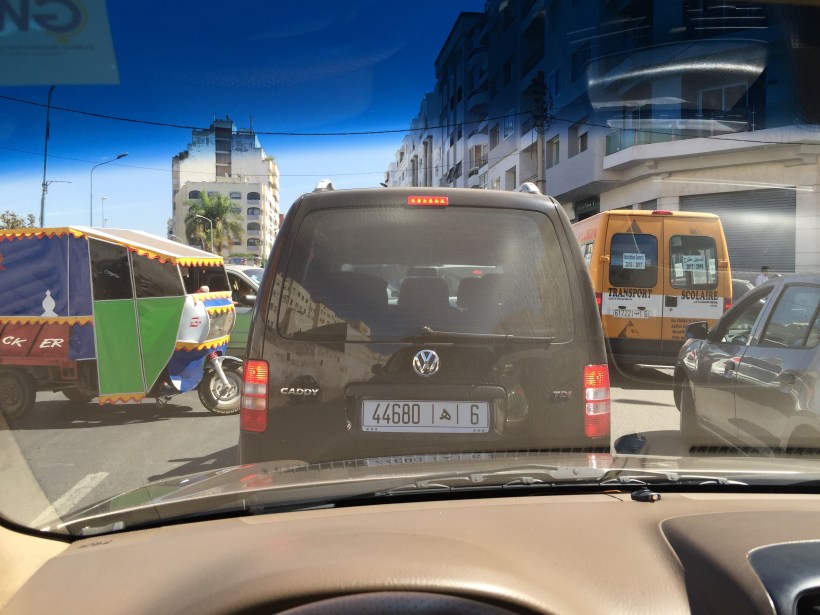
Driving in Morocco is not just a matter of getting used to kph instead of mph. Driving here is an exhausting, all-senses-on-high-alert, full-contact sport. Take the first lesson of driving here: No matter how many lanes exist on a road, a turn can be made to either the left or right from any lane. As you approach an intersection in the left lane with plans to go straight through it, be wary because the drivers in the middle and right lane may swerve suddenly in front of you as they make left turns from your right side.

Not to be trite, but this, of course, implies that lanes matter.

They do not.

This is particularly true around traffic circles (aka, roundabouts), which typically are a death challenge every time you enter one because it is always unclear who has the right of way and from which lanes people may come to turn or to go straight. Daytime is better for entering traffic circles, because you can try reading the faces of oncoming drivers to gauge how committed to playing chicken they are; at night, all you have is their headlights and a prayer. Even on straight roads, though, we have seen a three-lane road swell to eight “lanes” of cars packed side by side, with vehicles on the far right trying to turn left and vehicles on the far left trying to turn right, and a taxi stopping to pick up passengers in the middle of it all. As a consequence, yes, traffic can slow to a standstill. At such times you can hop out of your car and buy a helping of snail soup from one of the three or four dozen women lined up roadside with their snail soup stands. People behind you will honk, but that is okay.

People honk their horns all the time. They do so not in aggravation, but to make their presence known in a sort of roadway existentialism: “I honk, therefore I am…so get back in your own lane before you dent my fender, or before I dent yours.” While honking wins the “favorite Moroccan pastime while driving” award, the “Moroccan Wave” comes in a close second to it. Rather than honking, drivers may use the Moroccan Wave out the driver’s window – a wave of the hand that might swoop out with intentional warning, might wave quickly then disappear, or might shake emphatically to declare gesticularly that someone intends to change lanes/pull out/turn/etc. in front of you. The appropriate response to the Moroccan Wave varies from waving back, to making a nasty face, to honking, to gunning the engine in a sudden game of chicken.

Fortunately, the right-of-way code minimizes the frequency of games of chicken. Put simply, the bigger and faster vehicle has the right of way. The driver of a teeny vehicle crammed with a family of six does not challenge a large truck ignoring lanes as it prepares to turn right by getting into the left lane. What happens if one vehicle is bigger and another is faster? See previous “game of chicken” as the slick Mercedes with tinted windows tries to weave between others to get ahead of the bigger Dacia van.

The exception to this code is scooters. Scooters are the top of the roadway food chain. For our purpose here, a scooter is anything from a mo-ped (most common) to a motorcycle (rarely seen on the city roads, though Casablanca has a Harley dealer). Scooters are the über-gnats of the Casablanca roadway: ubiquitous and entitled. You may pass them as they putt-putt along, only to have them swarm you from all sides when they catch up to you at a stoplight and they weave between cars to move to the front of the line. To protect scooter drivers, legally they always have the right of way. Yet, as history again and again proves Lord Acton’s claim that power corrupts and absolute power corrupts absolutely, scooters take full advantage of their superior status. Some scooter drivers even look for “safe” accidents they can create to make a quick buck. Generally, though, those are not the scooters with dad, mom, and a couple kids pressed between them as they enjoy good family time riding on one scooter.

A few other things to beware while driving here:

  • buses (usually packed so full of passengers that the doors cannot close fully, so people may hang out the door close enough to adjust your driver side mirror as you travel next to a bus)
  • red petit taxis (three passenger maximum, and they stop to pick up more people until the three person limit is reached)
  • white grand taxis (an old Mercedes sedan with two passengers sharing the front passenger seat and four passengers crammed into the three-seat back; also stopping to pick up more people until it reaches the six person limit in four passenger seats)
  • pedestrians popping out from anywhere and eschewing crosswalks while expecting traffic to yield to their jaywalking across the street or arterial or highway
  • taxi drivers – or others…one day we saw an entire car of four guys – pulled most of the way off the road and positioned by the back right tire in a ¾ turn away from traffic while relieving themselves
  • three-wheeled flatbed carts laden with fruits, vegetables, prickly pear cactus fruits, melons, machinery, recyclables, people, you name it
  • sheep, cows, turkeys, goats, donkeys, dogs, cats, or other animals eschewing crosswalks and expecting traffic to yield to their jaywalking across the street or arterial or highway
  • donkeys pulling carts laden with fruits, vegetables, prickly pear cactus fruits, melons, machinery, recyclables, people, you name it
  • people walking individually or en masse along the side of the road, or even in the road
  • people pushing carts laden with fruits, vegetables, prickly pear cactus fruits, melons, machinery, recyclables, people, you name it
  • And, last but not least…wrong way traffic (especially brightly-colored three-wheeled truck taxis cramming as many as a dozen people into what is basically a small box open at the back, with a guy on top smiling as he waves oncoming vehicles away with glee)

After reading this, one might wonder what role law enforcement plays on the roads. Have no doubt that they exist prominently. They stand on corners, in intersections, on roadsides, and at guard posts in their blue uniforms with stiff white plastic sleeve protectors on their forearms. Driving along a road, you may see suddenly a police checkpoint channeling people through with strategically-placed panels of high metal spikes laid on the road. Or you may pass a radar team of at least three officers operating one radar gun placed on a tripod, making you wonder if someone could zoom past them and be gone before they packed up their gear and rushed after the speeder in their radar team truck. If you get pulled over for some reason, any fines must be paid on the spot, so it may be a good idea to keep extra Dirham in the car.

Fortunately for us, Brian honed his Darwinian driving skills in Washington, DC, which has proved a good preparation for driving in Casablanca. Audrey has been brave in the passenger seat, but has yet to give driving here a whirl. That is coming soon, though, and then we will have a competition to see who can go longest without putting a dent in the CRV’s body or a getting pulled over for a ticket. Inshallah.

On your mark…get set…here we go!
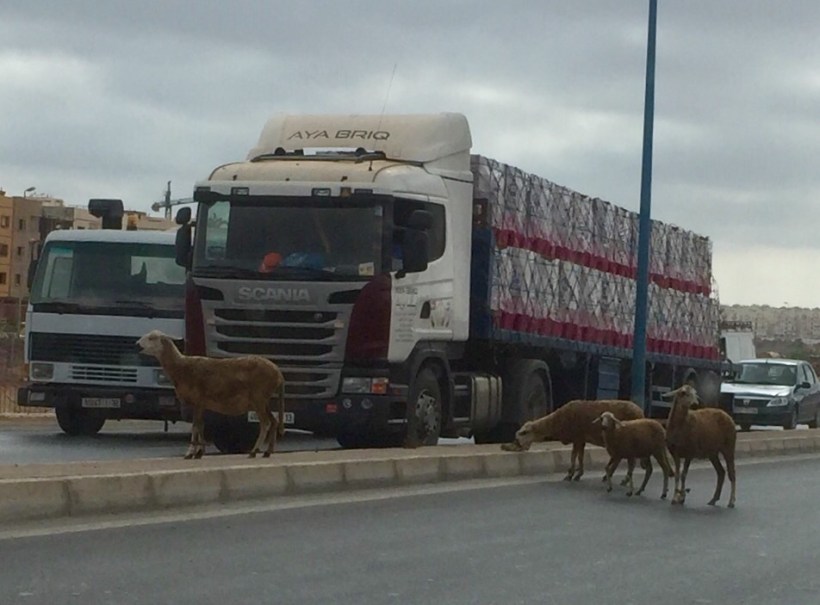
Settling In

We have come to the point in our Moroccan expedition at which we can start counting our time here in weeks (albeit only three) instead of days. Happily, in that still-brief time we have made good progress settling into our new northwestern African home.

In 1943, Abraham Maslow published his “Theory of Human Motivation” paper that first established his now-ubiquitous hierarchy of needs. More than anything else in our lives, moving to Morocco has given us a deep appreciation for Maslow’s primary needs of things like food and shelter, safety, and relationships.

While finishing our packing last month, we made sure to include among our 25 boxes and bags some basic foodstuffs – like pasta, sauce, and Mac & Cheese – that we could access upon arrival. If nothing else, we figured, we could ensure that our tired stomachs would not have to sleep empty. It was a good plan.

Upon arrival, first we found shelter in our comfortable faculty residence. We had resolved before our stateside departure to have low expectations of our quarters, leading to the pleasant discovery of our spacious 3BR/2.5 Baths unit with a long entryway, a large balcony deck, terrific cross breezes to give us God’s air conditioning (since we have none made by humans), and a beautiful view of the Atlantic Ocean perfect for enjoying African sunsets (though when we arrived at after midnight we could only guess where the ocean was). Next, with much-appreciated help from other school staff, we finished lugging boxes and bags up the “Moroccan elevator” – known as stairs – to our third floor apartment very, very late. When faced with going to bed sooner with empty stomachs or still later with full ones, we pulled out Brian’s handy package manifest to see where we would find a box of Mac & Cheese…or, in this case, two boxes. The three of us gorged, and then we slept.

The next day, we kept climbing Maslow’s pyramid when someone came by with a school phone for Audrey (Brian would have to wait for his) and a router to give us home wifi. Then we piled into a school vehicle with an HR staff member who dropped us at the Morocco Mall, not far from our school and home. Our first stop there was a Meditel store to get Charlotte’s phone a Moroccan SIM card and data plan that would allow her to connect with her friends stateside and elsewhere around the globe. Next we went to Fnac, a sort of Best Buy downstairs and Barnes & Noble upstairs, to buy Moroccan-plug chargers for our iPhone and iPad electronica. Having procured the technology to connect with friends and family to let them know we had arrived safely, only then did we go to the Mall’s Walmart-like Marjane Supermarche to begin outfitting our new home with the basics of home operation (Item #1: Fans!) and food supply so we could eat and survive the next few days.

We must admit, ever so reluctantly, that beyond the tangible satisfaction of our primary Maslow needs, shopping at the Mall helped with our incipient sense of belonging as well. Stateside we are not mall rats, yet on our first day in Casablanca we drew a measure of comfort from easing into our Moroccan acclimation by walking around a western-friendly setting that included some stores we would see in Scottsdale’s malls (albeit with a Moroccan style), and even a food court that mixed Moroccan establishments (where from a display you can choose a skewer of meat or vegetables that they will grill for you) with the western extremes of Dominos, Pizza Hut, KFC, Burger King, and – of course – McDonalds (or, as advertised on billboards and signs here, Chez McDo).

Efforts to establish HOME continued on Day Two with a field trip to IKEA with two other newly-arrived families. Piling into a yellow school bus, a school driver ferried us to the familiar blue and yellow. After more than four hours that included an IKEA café stop with tajine instead of IKEA’s famous meatballs, our three families had nearly bought out the store and filled the entire bus with enough “LEGOs for Adults” projects to max out three impressive “honey do” lists.

Despite the perception this western-leaning time might create, not all our early day activity focused on western familiarity and 1WPs (First World Problems). On our third day, we decided to take a family walk to the beach a mile away. Settling upon the “shortest distance between two points” manner of navigation, we shot out straight from the school gate toward the water and traipsed through a pasture of mostly-dried grass, dust, manure, and a few cows for good measure. Seeing a black-topped parking area by what we presumed was a high upper class residence, we redirected a few dozen meters to the right for easier walking. No sooner did we set foot on the blacktop than an official-looking guard approached and stopped us. In Arabic, he nicely but firmly asked where we were going, and chided us for speaking no Arabic. After a couple minutes of gently dressing us down, he indicated – with the ever-useful Moroccan pantomime to make up for foreigners’ language deficiencies – that we should go back to the road and take a different route to the beach. Only later did we discover that we had traipsed onto the property of the King’s summer palace. Oops!

After a few days of acquiring and using western comforts and a bit of peer get-to-know-you time, as quickly as possible we sought to expand our local universe and discover real Casablanca. Near the end of our first week, thanks to the generous offer by another school hand to show us around town, we counter-balanced our Morocco Mall and IKEA experiences with an exploration of everyday shopping in Souks (open air markets) and Hanouts (Moroccan versions of NYC bodegas) so fascinating that they merit their own soon-to-appear post. Now we felt like our real acclimation had begun.

Our world expanded further as the 15 year old car offered to us in a private lease for this year by a friend of the school got delivered to us and we could venture out on our own. As with Souks and Hanouts, we soon will share a post dedicated to driving and parking in Casablanca. For now, suffice it to say that getting keys and wheels made us feel liberated and daring enough to head downtown – utilizing Brian’s “D.C. Driving” skills from Capitol Hill days – and go to a restaurant that Charlotte picked with technology using the newly-acquired SIM card in her phone. It would have been better if, in our excitement to be independently mobile, we had thought to dress more appropriately for a nice restaurant downtown. Instead, Brian looked the most like an American sightseer with his cargo shorts and flip-flops. Upon our walking into the restaurant, the English-speaking maître d’ swooped over and handled these American tourists himself, saving his staff from having to manage with them.

Another important piece of settling in for us was getting a grill. As foodies, a grill expands significantly our culinary repertoire. After finding Monsieur Bricolage, the closest Morocco comes to Home Depot, Brian bought a grill, hose, and clamps and set to work turning its million pieces into a working grill. After several hours, he had a working grill that did not explode when he lit the burners, and Audrey had plans for what she would give Brian to grill over the next few days.

Perhaps the last piece of starting to settle in came with our outreach to start networking beyond school life. We had read, in our preparation this spring for a successful experience living abroad, of the importance of building relationships with three groups: at our school, with native Moroccans, and in the expat community. To facilitate these latter relationships, we joined an online-organized community called InterNations. Already we have attended several events and met a number of interesting expats and Moroccans who have helped us leap forward in what we have learned already. We even found an expat living the last 30 years in Marrakech interested in showing us around when we journey there later this fall.

Through all this, while Audrey had a phone, office, keys, and a computer, Brian had none of these. As a result, Audrey could also start settling into her job role, while the good feelings Brian felt about home life stopped short of extending to his job role. In Morocco, though, one of the earliest and most important lessons is about patience. “Moroccan time” means things happen when and as they are supposed to, a reflection of the Muslim fatalism that God controls all. Lhamdo Lillah (“Praise be to God”), eventually Brian got office-outfitted in time to be ready for new faculty orientation.

So, after three weeks, we feel very much at home here. We have learned much already, as people here have already learned much about us. One longtime staff member commented on how difficult it is to predict what incoming faculty and staff will be like, saying with apparent relief after meeting us, “You guys are remarkably normal.” More recently, he paid us a high compliment when predicting whether we are more likely to succeed here or to disappear (like some do when their experience teaching abroad fails to be what they hoped it would be), saying to Brian, “I think you guys are going to be here a lot longer than you think you will be.

Perhaps most telling of our settling in is that we feel perfectly at ease with getting around on our own. We have had both failures and successes; but, even the failures can turn into successes. For example, last weekend we hoped to attend an InterNations art exhibition. However, when Google Maps took us to a location nowhere near where we wanted to be (but we did not know how to get where we wanted to go), we just shot an apology email to the woman hosting the event and used our suddenly unscheduled time to drive to the Cil neighborhood for a car wash (lest “Moroccan Dust” become the new paint color for the car) and shopping at the Souks, Hanouts, and the French grocery store there. Likewise, after not even three weeks in Casablanca, Brian got to share his new competence getting around by playing “Basic Survival Tour Guide” to a family that arrived last week, taking them to the supermarches, Souks, and Hanouts, and letting them in on handy advice that can help make their settling in easier.

To be certain, much learning and excitement, as well as many challenges, lie ahead for us. Maslow’s secondary goals stand far off for us as we look someday to achieve them. Indeed, we keep hearing about how culture shock starts to hit hard around October. For now, though, it feels good to say confidently after just three weeks that we are settling in, that we are happy, that we love living in Morocco.

On your mark…get set…here we go!

Getting to Morocco: Preparations, Challenges & Anxieties

Before our posts move forward from our arrival in Casablanca, we want to backtrack a bit and mull our preparation for moving to Africa. Bear in mind, while younger and/or single educators can make more spontaneous decisions, this is not something we could just wake up one morning and decide to do. After years of talking about going abroad someday, and having international job offers that we declined at times in our past, we started looking for the right international school opportunity about a year ahead of our arrival in Morocco. Working together on such a big decision was of primary importance to minimize the chance of one of us backing out and killing the move – which could lead to resentment from the other wanting to proceed with the plan – or, even worse, going along without buying in fully so that our arrival would lead quickly for at least one of us to buyer’s remorse, resulting regret, and disharmony. With two very different personalities and planning styles, this posed a big challenge. Yet, through much intentional effort to consider and include each other at every step along the way, we stayed together pretty well throughout the process. By December we had found the right school and signed contracts that would take us abroad for at least three years.

Once we signed our contracts, our excitement shifted from that of looking for an international school to that of preparing to go to one. We googled and searched and read and watched in manic effort to learn what we could learn as quickly as possible about Morocco, about Casablanca, and about our school. The wonderful HR people at our school fed this habit by emailing us with lists of worthwhile resources, and even a “Casablanca Survival Guide” designed to help steer incoming faculty and staff through the substantial culture shock that new expats encounter after the “honeymoon” period wears off. Some, apparently, do not make it. “The first year is pretty tough,” one person told us back in December, “But after that, people love it here!” The key, many told us, is your attitude as you come in. If you are open to the Casablanca experience, you will embrace what it has to offer. If you want merely to replicate the U.S. experience living abroad, you will find disappointment. We suspect this truth applies at international schools around the globe.

Before long, while that preparatory excitement remained, we also felt the challenge of preparing to go as the reality of our commitment started to set in.

One early aspect of this challenge was deciding how to downsize our lives to what we could take with us on the flight to Morocco. Multiple sources advised us not to send anything by cargo ship; instead, we should check everything we want onto our flight. How to arrive at that goal feasibly was a mystery. We lived in a very comfortable 3500 square foot house in Scottsdale, AZ, with four bedrooms and four bathrooms; a huge kitchen and large walk-in pantry; nice furniture in our living room, dining room, and master bedroom; antiques; artwork. We would never fit everything into our faculty housing apartment in Casablanca, to say nothing of the impossible cost of shipping it all across the Atlantic. Likewise, it would be cost-prohibitive to keep everything in storage units.

First there were the cars. Brian’s beloved 2001 Jeep was not welcome in Morocco, where a few years ago it was decreed that no vehicles more than five years old could be brought into the country. Audrey’s 2013 VW CC made that cut…then we learned that beyond shipping costs we would have to pay somewhere in the neighborhood of a 35% import tax: not on the current value, but on the ORIGINAL purchase price! We decided to leave Brian’s Jeep with his folks for when we would return stateside for visits, and Audrey’s CC we would sell sometime before we departed in mid-July.

Once we had a car plan, we turned attention to our voluminous stuff. We purged and repurged. We inventoried. Audrey read books and articles about minimalism, while Brian leaned toward holding on to things that we would want at whatever point we returned from abroad or that our kids may want during or after college. In the end, working together and with both of us giving ground to the other, we prioritized what was (1) important in our new jobs, (2) nostalgic, (3) irreplaceable, and (4) otherwise special. The rest – over 80 percent of what we owned – went to the dump or to an estate sale auction house for sale (albeit with a return of about four cents on the dollar that did not come to us until two days before we took off, and that was only after weeks of pestering them to send us our overdue check before we disappeared to Morocco). So after vacating the house we rented and downsizing the majority of our stuff, our material life of 20 years of marriage now is based in a couple UHaul storage units.

The next big challenge we had was not physical, but emotional. Things we read told us to expect that not everyone close to us would share the excitement of our plans, and some might even vent their frustration over our leaving with highly negative input. Many friends and family reacted to our news positively, with some even declaring their desire to visit us in Morocco as soon as they could. (Months before we left the U.S., our first visitor reserved her spot in our guest room for this coming September.) Others seemed perplexed, but wished us well with a “better you than me” attitude. Yet, still others had quite negative reactions that took some wind out of our sails. The world is a dangerous and scary place today, and some people worried that we were moving far away – and away from them – to what they considered an unsafe and incompatible part of that dangerous world. Emotionally difficult as this was, we were determined to keep moving ahead, while hoping that naysayers and critics would fall into line over time.

Another hassle came with the need to review and update legal documents – e.g., wills, medical directives, etc. – especially choosing whom to name Power of Attorney for us while we are overseas. We were quite blessed with a lawyer friend of ours agreeing readily to be our POA, and with other family and friends who willingly shouldered other important roles that made us feel much better about the status of our stateside lives.

After handling the bigger-picture, longer-term challenges, the last few weeks before we left included anxiety over several matters of logistics, finance, and timing.

  • First, after spending liberal transition time with Brian’s family in the Pacific Northwest, we had to figure out how to get all our bags and boxes from the apartment where we were staying to the airport where we would depart. From Brian’s meticulous measurements of the cargo volume and of the space available to transport it in his Jeep and in his parents’ pickup truck bed, it seemed he could make it all fit. Not until loading it on departure day, though, did he know actually that the pieces of this 3-D puzzle would fit in the two vehicles heading to SeaTac. Then, of course, there was Brian’s “Will they take all our bags and boxes?” worry, the ending of which we covered in our previous post. Fortunately, the measurements were sound, and all fit perfectly with enough room even to include the people who needed to accompany the stuff.
  • Second, the need to manage finances was and is a source of great anxiety as we gear up in Morocco. Not only did we have to marshall our funds to cover costs (especially the extra bag fee!) for getting here, but we also have to manage both our U.S. and Moroccan funds carefully until we can get set up with (a) a Moroccan bank account – which could take a couple months – and (b) the ability to convert Moroccan Dirham (MAD) into U.S. dollars we can wire to our U.S. bank and pay stateside bills (like for our storage units, insurance payments, credit card statements, etc.) – which may not happen until December! We should be fine, but there is a bit of angst that comes with not being able to add to our stateside cash for as many as five months.
  • Third, as mentioned above, we needed to sell Audrey’s super-fun Volkswagen CC, known to her as “Precious.” We explored private sale and dealer buyback options. For a variety of reasons, these proved to be less-than-desirable scenarios in this case. But Precious still needed to go away in order to avoid continued finance and insurance payments on it. Two weeks before departure, we contacted an independent dealer who had been recommended to us. He sold lots of cars on consignment, and offered us a great price well above what VW dealers had offered. Even better, he suggested we hold on to Precious until our last full day in the states, at which point we could drop the car with him and he would take care of all issues of title transfer, payoff of financing, even do some scheduled maintenance and a thorough detailing to make it sparkly and ready for a buyer. Auto issue: Gone.
  •  Lastly, another logistical timing issue hit from out of the blue during our last month in the states, threatening suddenly to keep Brian from getting on the flight to Morocco with Audrey and our daughter Charlotte. After what Brian thought would be a routine wellness visit with his doctor, the PCP sent a message a few days later saying he wanted blood work repeated to ensure some bad results were due to lab error instead of bleeding internally. BLEEDING INTERNALLY? You gotta be kidding me! Certain that a second blood draw would exonerate his internal plumbing, Brian was shocked when his return visit instead confirmed iron deficiency anemia, a sign that something was likely awry inside. The exchange between PCP and Brian: “We need to know if you are bleeding internally before you get on a plane to Morocco. But what if things cannot be scheduled before my flight in mid-July? We need to know if you are bleeding internally before you get on a plane to Morocco.” [Microphone…drop.] Naturally, this opened up the “it sucks getting older” element of bodies not being what they used to be, and Audrey being worried about Brian while Brian worried about losing crucial packing/prep time in our final weeks and possibly having to delay his own arrival and orientation at the new school. More practically, this created a sudden and serious problem of scheduling and executing a battery of tests by various doctors in different departments at several medical facilities (to say nothing of getting insurance pre-authorization of all the procedures) to check him out stem to stern and see if he was leaking blood from his __________ (fill in as needed: liver, aorta, stomach, spleen, intestines, colon, etc.). Somehow, some guardian angel must have taken over the case as what normally would have taken many weeks to schedule instead got scheduled and performed in less than two weeks. Better still was that the snout-to-tail results, the last of which came days before our departure, revealed nothing out of the norm, and a scrip for iron supplements got things back in proper order. Cleared to go!

And so we went. And now we are here. In nearly two weeks since our arrival, we have already seen and done much. Our jobs started this week, though they are beginning with a couple office setup days followed by several days of admin team orientation. Meanwhile, Charlotte has discovered the joys of surfing, for which she has been taking lessons at a Moroccan surfing school on the beach. We know there is a honeymoon phase to this move, and that this phase will come to an end. For now, though, suffice it to say that all three of us love living in Morocco. Through the humidity and the large cockroaches that fly and the need to scrub your fruits and vegetables to avoid getting sick, we enjoy the warm people who daily welcome us to Morocco. All three of us came in with positive attitudes and desires to embrace what Casablanca and Morocco have to offer. We are happy, and we are ready for so much that lies ahead in the intentional adventure of our Expat Expedition.

On your mark…get set…here we go!