Muharram: Better Than a Snow Day

When we served as school administrators in Cleveland a decade ago, with Audrey as Principal of a school with Cleveland’s western border on its campus and Brian as President of a school with Cleveland’s eastern border on its campus, we both had the dubious honor of making the decision to close school or not for snow days. Laying between our schools (i.e., as Brian drove from our west side home to his east side campus) was a snow line for “lake effect snow” off Lake Erie that tended to dump more prodigious amounts of snow on Brian’s school than on Audrey’s. Yet, more often than not we made the same decisions about closing our schools or leaving them open. That is because – as in subsequent years we explained to our warmer climate staff and students in Louisiana, Arizona, and ultimately Casablanca – in Cleveland we rarely closed school for snow. Rather, we closed school for COLD. Good municipal planning and operations let snow plows keep roads in good shape so buses could pick up children and deliver them safely to school even with a couple feet (or a half meter) of snow in the ground; but woe be unto the school administrator who expects little darlings to wait for the school bus in the cold!

The magic number for defining “cold” was -20°F (-29°C). And so each winter we participated in a game, of sorts, with each other and with school administrators across the Cleveland metropolitan area. When meteorologists made predictions of a big snowfall with dropping temperatures, a buzz electrified the city as people wondered, “Will we have to go to school tomorrow?” Certainly students conducted the electricity that fueled that buzz; but, just as much, so did teachers and administrators. (The only people NOT excited about snow days were the parents who knew they would have to spend an hour stuffing children into layers of snow attire; then make hot chocolate while kids played in the snow; then spend an hour peeling layers of snow attire off children crying because of their frost-bitten fingers, toes, and noses; then clean up spilled hot chocolate while children cried because they burned their tongues; then spend an hour stuffing children into layers of snow attire…)

Through the day people would ask, “Do you think we will have school tomorrow?” Inquisitiveness would grow into eager hope, with students and teachers alike wondering if homework needed to be done or tests needed to be graded. Administrators would remind everyone to check the news at night and again in the morning to get the latest word on whether to come to school the next day. SMS messaging was just coming into its own, letting people subscribe to an “alert” system that sent text messages to people subscribing for different schools. We would check to make sure we had our Snow Folders with school phone tree lists and contact numbers for television and radio stations in anticipation of making The Call.

Then the game would begin. The first stage of the game: The Wait. No one, including administrators, wants to go to school the next day; yet, everyone has to pretend normalcy through the evening in case The Call never gets made and everyone has to go to school the next day. Simultaneously, everyone watches through windows as snow accumulates outside and temperatures drop.

The second stage: The Inquisition. As minutes and hours tick by, everyone wants to know with growing fervor, “Are you going to close school?” Emails, phone calls, neighbors, our own children, even each of us asking the other, “Well, are you?” Into the void left by no answer falls wild speculation and rumor; but still no answer comes.

Because each administrator knows what comes next in the third stage of the game: The Anticipation. No administrator wants to be the first to close school. He or she knows that parents pay attention to these things, and that parents who otherwise would complain about their little darlings having to wait for the school bus in the cold will just as quickly second guess administrators for closing school “too early”; and no one wants to wear the cognomen “Weather Whimp” among peers. Our family lore preserves Audrey’s first year as a Cleveland principal when, in early October, she saw a few flurries wafting down and, brimming with excitement, promptly got on her school’s intercom with the all-school announcement, “Look outside…IT’S SNOWING!!!” The native Clevelanders saw the five snowflakes and said to their new principal, with a mix of amusement and endearment, “That’s not snow.” Audrey resolved then and there never to be the first to close her school. Nor did anyone else want that tied to them. So, with more snow falling and temperatures dropping further…-14…-17…-18, we would watch news flashes on the half hour, knowing every other school administrator also sat with eyes glued to the updated scrolling lists of municipalities that showed no closed schools.

The big update always came at 10:00, serving as the transition to the final stage: The Avalanche. With a blanket of white outside and thermometers dancing close to -20 but not quite dropping that far, parents let children whose bedtimes were 8:00 stay up to watch the start of the 10:00 news, knowing it would begin with the updated school closings. Children’s hopes were dashed, and administrators watched with equal disappointment as the first scroll through the region showed no closures. Then as the scroll bar at the bottom of the television screen began its continuous loop again, a school or two in the hinterlands would appear and break the jam that held everyone else back from making The Call. Both of us, along with administrators everywhere, would grab phones and give the special codes that closed our buildings for the next day. As the third round of scrolling began, the avalanche of closures would fill the list, school staff phone trees would go into action, and cheerful rejoicing would spread across Cleveland and up to the heavens with prayers of thanksgiving from students, teachers, and administrators alike. Audrey even had a little snow dance she would do.

Which, with seeming illogic, brings us to last night in Casablanca, Morocco. Islamic countries follow a lunar calendar. Holidays like the Islamic New Year celebration at the inception of Muharram (the first month of the Islamic calendar) to mark the start of Hijri 1440 (Islamic year 1440) begin when the first crescent of the new moon becomes visible. Astronomical science may make calculations, but in Morocco the holy month of Muharram does not begin until the moon appears and imams across the land make The Call. At our school, we actually have the very devout mother of one staff member serve as the conduit for this important information from imams to us.

Our published school calendar marked Muharram on Wednesday this week, with the asterisk that it might fall on Thursday instead. In anticipation of it this week, people made contingency plans: If Muharram’s start falls on Thursday instead of on Wednesday then we will follow on Wednesday the schedule we otherwise would have followed on Thursday, and vice versa. But yesterday we heard titterings about the possibility of the new moon peeping out on Monday night instead of on Tuesday or Wednesday night. Together we fell back into old ways and old anticipations, with all the growing eagerness through the afternoon and into the evening that it might come early. We had all the institutional messaging set to go out to parent and staff stakeholders by SMS and email. We just had to wait for The Call.

And so we waited.

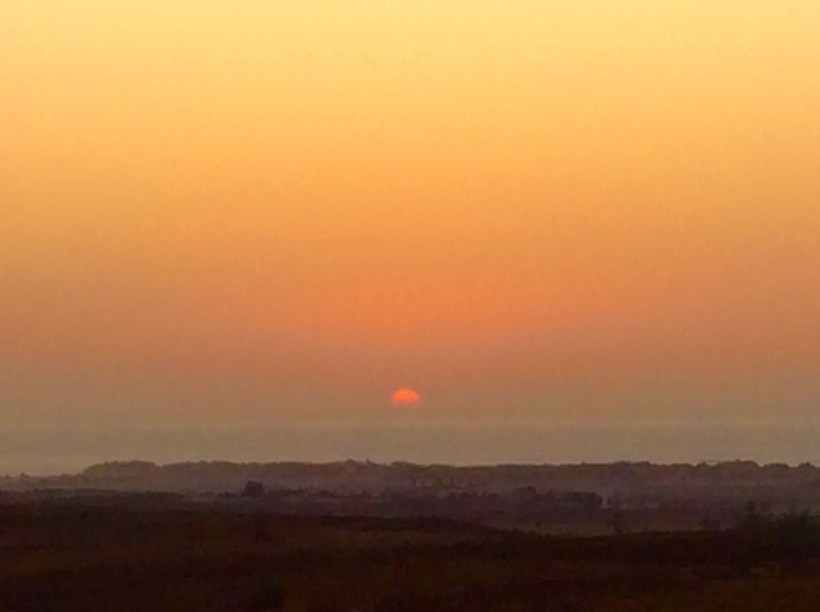
Like most evenings, we watched from our balcony as the sun dissolved into the Atlantic and washed its dissipated color into the clouds. We heard the Call to Prayer in stereo from the mosques north and south of our campus. And we waited for Audrey to receive an email or text with news from the devout staff mother.

People called and texted and emailed, “Any word yet about school tomorrow?” Not yet.

Charlotte, who planned to phone tree news to her classmates once The Call came, had gone out with friends a bit before sundown and texted asking for news. No news. She had a vested interest in Muharram starting last night, because no school today would mean she could stay out later last night. She texted again. Still no news.

And then it came. Audrey received the email our longer-than-expected wait had led us to fear: No moon.

Let them know we’ve got school tomorrow,” she said with deflation, and the first texts to top administrators started to go out with a heavy resolution to disappointment in doing what any other day would have been an energizing day at GWA. Audrey texted Charlotte to share the news and tell her to come home. Brian started looking over his Tuesday schedule to see what evening preparations he needed to complete.

But then, just like the second round of scrolling on the eve of a sub-zero blizzard in Cleveland, when hopes initially dashed resuscitate as the thing the eyes so long to see appears, another email arrived with updated news: THE CRESCENT MOON HAD APPEARED! As we heard the mosques around us start their New Year calls, Audrey pulled the trigger on our SMS and other messaging to GWA’s families and staff. Then she texted Charlotte to present the update’s hairpin turn. At first, Charlotte did not know whether her mother was teasing her, then rejoiced in being able to channel the news to her friends. She sent Audrey a snap with a tear of happiness gliding down her cheek because she did not have to come home early. (Oh, to be a high school Senior with such cares.) As word spread, an avalanche of celebrations cascaded across the cyber land in emails, texts, snaps, and calls. One administrator texted to ask if we could still have admin meetings scheduled for today…Nope. Audrey smiled broadly and said aloud, “It’s officially Snow Dance time!

But this is better than a snow day. Brian has no snow to shovel. We have gorgeous weather instead of freezing temperatures. People can go hiking and surf, both of which we have no doubt GWA faculty and staff are doing today. The municipal coffers in Hay Hassani, the south side Casablanca neighborhood that GWA calls home, need not be depleted by overtime paid to snow plowers keeping the roads clear (unless they were clearing them of horses and dogs and cats and chickens and turkeys and donkeys and sheep). Instead of being shut up in our house, huddled around a fire to keep warm, we can go out to a matinée movie at Morocco Mall’s IMAX theater on English Movie Tuesday (which we planned to do until we saw the current film is about a megalodon that appears from the depths of the ocean to attack a submarine and menace the deep blue waters…No thanks). Best of all, no one can criticize the administration’s decision based on differing views of whether there was enough snow or it was cold enough. The moon appeared…mic drop.

And so we have a very pleasant Saturday cleverly disguised as Tuesday. The start of Muharram took us back last night to midwestern winters and the school closing game; but this is better than a snow day. We appreciate the midweek break, especially coming earlier than we had expected, and we wish our Muslim friends and coworkers Happy New Year.

On your mark…get set…here we go!
Les Ventilateurs de Plafond

This morning Brian awoke very early despite, or maybe because of, the continuing Eid al-Adha holiday. The smokey haze covering the land, residual from nights of charcoal braziers roasting sheep parts over open fires, carried a pungent earthiness that marked the ongoing celebration of the Feast of Sacrifice across Casablanca, Morocco, and the Muslim world. This major of two Eids recalls how Ibrahim (Abraham) was willing to sacrifice his son in obedience to God before God stayed his hand and provided a lamb that he sacrificed instead. Unfortunately, the roasty smoke smell wafting through our open windows and sliding doors this morning provided Brian with a migraine that woke him unhappily. He popped a couple Tylenol, generously brought over for us from the U.S. by Becky when she arrived last month, and went back to sleep. Waking again a few hours later, he felt much better and the earthy haze had settled back into the ground to make way for another beautiful day.

As we draw close to the end of our third summer in Casablanca, we feel quite spoiled to have enjoyed this one’s weather. While winter ran long, progressing slowly into a cool spring, the tradeoff for a cool climate late harvest from our balcony garden has been an otherwise delightful summer.

Two years ago we arrived on a hot and humid night, followed by hotter and humid days and nights that reminded us of our time living in Louisiana…except that in Louisiana we had central air conditioning, whereas Moroccans eschew air conditioning due to a standard belief that having (what Americans consider) refreshingly cool air blowing around a room makes one sick. The apartment buildings at GWA stand at a perfect angle to catch the ocean breeze blowing up the hill year-round, so leaving doors and windows open to invite the breeze inside our Moroccan concrete walls knocks the thermometer down a few degrees. But when temperatures approach high 30s Celsius (nearly 100°F) with humidity well over 90 percent, that does not help much. We survived days in our first summer with floor fans that we bought at Carrefour Hypermarche, our own Walmarty superstore, but we found most nights fairly miserable through August and well into September.

As our second Casablanca summer approached last year, and as we decided we would keep our balcony sunset view by planting long-term in our on-campus apartment, we decided also that we should install ceiling fans to make summer’s hot and humid days – and especially its nights – more bearable. We looked everywhere for ceiling fans that we could buy, but found only one warehouse type model with three spindly blades that hung several feet from the ceiling and included no lamp for illumination – not something that would work in a private home setting. We asked people we knew where we might find ceiling fans, and they seemed not to know what we meant. Apparently, fans in Morocco stand on the floor, on a table, or on a dresser. They do not hang from the ceiling, or le plafond. One guy said he knew someone who knew someone who might know where in Morocco we could procure ceiling fans, but eventually that lead dwindled to nothing as well.

Then, that July, we headed to the Dordogne region of southwestern France for a month of intensive French study as a family. While there we again explored ceiling fan options, and again found les ventilateurs de plafond to be a foreign concept. We found no shops selling ceiling fans in the hamlet of Sainte-Eulalie-d’Eymet where we stayed or in the nearby village of Eymet where we spent many afternoons. We found nothing two hours west in Bordeaux when we had a weekend wine junket there. We struck out in Bergerac a couple times that we shot north a half hour to stake out Cyrano’s territory. Nearing the end of our stay, we looked into buying ceiling fans on Amazon and having them delivered to our host family, but had not enough time to guarantee their delivery before we would depart on our journey back to Casablanca. Not wanting the quest to dominate our closing days, Audrey wavered in her resolve; but Brian’s determination encouraged one last trip to Bergerac to try one last Lowe’s-type store called Tridôme the day before we started driving from France to Morocco. Walking in, Brian asked the first Tridôme person he found, “Avez-vous des ventilateurs de plafond?” Following the seemingly-helpful person’s directions, we landed in a spot that had fans…but not ceiling fans. Foreign concept strikes again. While Audrey pronounced the quest failed, Brian grabbed another Tridômer to ask again, “Avez-vous des ventilateurs de plafond?” He told us to go clear across the store, requiring a solemn promise from Brian to Audrey to quit the pursuit if this last location again resulted in nothing more than extra steps on Brian’s Fitbit and one more confirmation that the world did not know what a ceiling fan was. We trudged across the store to the designated aisle, looked around, and saw no ventilateurs de plafond on the shelves.

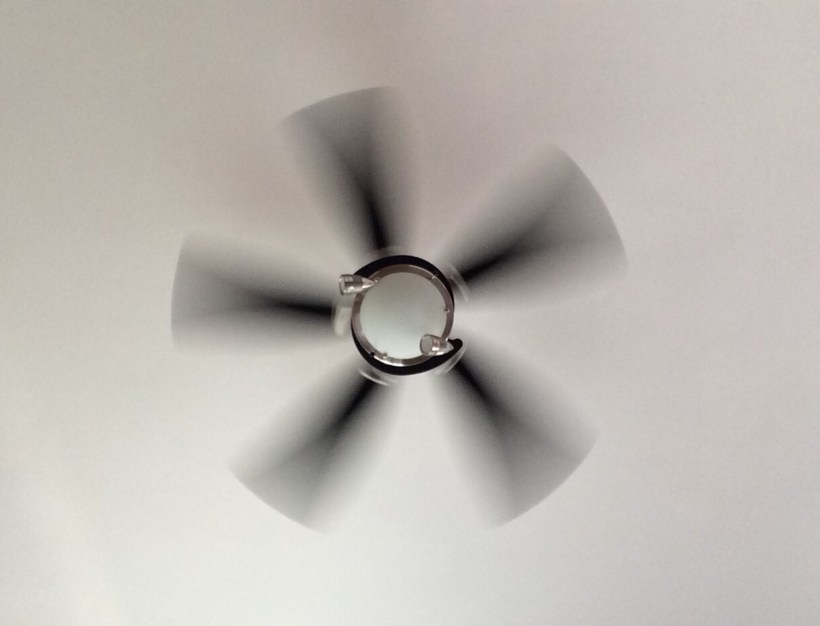
But then, just before conceding defeat, Brian spotted a small and random collection of les ventilateurs de plafond in a stack on the floor in the middle of the aisle: three models, one of which looked exceedingly ugly, one like a small airplane propeller, and one that seemed OK but took an usual size/wattage halogen bulb. We grabbed one small propeller fan for our bedroom, and the only two strange halogen bulb fans for our living room and dining room. Our resulting giddiness lasted much of the two long days driving back to Casablanca, and when we arrived home we called Thamy (Tommy) our handyman to install them dans notre plafond (in our ceiling).

So for the last year we have had what may be Morocco’s only ceiling fans. We used them constantly in August and September last year after Thamy installed them. This year, because we have had such accommodating weather, we have needed them only four or five days all summer long. Yet, we have kept them spinning for much of the summer because we can…because we have them. Just knowing they look forward to welcoming us home after long days and to serenading us to sleep with their low hum white noise makes those few hot days we have had this summer less intimidating.

We have not located a source for the odd halogen bulbs either locally or internationally, though each time we travel we inquire at whatever hardware store we may find around us. No luck in Spain, Belgium, Denmark, Cyprus, or Italy. Last December, Brian bought the right shape but wrong wattage bulbs at the famous Hardware Sales, Inc. in Bellingham, Washington. He was sure that they would fit, but doubted they would work successfully. He was correct. Loading a bulb into the fan above our dining room table and flipping the switch, it flashed and died from the excessive wattage. Through our ongoing travels, we will continue to hunt for 80-watt halogens that fit the ballast of our living room and dining room ventilateurs de plafond. Meanwhile, they both have LED spotlights, plus we have other lamps that provide sufficient illumination in those rooms. As our friends in Louisiana say, “It’s all good.”

On your mark…get set…here we go!

Brace Yourself!…Time for the Dentist

Tonight Brian grilled a beautiful steak to share; Audrey made a spectacular pasta dish with bacon, peas, and leeks; we enjoyed a nice Bordeaux procured from our friends at Grand Sud Import; all prefaced by a spectacular Italian prosecco that we brought back (ironically) from France last year, some strawberries dropped into the flutes to give the wine an extra special touch. We are celebrating our 22nd anniversary, though the actual date was on Friday, August 10. Why the delay of two days? Not because of new faculty/staff orientation last week and Admissions testing commitments yesterday, but because on Friday Audrey could not chew.

First some context: Week One of new faculty/staff orientation – CHECK.

All our newbies arrived safely and in time – if jet lagged in some cases – to kick off the two week orientation program last Sunday with some icebreakers and a “Welcome!” BBQ. Everyone in the administration and HR involved with orientation thinks it is a particularly good group that brings a broad array of experience, knowledge, and skills to their teaching and staff roles from locations around the world: two dozen people coming from at least seven countries on three continents and the Middle East. With that spread, the most common place of origin in the group is…Minnesota?! (We find that particularly interesting, since we both have family ties back to the Land of 10,000 Lakes.)

On Monday Audrey welcomed everyone again as they began learning about Morocco, Casablanca, and GWA. By far, the favorite part of orientation for newbies and veterans alike is the collection of Leadership Reflections that start each morning as members of the Senior Leadership and Academic Teams share a bit about themselves, their journeys to Casablanca, and their insights into education and into GWA. In this series of reflections, an administrator from Oklahoma each year reveals her proud heritage by playing the title song clip from the 1955 Shirley Jones/Gordon McRea movie of the classic Rogers & Hammerstein musical. This year – while Curly, Laurey, and cast sang, “We know we belong to the land, and the land we belong to is grand!” because it produces tomaters and potaters – Brian observed one new teacher from Italy as he tried to square the first few days amid his new expat peers with the petticoats, rancher hats, and cowboy boots he saw dancing and singing on the screen. As the clip finished, Brian made Audrey laugh herself silly when he piped up to say to the proud Okie presenting, “I think you just rocked Alessandro’s world.”

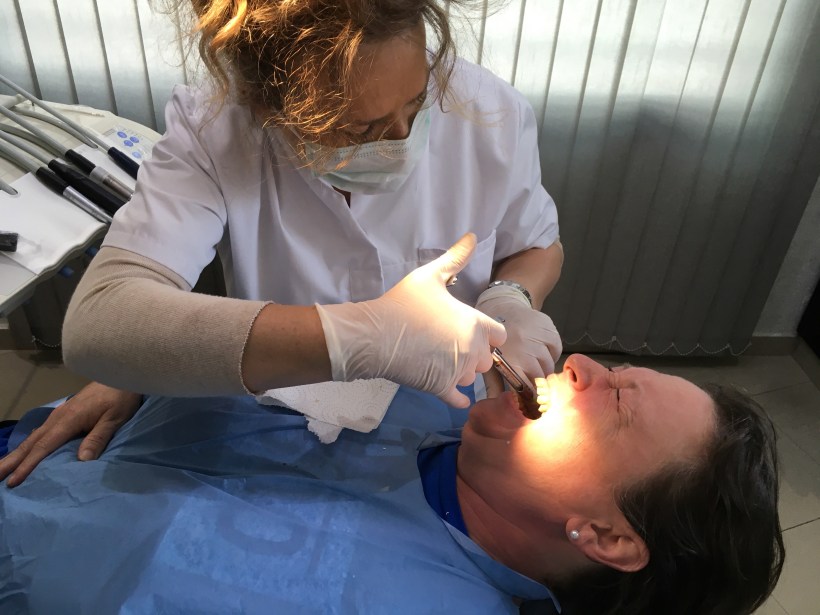
But this week the new crowd learned more about Audrey than just what she shared in her own reflection a few delays before the Oklahoma chorus. They also learned that Audrey HATES going to the dentist. They know this because she told everyone she encountered at school that she hates going to the dentist. She hates it so much, in fact, that until a week ago she had not paid a visit to one in eight years. Needless to say, the toothache and abscess that finally prompted her visit ended up being just the tip of the incisor…er, iceberg. We made three visits over one week, and she still has at least one more visit to finish the oral equivalent of Boston’s infamous “Big Dig” public works project.

Notice the “we” in that description of the visits. That is because Audrey, they bold and confident Head of School, becomes a timid and scared kid who needs Brian to hold her hand during trips to the dentist. Somehow no matter how kind and gentle a dentist is, all Audrey sees is a new embodiment of Steve Martin playing the Dentist in “Little Shop of Horrors” and singing…

That’s when my momma said

She said my boy I think someday

You’ll find a way to make your natural tendencies pay

You’ll be a dentist

You have a talent for causing things pain

Son, be a dentist

People will pay you to be inhumane

Your temperament’s wrong for priesthood and teaching would suit you still less

Son be a dentist

You’ll be a success!

I am your dentist

I enjoy the career that I picked

I am your dentist

And I get off on the pain I inflict!

I thrill when I drill a bicuspid

It swells and they tell me I’m mad

…and so on.

It all makes sense, considering that as a Marine Corps kid her experience with dentists meant going to the dentist on whatever base where she lived and getting drilled by military dentists without Novocain. So each trip to our Moroccan dentist means Brian comes as well and contorts himself to reach over the spit bowl to hold Audrey’s hand while the Marquee de Sade has at it.

In truth, this dentist is actually quite wonderful. We found her through Charlotte’s orthodontist (whom Charlotte quite adores because they sing together in Arabic while her braces get tightened). The dentist comes to the orthodontist’s office one or two times each week to take appointments, and she is as positive and understanding as the wonderful orthodontist. She has limited English, but between her limited English, our limited French, and the universal language of “OWW!!!” when the Novocain has not yet kicked in fully, it all works out. For reasons we do not know, she usually asks Brian how Audrey is doing, leading to interesting conversations like:

“Veut-elle une autre injection?”

“Non, elle n’aime pas les injections…Mais elle aime les injections plus qu’elle n’aime la douleur.”

(Does she want another shot?

No, she does not like shots…but she likes shots more than she likes pain.)

When Audrey first met her, Audrey told her that she loved the idea of sedation dentistry. The dentist responded that sedation was not necessary; she would be gentle and take very good care of her, and Brian was welcome to hold her hand through the whole encounter. Then she took Audrey’s panorama X-ray and poked around in her mouth. At the end, she proposed a plan to address the toothache and abscess, and also to replace several decades-old degenerated fillings and crowns. All told, it would take three more visits and cost 27,000 dhs (about $2700, which is $200 more than Charlotte’s entire experience with braces are costing us), and if she found anything more along the way she would just take care of it as part of that package. After gulping hard at the unbudgeted outlay, we scheduled the next appointment and went home to do some comparison shopping. How wonderful to discover that all the work proposed would likely cost over $10,000 USD in the States. So it made sense when a friend of ours told us about a “vacation dentistry” situation in which someone he knew flew his son back to Morocco from the U.S. to have dental work done because the cost of the trip plus dental work totaled less than what doing the work in the U.S. would have cost, and his son got to visit with friends while back in Morocco. Anyway, once she got started with Audrey’s mouth, she did find more things to do – ended up doing several root canals on top of other fun things – but charged not one dirham more.

Besides Audrey’s dental avoidance, Charlotte and Brian also have not seen a dentist since arriving two years ago. We wanted to find the right person, and we had heard bad stories about people having teeth yanked because that is what dentists in Morocco do. Indeed, that cut-rate activity exists here, but our sheltered worries kept us from exploring the many viable options that exist for expats seeking a certain degree of cultural comfort. Once we found someone with the combination of dental and language skills and necessary “bedside manner” we were game to move forward with Audrey, and Brian and a Charlotte will follow.

When Audrey sits in the chair, the dentist reassures her that everything is fine and welcomes Brian to hold her hand if she wants. Then she gets to work, smiling, speaking with a cheery tone, all the while wrestling with Audrey’s mouth like there is an alligator loose in it that needs to be brought under control, only to repeat after drilling and filling that everything is fine.

“Aucun problème. C’est bon. As-tu mal?”

(No problem. It is good. Do you have pain?)

After our first visit, Brian said to Audrey, “I never knew you could stick a wire so far up into someone’s jaw without puncturing the brain.” That probably did not help much with her dental phobia. Still, it amazed him nonetheless.

So on Friday, following her third oral excavation in a week, with wires having been shoved into her jaw and twisted around and around for root canals, Audrey thought that the best celebratory anniversary dinner she could handle on Friday night was a bowl of Top Ramen served with the hope that we could do something more celebratory soon. Fortunately, today she was game to have steak and pasta before the fun starts again in a couple days.

We are pleased to have found a great dentist. We are pleased that she is much cheaper than doing this in the U.S. would be. And most of all, we are pleased that Audrey got the care she needed with the degree of confidence we needed to have her go, and the openness to having Brian hold her hand through it.

Happy 22 years!

On your mark…get set…here we go!

Welcoming the Newbies

On Saturday we took Becky, GWA’s new Upper School Principal, to tour the downtown apartment of Dave, GWA’s new Director of Finance & Operations, and to get a tour from Dave’s rooftop of the neighborhood he is coming quickly to love – grocery store across the street, coffee shop around the corner, pâtisserie a block away, lots of restaurants with different cuisines, etc. The rooftop tour included seeing the numbered water stations – assigned like parking spaces in the garage below the building – for washing one’s sheep after killing it for the Eid al-Adha celebration coming next month, or for any other occasion (like celebrating the birth of a new child) that might require killing, cleaning, and roasting a sheep. Though Dave made two trips to Casablanca through the Spring to begin transitioning into his role and arrived permanently in early July, his apartment remains – by intentional spousal consideration – a bachelor pad while he waits for his wife to arrive from Washington State in time for next weekend’s start to our New Faculty & Staff Orientation. When we had toured with Dave and admired his very own rooftop water station, we brought them both to Grand Sud Import, our favorite place among Casablanca’s limited locations to buy wine. After stocking up, with Fareed marking Dave’s boxes with “D” and Becky’s boxes with “Bacy” and Brian’s boxes with “K” because he though Brian was another GWA administrator named Kevin, and enjoying the Moroccan tea that Fareed served us while we were there, we all went to lunch at Au Four A Bois (literally “In a Wood Oven,” a great French-named Italian restaurant by the U.S. Consulate); took Dave home; then introduced Becky to weekly shopping at Carrefour Gourmet, a mini-Casablanca version of Whole Foods and our default one-stop shopping place when we do not go to the souks and hanouts for comestibles, so that she can feel confident about basic survival in Casablanca. It was a long day of chaperoning two new members of GWA’s Senior Leadership Team through their post-arrival adjustments to Casablanca, and a good day of the same. This is what we do for “newbie” expats coming to GWA, and it gives us pleasure to do such things.

Over the next week our school community will welcome the incoming group of newbies joining us for the 2018-2019 academic year. This ritual marks the end of summer each year at GWA and international schools around the world. Following the yin of some people leaving at the end of a school year, the yang of summer’s end brings new faculty and staff for the coming year. We had about 45 newbies with us in our incoming class of new faculty and staff two years ago. Last summer, when we were one-year “veterans” who still felt like we had so much to learn, we welcomed a cohort of about 35 newbies. This summer, after working last year to improve stability and extend people’s tenures, we have only about 25 newbies arriving for our August orientation.

GWA does a great job orienting and on-boarding new faculty and staff. While many international schools offer newcomers an orientation of a couple days spent listening to policies and expectations while leaving new people to sink or swim adjusting to their expat lives, GWA spends two weeks acclimating new expats first to Morocco and Casablanca – complete with daily lessons in French and Darija, daily outings around town and even on the train for a day trip to Rabat (Morocco’s capital), and a variety of sessions about acclimating to life abroad generally and to Casablanca specifically – and next to life and school at GWA. Each day begins with a leadership reflection by someone from the Senior Leadership Team. And our HR and Staff Services folks show great care for helping our new expats adjust successfully to what will be their new home for the next two years (or more, inshallah).

This year, our Staff Services people formalized a Newbie Buddy program that had existed informally through recent memory, making sure to pair each new expat with a returning expat (or new family with a returning family) to help folks find their way to places to shop, make sure they have what they need to survive, serve as a friendly face with whom to share thoughts and concerns, and just serve as a general resource as our newbies get started as new members of our community.

We had kind people adopt us and daughter Charlotte upon our arrival two years ago, demonstrating good “pay it forward” behavior that we have replicated with our own flavor and style. With the formalization of such intentional welcoming, we volunteered to be Newbie Buddies for Dave and Becky. While the bulk of our newbies will land in Casablanca in the coming week before our August 6 startup to Orientation, Dave (coming from the U.S. where he did the same finance and ops job for multiple public school systems) arrived earlier this month and Becky (coming from an international school principalship in Shanghai, China) arrived last Monday. We fit well as their Newbie Buddies most importantly because we really like them and look forward to working with them on GWA’s Senior Leadership Team, but also because we were actually here when they each arrived, as opposed to most veterans who are still traveling or visiting friends and family during the Summer Break.

Last week while Audrey was the Summer Administrator on Duty for the week, Brian spent some time helping Becky get established. She arrived on Monday morning, when Dave (already getting into the pay-it-forward spirit) went with Abdellah, our Transportation Manager, to welcome her at Mohamed V Airport and bring her to her campus apartment. Brian saw Becky shortly afterwards when she came down the hill to pick up some bags she had left in someone’s office a month before durning a quick stopover in Casablanca on the way to a few weeks of vacation in the U.S. from her previous billet in Shanghai. She had engineered that quick stay to kennel her dog and cat here during her U.S. vacation. This proved to be a good call, subjecting not only her pets but also her fellow passengers to only one pet airline junket. Leading up to her Chinese departure with them she spent uncountable hours getting all the shots, paperwork, and other bureaucratic requirements to bring the pets to Morocco. During the journey from Shanghai to Casablanca, her dog travelled crated in baggage but her cat – much to the chagrin of her cabin mates – went in a travel bag with her on board and “yowled” for the entire 10-hour flight. Then when she landed, she found her pup-in-crate had ridden the circuitous route of the baggage conveyor belt the entire time it took for Becky to deplane, walk through the terminal, get through Passport Control, pass through a final security checkpoint, and finally get to Baggage Claim to retrieve her dog. To top it off, after all the effort and time to clear the path for her pets to win immigrant status in Morocco, no one checked her pets’ paperwork. As she wheeled her collection of bags and pets through the exit and past the last security check x-ray machine that ensures people do not bring more than two bottles of alcohol each into the country, she wanted to grab someone, thrust the paperwork in his official face, and say, “LOOK AT THIS…MY PETS ARE LEGAL!”

Anyway, when they met on Monday morning, Brian took a break from an Admissions & Marketing strategy meeting to welcome Becky “home” and scheduled a later time when he could run various startup errands with her. In the afternoon they joined up for a run to get the pets and, on the way out to the apartment buildings’ parking lot, took care of another piece of startup business when they encountered the sister of our house helper – a chance meeting that allowed Becky to secure yet another sister as her own house helper a few times a week. Then we hopped into Becky’s car that she bought as a hand-me-down from an administrator who departed in June and set Google Maps for a jaunt to Cabinet Veterinaire La Corniche to pick up her dog and cat. Because she had not driven a car with a stick in years, Becky’s first encounter with Casablanca driving required not only norming with the standard roadway etiquette here (see our previous post on driving in Casablanca from our own newbie experience two years ago), but also doing that while reacquainting herself with driving a standard transmission vehicle. Not far from school, but a world away, Becky drove up a narrow road of varying severities of “narrow” with a fair bit of traffic coming the other way, requiring her at one point to stop, back up to a wider part of narrow, then have a “You first…no you first,” pantomime conversation through windshields five meters apart. Add to that all the pedestrians sauntering along the small road as if they had right of way to everything (because they did) with the car’s clutch not a friend on the ascending incline. Slowly, she went up a little further and saw the sign for Cabinet Veterinaire La Corniche and pulled into an open dirt space with cars parked, having to navigate around a small goal that designated one end of an otherwise unmarked dirt soccer pitch and circle back to where the cars were parked. Entering the metal gate of the kennel, Becky successfully secured her dog and cat from the genial and smiling staff that had no English, and took them – cat yowling the whole way – back to campus.

After Becky and Brian introduced the pets to their new home, even enticing them onto her third floor balcony to survey their new domain, they headed out again so that Becky could buy pillows at Morocco Mall as the final requirement for a much-anticipated sleep after having been awake for more than 24 hours. She drove with increasing adeptness with the clutch through Casablanca traffic, with cars and trucks and scooters and tissue boys and all the other daily highlights weaving around her, negotiating roundabouts with right-of-way rules that some people follow and others do not, and with cars and trucks and scooters and tissue boys encroaching from left and from right into lanes where she drove. She passed Snail Corner and turned toward Morocco Mall, drove the length of the mall and looped around the roundabout by the IMAX theater because one cannot make a left-hand turn into parking, chugged back up the rise, made the right-hand turn into parking and got a nod from security to proceed past the vehicle check point (being profiled as an expat has its privileges) and down to the underground lot. Along the way Brian told her that Morocco Mall is Casablanca’s high end Mall, with Anfaplace by the Corniche being less pricey. The first stop was BMCE Bank, where Brian explained his confidence in some unknown-to-us logic about tellers sometimes being present to facilitate cash withdrawals or exchange money and sometimes not, and sometimes tellers being present but responding to a request to make a withdrawal by explaining that they have no money available to be withdrawn. (In this case, no tellers present, but happily the ATM had cash for withdrawals.) On the way up to the mall’s second floor (or, in non-U.S. terminology, the first floor because one goes up one floor from ground level) they waded through a parade of people led by a very loud drum corps dressed inexplicably in green and yellow Brazilian national colors and waving large Brazilian flags. Rising on escalators above the din of drums, Brian led Becky to a French home store in search of pillows. The French home store, naturally, had neither pillows nor anything related to bedrooms. Next door stood a Moroccan home store that did, indeed, have bedroom supplies. Becky found a pillow sample she liked and asked a clerk if they had more than just the sample. The clerk spoke no English, but communicated that he understood and that he could retrieve the four pillows she wanted from the storage room. He then disappeared for 15 minutes, returning at last with one pillow that was not the kind she wanted, apologizing that they actually did not have a supply of her pillow of choice but should have some soon…inshallah. Becky asked Brian if they should just comeback another time, to which Brian said that someone who always leaves to come back another time to get something not available when they want it will never buy anything in Morocco because each time one comes back there will always be another delay. Instead, Brian suggested going to Marjane, a superstore in Morocco Mall (and elsewhere) akin to the Walmart-like Carrefour Hypermarche. Exiting the Moroccan home store, Brian directed them to the far end of the mall, “First because that is the direction of Marjane, and more importantly because that route takes us away from the Brazilian drum corps” that had settled in the central court of the mall.

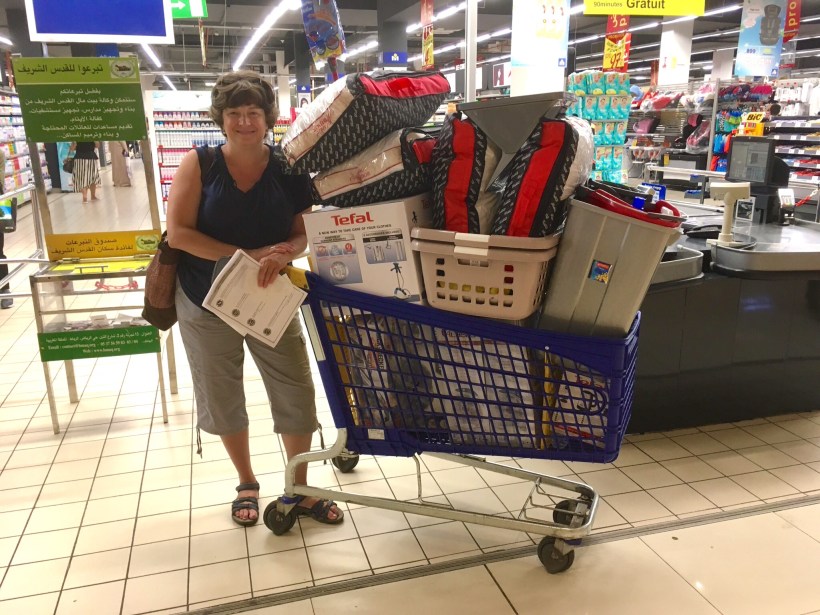
So downstairs they went to Marjane in search of pillows. Then it happened…that moment in a newbie’s new reality when they see the confluence of all the things they think they need for setting up their new home with the opportunity to procure such things. It might happen at Carrefour Hypermarche. It might happen at IKEA. It might happen on a street with various hanouts with different specialties. For some, it might even happen in all those places. It is at once an intimidating yet glorious and triumphant feeling as the newbie processes all the things they want but did not know where or when they would find them, laid across a mental landscape painted by the often-shared encouragement from veterans to buy whatever you think you might need when you find it because later when you KNOW you need it you likely will find it gone. (Hint: When you arrive in Morocco in August and see fans in the stores, buy however many you want then instead of thinking you can wait a week or two to get settled and then buy them.) For Becky, it happened in Marjane. Entering in search of pillows, she first stopped by the fans and – with Brian’s encouragement – put two into her cart, then metagrobolized her way into buying laundry baskets, a steamer, a vacuum, an iron and ironing board, mop and bucket, floor cleaner, garbage pail, etc. With a full cart, they started toward checkout when Becky remembered…she still needed pillows. With a quick flank across a few aisles, the capture of four nice pillows, and steering an overflowing shopping cart, Becky declared victory in her two hour startup campaign and headed for the checkout aisle.

Once back on campus, Becky hauled her victory spoils up to her apartment, then we took her to dinner at Le Relais de Paris, one of our favorite restaurants between the Corniche and the Casablanca lighthouse. From arrival to pets to house helper to supplies, she had achieved a very successful day – all after a red eye flight from the U.S. – and deserved not to have to worry about what to prepare for dinner. Besides, we knew she still had a long week of settling in ahead of her, among other things as she sought to claim her shipping container – sent from China with an apartment’s load of furnishings and supplies – from Customs at the Port of Casablanca. That proved to be another entire story unto itself, full of stereotypically Moroccan quirks and officials battling each other in a bureaucratic turf war navigated for Becky by GWA’s guardian angel in bureaucratic entanglements. It ended on Friday, though, with another victory when a semi hauling her container climbed the hill and a team of hard-working guys hefted 46 boxes and crates up three flights of stairs to her apartment. Best of all for us, we got to retire our status of being the people who brought the most to Morocco, with her 46 boxes and crates trumping the 25 boxes and bags that we checked onto our Royal Air Maroc flight two years and ten days ago.

Everyone starting their own expat expedition in Casablanca has their unique experience. Yet, whatever the particular details, everyone’s seems to share some version of a meandering tale that blends excitement and obstacles and jet lag and fulfillment and bureaucracy and hucksters and shopping and fascination and exhaustion and achievement and new people and craziness on the roads and tea and sheep/donkeys/chickens/cows/turkeys and the welcoming spirit of Marhaba that makes moving to Morocco such a wonderful thing. We love living here, and we love welcoming others joining us from around the world to share our expat expedition with them and theirs with us.

On your mark…get set…here we go!
MASSIVE DECOMPRESSION

Three months flew by since our last post as we finished our marathon sprint through the end of the school year. Now well into summer, over the next few short weeks we will welcome the incoming set of faculty/staff/administration newbies to join GWA, with much big picture and strategic work to do before new staff orientation begins in August. With a great need to process one year’s closing activity while making a new year’s startup plans, we took advantage of the brief nexus between the two to implement a rapid “massive decompression” phase that first got us away from school and then allowed us enough time upon return to retrench for what lies ahead.

The 2017-2018 school year proved brutal – not in substance, but in pace. Its constant and frenzied activity started in August and continued through June. Everyone felt it, perhaps especially GWA’s leadership team. Such is often the case in the first year of transitions, and the progress achieved proved very satisfying. But the body and mind can take only so much, and we needed the opportunity to process all that happened and all the changes that resulted. Our second year abroad offered us insights different from Year One. Leading the change with Audrey as the “buck stops here” Head of School and Brian overseeing institutional advancement efforts is different from merely contributing toward change as we did in Year One. As we have experienced repeatedly at other schools where we have each been heads, the job has to get done. So at the end of the day, we often find that “the end of the day” is a lot later than we would like. And weekends might last only for a few hours on a Saturday or Sunday afternoon amid other school responsibilities. Moreover, even after we leave work and walk the 300-step commute from our offices to our delightful apartment, we have to be diligent about not continuing to talk shop too much through our evenings. As much as we love what we do, we need to recharge periodically to stay fueled for the 60-80 hour weeks we typically invest in helping GWA achieve its Vision Statement to equip minds and build character so that our graduates can serve Morocco and the global community with wisdom and compassion. The Fourth Quarter was a blur, as was Graduation…both things through which we had to steer more than things we could enjoy with people we enjoy.

Then we had the goodbyes. GWA stands as no exception to the modus operandi of transitions at international schools. Like last year, we had to say goodbye to good people in June. But goodbyes in Year Two overall came with greater difficulty than in Year One. In addition to a number of faculty, some of our senior leadership people who had been here for as long as half the school’s life decided it was time to move on to the next chapters of their own lives. Saying farewell to people who had helped us with our transition to Morocco and GWA and who made administration here both more successful and more fun hit us especially hard. Additionally, our own transition into next year no longer has the sheen of combined excitement over having survived our first year and eager anticipation over taking the helm as we steer toward the future. The year was good, but the honeymoon is over and the hard work continues into next year. And the end of the school year was so busy that we barely had time to say goodbye to these people who mean much to us before they disappeared from our daily lives.

Through all this, we craved time to process all that happened in order to assess what went well, what we could improve, and what greater significance of things we should maintain for broader context. But the pace of closing out the year simply did not afford us that luxury. So we snatched the opportunity available to us as soon as the year finished and escaped to Umbria, our favorite part of Italy.

While our rising-Senior daughter went stateside to visit grandparents, aunts and uncles, cousins, her working-college older sister, and pre-Morocco friends, we secured a 624 square foot 11th Century house in the heart of the Medieval sector of Orvieto, Italy, on Bookings.com, and spent two weeks exploring Umbria, Tuscany, and Lazio. It served as a vacation, but also as a first stage exploration of potential retirement locales. (We plan to be in Morocco for the next 10 years, then find another school opportunity to call Home for the better part of the next decade until we reach retirement age. So we have lots of time, but it never hurts to start the due diligence work to ensure we land well.)

Italy was great, and we turned off as much as we could. A couple school Skypes and keeping tabs on emails and texts, but mostly steeping in the history and natural beauty around us in Orvieto, Assisi, Spoleto, Gubbio, Lago di Trasimeno, Montalcino, Lago di Bolsena, and more. Brian has long felt a strong connection to St. Francis of Assisi, who from 1206 until his death in 1226 lived his vocation commissioned by the Cross of San Damiano to rebuild the Church (founding along the way the Order of Friars Minor, the Order of Poor Ladies, and the Third Order for lay people). We satisfied our “foodie” selves by shopping at local public markets to cook delicious meals at the house, as well as sharing multi-course lunches at restaurants in the towns we visited as our main meals of the day. And, of course, there was gelato…and more gelato. Perhaps that explains how – according to Brian’s Fitbit – we could climb 500 flights of stairs, walk 158,000 steps, and cover 70 miles on foot in two weeks without losing any weight before we came home. People keep telling us that is because it turned into muscle. Yeah, we have LOTS of muscle. Besides feeding our bellies, we fed our minds with great history – Etruscan, Roman, Feudal, Church, and more – everywhere we went. And we fed our souls as we followed St. Francis loosely through the region. It was not a true pilgrimage, but at times – such as when we looked into the original eight foot square cells of a hermitage Francis had built with his friars on a mountaintop overlooking Spoleto in 1218, and when we joined a small group we happened upon saying the Rosary in the Porziuncola below Assisi that he rebuilt by hand and where he died in 1226 – it had that feel. For the first time in months we allowed ourselves to be completely in the moment and enjoy fully what we experienced, rather than never escaping completely from school affairs.

Yet, the time away merely gave us the first part of what we needed. Massive decompression requires more than turning off. The purpose of the decompression is to create a circumstance with the time and space to process what previously the lack of time and space did not allow to process. We had a great trip; we saw and did much; we fed our bellies, minds, and souls. We recharged. But we boarded our flight home at Rome’s Leonardo da Vinci airport merely pleased to have enjoyed a magnificent two weeks, but not having processed what we need to process.

Arriving late on a Saturday night, we came home to find our apartment a mess, our car in pieces with the mechanic, and a lot on the agenda to tackle for the new school year. But those seemingly disappointing things catalyzed the processing we needed. Our wonderful house helper was midway through her summer deep clean of our apartment and did not realize we would return as soon as we did. We did not even have a bed in which to sleep because she was airing out the mattresses. So we rebuilt our bed and threw sheets on it. It was hot and humid, so we had three fans blowing on us as we slept. We drove a school car to shop the next day to put food into our empty refrigerator. We bade farewell to the stay-in-your-lane order of driving in Italy and reacclimated to driving with donkeys and vehicles going the wrong way in Morocco. We bought fresh produce and other groceries for cheap and delicious meals that we took the time to cook and enjoy fully, still bring in the moment. We were happy to be home.

And the cleansing time in Umbria washed away the built up residue so that we could finally process the now-finished school year. In the week since we returned, while we worked in our offices and at home, as we technically were still on vacation we did not hold ourselves strictly accountable to GWA’s summer hours schedule. We processed the year. We planned for the coming year. We played cribbage. We cooked and ate. We took naps. We had a quiet celebration of Audrey’s 50th birthday, going to Chez Marie Jean (one of our favorite restaurants) for a Funk Party where we were the only people who danced as the DJ spun James Brown and Kool & the Gang on vinyl. We gave ourselves the time and space back at home that we needed to complete our recharge and to process all we needed to process.

We loved our time in Italy. Someday we may retire there. For now, we love living in Morocco and feel richly blessed in so many ways – apartment, food, cost of living, transportation options, sunsets: the ability to feed ourselves a splendid meal and enjoy it together as we watch the sun set over the Atlantic Ocean. Thinking back to our lives exactly two years ago, as we put the finishing touches on our preparations to start our lives in Morocco, so much has happened and so much has changed. We are at once the same people we have always been, and are different at the end of our second year here than we were at the end of our first a year ago let alone two years ago before we left the U.S. to begin this adventure.

We will miss our friends and colleagues who have left. We will tackle the summer agenda to prepare for the 2018-2019 school year. And we will welcome the newbies who currently prepare for their own arrivals to Morocco and GWA with a likely mix of excitement and a little apprehension. As we prepare to start our third year of this Expat Expedition, we feel more like the veterans we did not feel worthy to call ourselves last year. And we continue to feel blessed to live in Morocco.

On your mark…get set…here we go!

Marhaba Abroad: Meeting Moroccans When We Travel

Spring Break began at GWA when classes finished last Thursday. By 10:30 pm (or 20:30 in the format much of the non-American world uses) we had hopped into our car to drive to Mohamed V Airport in Casablanca to fly to Cyprus so Audrey could attend the annual Directors Meeting of the Mediterranean Association of Independent Schools. Of course, already at the end of a long day, that actually meant a few minutes shy of 24 more hours of travel time to drive to the airport, go through layers of security, fly to Frankfurt in Germany, fly to Vienna in Austria, fly to Larnaca International Airport in Cyprus, and drive to the Hilton Cyprus in the Capital of Nicosia where the meeting takes place.

Our first education about Cyprus was that driving from Larnaca, at a distance of 48 km from Nicosia, fortunately took half the time it would have taken to drive from Ecran International Airport even though Ecran is only two-thirds the physical distance from Nicosia. Our second was that there is some question as to whether people flying into Ecran, lying well into the “Turkish Republic of Northern Cyprus” (occupied by Turkey since its invasion of the island in 1974 and recognized worldwide only by Turkey), may have difficulty entering either the Republic of Cyprus or Greece because of the TRNC stamps in their passports. So we arrived at our hotel, weary but happy with our ROC stamps to add another country to each of our passports. We checked in, and George the Bellhop pointed out shortcuts and other special hotel clues as he led us and our bags down a grand marble hall, through another magnificent lobby, and up a fancy glass elevator to our room where we could settle into our digs for the next few days.

Knowing how exhausted we would be after traveling so long, we had opted to arrive a day in advance of Audrey’s meetings commencing so that she could catch up on sleep before meeting up with the other MAIS school heads. The bonus for that was that we had an evening on our own to relax and to find the grilled meats for which Cypriot cuisine is famous. We both jumped into Google to find options, and both came up with the same top recommendation: Πιάτσα γουρουνάκι, or Piatsa Gourounaki, or Pork Square. Excited by the combination of top recommendations and the mere $ notation (Audrey usually likes the $$, $$$, or even $$$$ ratings, “but my favorite is $$$$$,” she added), we wrote the address on a piece of paper and called down to the front desk of the hotel to request a cab. Arriving at the front doors minutes later we found the cab already waiting. We got in and asked the driver if he knew where Πιάτσα γουρουνάκι was. “Of course,” he said. We asked if he had ever eaten there. “OF COURSE!” he said more emphatically. “Everybody eats there,” he told us. He usually gets the chicken, but we should get the mixed grill for two in order to try everything. Stopped at a red light, while we kept trying to reprogram our brains for traveling on the left side of the road in this former British colony, he drew us a map to show us how we should walk from the church where he would drop us 50 meters to our gastronomic destination.

Emerging from the cab in the Old City and walking up the pedestrian path we found the spot easily, as much by its sign with the bowtie-wearing pig as by the crowds that filled the outside square at simple wooden tables and chairs with delicious grill-aroma food piled in front of them. We ordered the mixed grill for two, an appetizer of baked goat cheese wrapped in phyllo and covered with honey and sesame seeds, and a carafe of local Cypriot wine. The scene reminded us both of a June evening we spent 15 years ago in the Italian hill town of Frascati, overlooking the lights of Rome about 30 minutes to the northwest, eating slices of roasted pork served on newspaper and Frascati wine in plastic cups procured from a street vender’s cart. Like that night, this slice of Nicosia included a wide swath of people, from young to old, well-dressed to raggedy jeans, singles and groups and families with strollers and older children. Just as our cabbie said, everybody eats there.

So, like everyone else there on the south side of Nicosia, we ate…and ate…and ate. And just when we felt about to burst a waiter we had not seen previously came to our table by mistake to drop off someone else’s order of fries.

What a happy mistake, because – much to our surprise – the waiter was none other than George the Bellhop who recognized us immediately as the couple who had arrived from Casablanca earlier that afternoon at his hotel. We joked with him about how when we got into a taxi after dinner to return to the hotel, we would not be surprised to have the driver turn around and reveal himself to be George once again.

George is a native Cypriot who helped us feel welcome in Nicosia. Often when we travel, though, that welcome feeling we get comes when we meet Moroccans who carry the Moroccan sense of Marhaba (“Welcome”) with them wherever they go. When we happen upon Moroccans outside of Morocco, two things typically happen. First, when they ask us where we live and we tell them “Casablanca,” they are surprised we said Morocco instead of America, and are not sure whether to believe us. Then, when we show them a carte de séjour (residency card, like a Moroccan “Green Card”) or otherwise convince them that we really do live in Casablanca, they fill with national pride and talk to us like we are long-lost family they are so happy to have found. It resembles our experience bonding with other Americans that we encounter overseas, except that now we are American expats living abroad whom Moroccans abroad accept as their own in an international Culture of Marhaba. Some examples…

Last summer as we drove in our Moroccan license-plated vehicle through Marmande in Southwestern France on our way to a month of intensive French study in Sainte-Eulalie-d’Eymet, a car zoomed from behind to run parallel to us while honking wildly. The front seat passenger climbed halfway out his window, displaying a distinctly Moroccan haircut as he waved exuberantly and pointed to our license plates while yelling, “MOROCCO! MOROCCO!” and giving two thumbs up. We did not get to stop and chat to confirm they were Moroccans; but the haircut, along with the revealing behavior, left little doubt.

Last October when we went to Portugal for Fall Break, we had the same Moroccan driver take us from the Porto airport to our Bookings.com apartment to start our trip, and from the apartment back to the airport to end it. He had been in Portugal a long time, and opened up to us with lots of suggestions on what to see and do during our stay after asking us where we were from.

In December, when Audrey and Charlotte spent Christmas in Amsterdam while Brian was with family stateside, they also had Moroccan taxi drivers who took extra-good care of them after learning they came from Morocco.

In February, when we went to Brussels for Administrator Training for the International Baccalaureate Programme, we again had Moroccan taxi drivers both from the airport and back to it again. Both drivers were born in Belgium; but, both went to Morocco multiple times each year to spend time with family, and they considered themselves Moroccan more than Belgian. As we rode, we talked and laughed about Moroccan drivers (who do not stay in lanes or lines) having an advantage in Belgium (where other drivers are very orderly), about Moroccan food versus European food, and about their families in different parts of Morocco (from Tangier to the Hay Hassani neighborhood of Casablanca where GWA’s campus is and which we call home). They said when they next go to Morocco they will find us at GWA and invite us to eat couscous with their families.

Which takes us back to our dinner of grilled meat at Πιάτσα γουρουνάκι. Just a minute after George the Bellhop-Waiter left us, another waiter sidled up to our table and asked bluntly, “Where are you from?” “Casablanca,” we replied. He said, “No, really, because you are making my hair stand up,” and he showed Audrey the goosebumps on his arm. Brian took out his carte de séjour and showed it to him. He beamed and said happily, “George told me there was a family here from Morocco but I didn’t believe him,” and then we talked for a few minutes about Morocco, his family in Rabat, and how when he next goes to Morocco he will come to Casablanca to find us and visit about Cyprus in Morocco like we talked about Morocco in Cyprus. He asked for a business card, but we did not have any with us. “That’s OK,” he said, “You can give one to George so he can give it to me.” And so we did the next day. We look forward to Ismail calling us in Casablanca so we can bid him Marhaba there as he did to us in Nicosia at the other end of the Mediterranean.

The world is small when it holds big hearts.

On your mark…get set…here we go!
SATURDAY IS GROCERY SHOPPING DAY

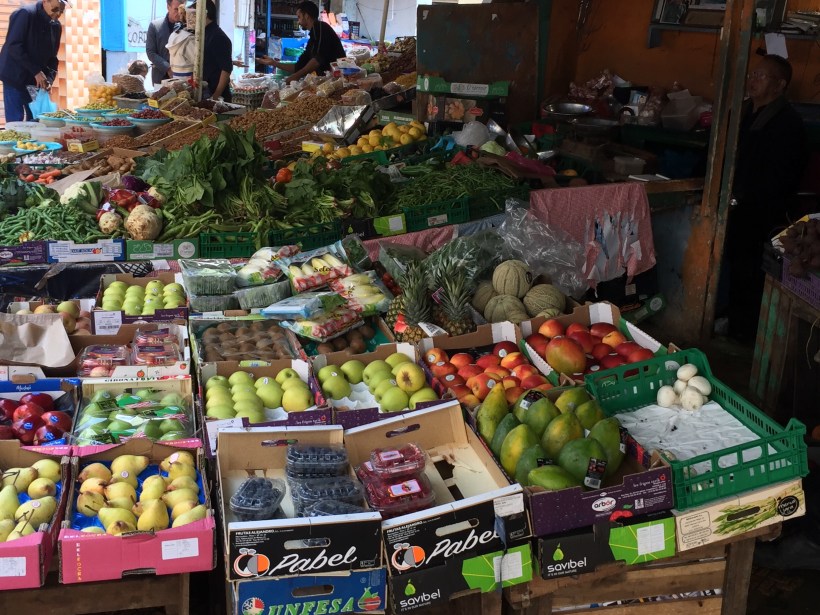
This weekend we met up with some old friends, at least within the spectrum of our expat lives in Morocco. School has kept us so busy this year that for months we have done our Saturday weekly shopping at the French grocery chain’s Carrefour Gourmet store that opened up about a year ago. It definitely caters to a European-American expat and high-end Moroccan crowd that prioritizes convenience and preference over Moroccan thriftiness (though even there the costs beat American prices by a mile…or by 1.6 km), and allows us to shoot out as our schedule allows with a weekly grocery list and get all we need with more reliable supply and high levels of quality. In addition to the ubiquitous parking guardians, there is a valet service. The guys know us, so when we drive up we just stop in the middle of the road in front of Carrefour Gourmet (because this is Morocco, so anyone might stop anywhere at any time on any road or highway) and one of the valets will walk out to greet us with a hearty, “Bonjour! C’est va?” We pop out; exchange greetings with the valet who surely recognized our car when it was still half a block away; grab our supply of bags from the back of the car (because disposable plastic grocery bags are illegal in Morocco, so reusable sturdy bags are a staple for survival); and shoot inside to shop for produce, fresh bakery items from the Amoud Boulangerie et Pâtisserie inside the store; meat from the butcher section, amazing cheeses cut to order from the cheese section (the best Brie we have ever eaten for a mere $3/kilo, or $1.50/pound), other groceries from the aisles, and wine/spirits from Le Cave (with its special entrance and exit to control access to alcohol in this Muslim country). We pay; load everything into our sturdy bags and baskets; and by the time we get outside the valets have spied our exit and pulled our car around to the front so they can unload everything from the cart into the back before we pay them a whopping 10 dhs (each, if more than one helps unload the cart).

But today, after months away, we reverted back to our normal routine of shopping in the souks, hanouts, and stores of the CIL (pronounced “see-L” as an abbreviation got “wordified” some time ago). Each stop seemed like a homecoming with a grand reception from “our people” who offered us warm greetings upon our arrival at each stop, and it felt very good to shop back in real Morocco instead of in the ritzy Gourmet market. We also felt proud that in three hours of shopping we made ten successful stops – which must be a record for shopping efficiency in Morocco.

We are used to being productive people. We have run schools and parented children and played active roles in the communities where we have lived. We are skilled, capable, professional people used to accomplishing things. So it took some getting-used-to during our adjustment to Moroccan life for us to say with any sense of accomplishment and pride that we made five shopping stops in under five hours on a Saturday. But every Saturday, that is indeed how we felt.

Why five places? Because that was often how many stops it took to complete our list of weekly errands. Adding more to the list – like dropping off dry cleaning or hunting for disposable closet dehumidifiers to keep clothes from molding – meant adding to our stops. Following our mid-July arrival, we developed a routine of buying produce at the souks (though it took visits to different stalls before finding all the fruits and veggies on any weekly shopping list – potatoes and onions from one, fruit from another, vegetables from still another, and herbs from one more); staples (canned goods, flour, sugar, rice, milk, water) and snack stuff at Carrefour’s Walmart-like Hypermarche; meat and specialty items (like Heinz Ketchup, when they have it) at the independent “French grocery” O’Self; bread at the boulangerie et pâtisserie Amoud. Of course, to hit all these spots meant traveling across a fair piece of Casablanca territory in Casablanca’s crazy traffic. Geographically, it was really three general stops – Souks Dallas in the Hay Hassani neighborhood, Carrefour past the Californie and Technopark areas, and the CIL. It took us six weeks to try out different vendors and find our preferred guys. It took longer for us to figure out we could accomplish more in less time if we consolidated further. We decreased our staples shopping at the Carrefour Hypermarche to once a month, saving us from battling traffic all the way past Californie. Then, when the Carrefour Gourmet opened in the Racine neighborhood closer to our home, we stopped going to the Hypermarche altogether. We also switched from shopping at the Dalles Souks to the souks in the CIL. We pay a little more than at the Dalles Souks, but doing most of our shopping in the CIL saved us lots of time so that Saturday shopping no longer took all day.

Yesterday took us three hours, but three hours for ten stops surely beats five for five. We started with a quick stop at the dry cleaners to drop off clothes, then headed to the CIL for bread and msemen at Amoud. The parking guardian at Amoud in the CIL always greets us with a bright smile and good cheer. Not having seen us for a few months, he ran over to Brian when he saw us and asked as he shook his hand warmly, “Avez-vous voyagé? Êtes-vous allé en Amérique? C’est va?” (Have you been traveling? Did you go to America?). “Labas, hamdullah!” Brian responded (No harm, praise God!) before telling him of travels to America, Spain, and Portugal. After scoring a batch of fresh msemen for Charlotte’s breakfast this week and some baguettes from the boulangerie (bakery), we splurged with some treats from the pâtisserie (pastry) section. Pulling out from the curb and handing the parking guardian 10 dhs out the window while he blocked traffic for us, he blessed us and wished us “Bon journee.” (Have a good day!)

Part of the beauty of the CIL is that we accomplished our remaining eight shopping stops with just one more parking job. While gentrification in the U.S. has built high-priced condos into shopping malls so that people need not venture beyond the mall environs once they return from their busy jobs, the CIL is a classic neighborhood with all that one needs readily accessible but without the sanitized and manicured setting. GWA, which rents apartments around the city and Dar Bouazza 15 minutes to the south to make it easier for faculty to find reliable housing, has a number of expat teachers who live in the CIL and love it. The road into the heart of the CIL is divided by a median, with cars parked on both sides of the road in each direction. An army of parking guardians mans the road, offering “Lavage?” to hand wash your car if you want, as well as guard it. Parking along either side of the center median is actually illegal, a condition generally disregarded…except for the occasional times when tow trucks show up and begin towing cars, with people running in a flurry to save their vehicles from the dreaded tow yard. We prefer to park on a parallel access road where another guardian who knows our car finds spots for us to park. Yesterday the CIL was packed. As we started down the access road and our guy held us up as he looked around to see where we might park in spot or along the curb halfway up the sidewalk. Seeing nothing, he whirled his finger around, instructing us to loop around and come back a second time. By the time we headed down the block, did a U-turn, went down the block in the other direction, did another U-turn, and started into the access road again, he had a spot open up and protected it for us until we came through again. Before Audrey had opened her door and emerged from the passenger side, the Berry Guy appeared. We may not have done our Saturday grocery shopping in the CIL for a few months, but the Berry Guy knows our car and knows that Audrey is the biggest sucker. “I can’t look at him with his bad teeth and not buy his berries,” she says. She did not even try to refuse him, telling him she would buy one container of raspberries. Brian stood silently, hand in pocket around loose change, hitting the “I Accept” button that he would soon pay Berry Guy for more berries than Audrey thought she would buy. He watched as one container of raspberries became one each of raspberries and blueberries, and then two raspberries and one blueberry. Brian has no problem telling Berry Guy no, but Brian also does not get bent out of shape when Audrey buys three pints of fresh and delicious berries for 50 dhs ($5).

With berries secured, we headed out to stop number three, the office supply and bookstore hanout, a sort of Moroccan Staples that took the pen, pad, and books sections out of an American Staples and crammed them into 1/10 the space with aisles too narrow to turn around, let alone accommodate two-way foot traffic. Picking up pens and a thank you card for Charlotte to give to a staff member who send her flowers after her knee surgery last week (stay tuned for a post on Moroccan health care), we moved around the corner into the souks of the CIL’s shopping square.

While Audrey went into a nut souk (stop four) to buy sesame seeds, cashews, and some other seedy-nutty things, Brian stepped toward the center of the square to begin gathering fruits and vegetables from Zwil, our produce guy, and his son Khalid (stop five). Zwil looks like he has run his souk for at least 40 years, and Khalid looks like he has spent that same time growing up in dad’s souk and learning the family business. The freshest, tastiest, most vibrant produce gets delivered around 10:30 on Saturday morning. It is best not to arrive before then; likewise, arriving too late in the day means not only that Zwil might be napping on a cot inside his ramshackle “office” but also that the best produce might be sold. As Brian walked up, Khalid saw him from 10 meters away and called out a greeting. Before starting to shop, Brian put down his bags and baskets and went to exchange hellos with Khalid and then with Zwil, who greeted him warmly and offered his trademark handshake where he yanks your hand hard and laughs that he was able to get away with his trick again. Again came questions about where we have been, and how Charlotte is doing. Shopping in the CIL is not just shopping. Like so much that is Moroccan, it is about relationships first and shopping second. Filling up our baskets with veggies and fruit, we asked Khalid if he had basil, parsley, and chives. What he did not have he got at another souk and gave to us. Then everything went into the office for Khalid to put on a scale and call out the weight of each item as Zwil tallied the cost by pencil in a worn notebook. He added everything in his head and gave a total: 270 dhs, or less than $30 for two huge baskets that will feed us for a week…plus throwing in the herbs gratuit (free).

On to stop six: the Berber butchers. They gave us a rousing duet of hellos, in English at first because of their professorial manner of speaking in whatever language their customers need, then giving butcher shop vocabulary lessons in French, Darija, and Berber. Audrey bought one of their free range chickens (“It walked from Marrakech”), kefta (ground beef, which they grind to order on the spot), and other meat for the week. As a treat, they had a tray of freshly made kibi, small deep-fried pods of spiced ground beef and onions, which is not Moroccan but is well worth the splurge. Of course, while we were there they tossed chunks of meat over the counter to feed the stray cats that panhandle for food from them.

Taking our bags and baskets to the car, stop seven was the hardware hanout to see what they might have in stock worth buying. (Remember the Moroccan shopping rule that if you see something you might want at some point, buy it now because you won’t find it later when you want it.). Then next door at stop eight we popped into what we call the Israeli hanout, a liquor store owned by an Israeli instead of a Moroccan. With Ramadan starting in a few weeks, all sales of alcohol will stop from a couple days (or, in some stores, a couple weeks) before Ramadan begins, and not open again until a couple days (or, again, a couple weeks for some stores) after Ramadan ends. So we got enough wine to last us through Ramadan, and the guy helping us boxed it up and delivered it out to our car.

Stops nine and ten took us across the street-median-street to the imported produce souk to get asparagus we could not find with Zwil because asparagus season has finished; and finally to O’Self. No sooner did we enter O’Self’s narrow aisles than Mohamed, one of the employees, found us. Mohamed adopted us last year when we were clueless newbies who knew where to find nothing in the store. He spoke no English and we spoke no French, but he helped us find everything we wanted and grabbed a few big jugs of water to hold for us at check-out instead of our lugging then around the store in the tiny cart. Despite our absence of several months, he fell right into our routine of asking how many water bottles we wanted, then swooping in now and then to see if we needed any help finding anything. We might have been gone for a while, but we have come to know the store well – including where to find Reese’s Peanut Butter Cups and Grape Jello on an shelf of American superfluous splurge items – and found all we wanted and more. The coup de grace was Audrey spying Häagen-Daz chocolate-almond ice cream bars in a freezer past the checkout, and asking Brian to snag one for her. Not the most Moroccan moment, but one for which she relished every bite. After Brian payed for the groceries, Mohamed piled everything into a cart that he wheeled outside, across one direction of traffic, across the median, across the other direction of traffic, across the sidewalk, and onto the access road over to our car where he loaded everything into the back before wishing us a good day and accepting the 10 dhs Brian gave him for his help.

Pulling out of the parking space, the parking guardian directed us across the sidewalk and onto the main road while he held traffic, and we headed home with a car full of supplies and hearts more full from seeing some of the people who make living here special for us.

On your mark…get set…here we go!

Thrifty Morocco: The Land Where Nothing Goes to Waste

Our grandparents came from very different backgrounds. Audrey’s grew up and lived in comfort; Brian’s grew up and lived without advantages. Both sides of our family, though, came of age during the Great Depression, which molded their world views and ensured a solid work ethic and thriftiness that steered them daily for the rest of their lives. They would have been good Moroccans.

Regardless of socioeconomic status, Moroccans abhor waste and elevate penuriousness to a level of accolade seen rarely. Those who have little guard it sparingly; those who have much do the same. (The exception in both cases, of course, comes in matters of hospitality when all pecuniary restraint disappears in the spirit of “marhaba,” or “welcome” to guests treated better than family.) Charlotte, who spends our money freely but parts with a Dirham of her own most reluctantly, has established an honorable reputation among her Moroccan friends as a skinflint. They used to compliment how easily she has acclimated to life in Morocco by saying she is a red-headed and blue-eyed Moroccan. After getting to know her Dirham-pinching habits, though, they started giving her the ultimate compliment by saying, “We thought she was Moroccan; now we know she is Berber” (referring to the nomadic people of northwestern Africa who make up the historical foundation of Moroccan culture, and are known for bartering to the last Dirham and getting the last bit of possible use from anything they or someone else may possess).

Last November, while leading a delegation of our faculty at a MAIS (Mediterranean Association of Independent Schools) conference in Valencia, Spain, Brian learned something from the Moroccans on the trip. Arriving post-conference at the Valencia airport for the trip back home, the Moroccans in the delegation immediately started hunting for the office in the airport where they could reclaim the taxes they paid on their shopping purchases while in Spain. While Brian – whose main concern was ensuring that no one missed the flight home – stood in line, checked in, and waited for the missing folks to do the same, they spent the better part of an hour searching through the airport and finding the fabled office, turning in their receipts, and getting reimbursed a few euros for their effort.

Such thriftiness naturally extends into the realm of business as well, though it may require some measure of flexibility. Some friends of our bought a house last year with some open community space next to their property. One day we saw that an oasis of mature palm trees had been planted in the open space, as well as around their property. They told us that they bought them for a small fraction of the normally hefty price for palm trees from someone they knew who had planted a forest of palm trees on unused public land years ago. After all, no one else was using the land, so why not plant a palm tree nursery there. It was a good plan, until the government came along and told him he had a few days to get rid of all the trees or they would bulldoze them, so he was getting what he could for them.

Morocco could boast as its national motto: “The Land Where Nothing Goes to Waste.” For decades the waste management trend of “reduce, reuse, and recycle” has gained ground in the U.S. Meanwhile, Morocco has no recycling program of note because it accomplishes the first two stages – reduce and reuse – so well. The prevailing tendencies favor using available resources minimally – thus not much need actually to reduce, because Moroccans do not pursue extravagance except in celebrations like marriage, graduations, and hosting people in their homes; and what people do use gets reused over and over and over, even after discarded by a first owner…or a second…or a third as long as someone can find some use for it in some way. This thriftiness both saves money and saves resources in a culture that wonders why someone would squander either one.

Remember that Morocco is the land of argon oil, ground and pressed from the kernels of the nut that grows on argon trees. In southwest Morocco, goats still climb the argon trees to eat the nuts the way they have done for as long as anyone can remember. While today argon oil producers employ commercial production methods, once upon a time long ago some industriously thrifty Moroccan thought, “Hey, I bet instead of trying to crack argon nuts by hand it would be easier to sift through goat poop to find argon kernels that I can press into oil.” Driving on the A7 highway from Casablanca past Marrakech and along the edge of the High Atlas Mountains down to Agadir, one still passes tree-climbing goats and people following behind hefting sacks of their herds’ droppings. Not even goat poop goes to waste.

On GWA’s campus, what is waste for many gets picked through in search of things that someone could still use or that someone could sell. When a cheap lounge chair from our balcony broke last year, Brian put it out by the garbage barrels. It disappeared before the end of the day. And each Spring, as the school year draws to a close, the apartments’ parking lot becomes a Garage Sale filled with tables of items changing hands from people no longer needing them to people who can make use of them.

Last Spring, GWA’s Class of 2017 unleashed a senior prank that included releasing a bunch of chickens into classrooms and hallways of the Upper School. Beyond the shock value of surprising teachers and students with the arrival of unexpected poultry, every one of the chickens went home that day with someone from the cleaning, kitchen, or other staff to become the guest of honor on a dinner table.

Heading into the souks one passes people with their assorted used wares laid out for people to buy: used clothing, shoes, small appliances, large appliances, furniture, bicycles, lighting, and more. You want it? Someone somewhere is selling it used and cheap. It is not unusual to see someone riding a scooter or driving a donkey cart with a hundred or so empty five liter plastic water jugs tied together in a bundle on the way to repurposing.

The Hay Hasani neighborhood’s Souks Ouald Mmeni, what we call the furniture souks, are filled with adornments – furniture, mirrors, paintings, wall mouldings, archways, windows, huge doors from churches and mansions and more – taken from old buildings that get picked through as well. An item may sit for years before someone buys it. No problem; there is plenty of time, but not plenty of whatever it is that someone may want someday.

So it is on a large scale as well. When we arrived in July 2016, a massive public works project had just begun to upgrade Boulevard Abdelhadi Boutaleb (renamed recently for a former Moroccan Ambassador to the U.S., but formerly named ingeniously Route d’Azzemour because it was the road down to Azzemour a little more than an hour to the south). Nearby GWA, at the roundabout that marks the start of the southwest ring road called Rocade Sud-Ouest (i.e., “Southwest Ring Road”) stood a high bluff of loose material placed there when the route for the southwest ring road was built a few years ago. Over the last 19 months that mountain has fallen almost to street level as dump trucks have relocated load after load for use as fill in the new road construction project. Driving around, one often sees similar deposit areas where what gets removed from one demolished or excavated site sits around until someone can use it in some building or road construction project somewhere else.

During the last couple weeks, we have witnessed this process happening right across the street from GWA’s gates and guard house. An abandoned building has sat there, giving a bit of old Casablanca character to the intersection at our school entrance. But developers have plans for the neighborhood, and the building and the simple potholed, quasi-paved cross street apparently does not factor into those plans. Slowly over the last couple weeks we have seen the building bulldozed in sections. The fascinating and very Moroccan thing about it, though, is that as more of the building comes down, people scavenge the site. While driving in and out our school gates we see people on the site carrying pipes for plumbing, wiring, slightly bent or dented sheets of corrugated metal, even long and heavy I-beams. And the crumbled concrete walls get trucked away to some site where they will sit waiting to be used someday as another project’s fill.

Rather than employing America’s “reduce, reuse, and recycle” tactics, Morocco does just fine with “use only what you need, then use it again and again and again.”

On your mark…get set…here we go!

The Balcony

And just like that, Spring surrounds us.

The weeks of the long Ayiali’s cold melted away and transitioned Casablanca in a single day into blue skies, warmer temperatures, grassy fields starting to boast a rainbow of wildflowers, and a common disposition of appreciation for the weather change among friends and strangers alike. People just seem cheerier, like a nationwide case of Seasonal Affected Disorder has lifted. Ironically, Ash Wednesday fell in the middle of that first warm week, inviting Charlotte’s explanation of Lent to a Muslim friend perplexed by the concept: “It’s like Catholic Ramadan.” She has become a TCK – Third Culture Kid. But not even the start of six weeks of atonement and sacrifice can dampen the spirit of this uplifting; we have had enough damp over the previous weeks already.

After lamenting the long cold season, we found ourselves lunching outside last Saturday on the patio of an Indian restaurant downtown. Platters of tandoori chicken and naan, steaming pots of dahl, and much more fueled hearty conversation with a GWA family that had invited us. Amazing to think that just seven days before it was too cold even to imagine doing this. Now the weather is perfect, our favorite time of year in Casablanca.

One reason is that now we make use of our balcony again. Brian, a rain or shine all-weather griller, goes out to the balcony year-round to satisfy Audrey’s desire for grilled meat. But beginning now, and through the next nine or ten months, we will enjoy time sitting on the balcony for the pleasures it offers.

From our third floor perch (what Audrey calls “our penthouse view”) we have a 180-degree view of the Atlantic’s eastern sands a mile away, including the beachside summer palace of our neighbor, His Majesty the King. The ocean breeze gives us a steady supply of fresh air instead of stale stuff from a claustrophobic city choking under diesel and gasoline exhaust.

Our balcony also overlooks GWA’s school buildings just a 300 step commute from home, including our admin offices on the ground floor of the new Library-Media-Tech Center that GWA inaugurated in September. Looking at the LMTC’s dome on the roof reminds us of the beautiful library that it tops (the largest children’s library in Morocco) and the cool Robotics lab, MakerSpace, and LEGO Education Innovation Studio (the only LEIS in Morocco and one of only two in Africa) on the middle technology floor.

Around the campus and stretching downhill to the coastline are rich fields that in a few months will have threshers cutting hay, but now have grazing cows and sheep happy to have grass and wildflowers again instead of having to paw for stray straw shoots left from last year’s reaping (like the poor creatures do from June through December and into January, no wonder that they are so lean).

We enjoy sitting on the balcony at our little folding wooden table and chairs in the evenings. We watch the sun set over the ocean, followed quickly by hearing the scratchy-amplified Call to Prayer echoing from the minarets of nearby village mosques. Then there is quiet stillness. We share a bottle of wine as we play cribbage, or perhaps just sit in the quiet to balance our otherwise nonstop lives. We watch the stars come out, and marvel at how many more stars fill our Moroccan heavens than we have seen in nearly two decades since we lived on the 1600-acre wooded campus of The Miller School of Albemarle on the eastern slope of Virginia’s Blue Ridge Mountains.

And Brian, the puttering king, will putter day or night around the plants in our balcony garden. Audrey, whose culinary endeavors more than compensate for her horticultural black thumb, likes to cook with fresh herbs. Brian obliged happily last year by ringing the balcony’s rails with hanging boxes of mint, rosemary, thyme, basil, oregano, chives, parsley, and cilantro. On the balcony’s floor he tended containers with a steady supply of beefsteak, roma, and cherry tomatoes, and succeeded with a few eggplants as well. Casablanca’s sunny but mild climate allowed him to keep his plants producing throughout the Fall, with some herbs even surviving the winter. Looking up to our apartment from school last year Audrey thought it looked like we had a rain forest on our green balcony. But eventually the garden grew tired of the cold as much as we did. Audrey’s rain forest became Audrey’s eyesore as long, brown tomato vines – staked and strung along the balcony railing – and stiff brown basil and mint poking up from boxes begged for renewal.

Last week’s awakening colors encouraged Brian to spend all of Sunday afternoon preparing our balcony garden for the new growing season. For Audrey, such investment of his time means the start of a new garden. For Brian it is therapeutic time steeping in God’s gift of nature, if but a balcony-sized snatch of it. Weeks ago he started seeds indoors in peat pots sitting in a large plastic tub on our dining room table. The shoots have been stretching daily toward what overcast light they could find through the balcony’s glass doors. With warmth and sun now having arrived, the time finally came to take them to their outside home. That satisfying task came after a trip to nursery chain Arborescence for more hanging boxes and planters that will expand our container “farm” this year with snap peas, rainbow carrots, green beans, and – vegetarian Charlotte’s special request – kale. While at Arborescence, Brian also grabbed some new thyme, rosemary, parsley, and cilantro to refresh the mature stock that limped through winter. The old rosemary still had enough life in it that he repotted it, after pulling it from its boxes, and gave it to friends living in other apartments on campus. Meanwhile, the return of green on the balcony is most inviting for us, calling us back to our perch to enjoy the gift it is to us.

It was a good day for Brian that will lead to many good days for all three of us as Audrey snips our “estate herbs,” let alone when harvesting begins.

On your mark…get set…here we go!

Alyiali: Waiting for the Warming, or Just for the Dang Cold to be Done

Having lived in various climates across the U.S. before moving to Morocco, we know how greatly seasons can differ from one place to another, and how people’s perspective on such can vary greatly due to different experiences. When we arrived in Casablanca people told us that we would freeze in winter time because it gets so cold and wet – and without central (or even baseboard or radiator) heating, the temperature inside of the ubiquitous concrete buildings tends be even colder than the outside temperature.

Then we went through our first winter last year and thought, “That’s not so bad.” The typical daily weather turned noticeably colder in November and the rains started in December. January continued a rainy and cold default, like winter in London or Seattle; but we found it quite tolerable as long as we had a nice fire crackling in the fireplace to warm our apartment. By the end of January, it had started to warm and by this time last year we had wildflowers bursting bold colors across fields everywhere we went.

Not so this year.

Instead, this year seems colder and windier and wetter and rainier than last year; and that condition seems to have lasted longer than it did a year ago. Indeed, looking around we see Morocco greening, as it does in Winter; but that process seems to move just a bit more slowly this year than what we experienced in our first go-round with Moroccan seasons. Heightening further our sensitivity to the clammy cold, the tarp Brian put over our firewood supply on the roof got blown off by the strong winter winds and our entire abundant supply of more than a ton of firewood got soaked by the prodigious rains. In other words, while the cold season has continued, our fireplace season ended over a month ago. In other words again, it has been very cold in our apartment for over a month. We have a space heater in our bedroom that does a nice job keeping our teeth from chattering all night long while we sleep. In the common areas of our apartment, though, we have adopted the typical Moroccan practice of wearing 93 layers of clothes to stay warm in Winter.

Sharing our meteorological observations and household status of apartment-as-refrigerator with some long-time expats we know, they smiled and taught us about the not-quite-season of “Alyiali” in Morocco. “Alyiali is that time from the end of December for a few weeks when it is cold, windy, wet, and rainy. Sometimes it lasts 30 days…sometimes it lasts 60. This is a longer Alyiali this year.

So, it lasts from New Years until the weather gets warm?

“No, mostly just until the dang cold is done.”

For weeks we have had dang cold. It rained with howling winds beating raindrops against the windows every day this week. Again.

It is not that we do not know cold or that we cannot endure it. Brian’s parents both came from hearty Minnesota stock, and we and our girls made it just fine through half a decade of Cleveland winters. During our Cleveland days, Brian used to call his 90+ year old grandmother outside Minneapolis in a regular contest to see who had colder temperatures. We have both closed schools for COLD instead of for snow. (Side note: In Cleveland, the magic number on the thermometer for closing school because of cold is -20°F.) But one can escape Midwest winter cold simply by going inside (a building, a car, etc.), while in Casablanca this DANG COLD is everywhere: from the cold tile floors to the cold cement walls to the very cold water left for a shower after your 17 year old daughter uses up all the hot water.

So Audrey was very happy to escape the Dang Cold last week by traveling 27 hours each way (Casablanca to Paris to Atlanta to Cedar Rapids, then back reversing the route) to and from Iowa to recruit teachers for GWA at the University of Northern Iowa Oversees Recruiting Fair. Our Academic Team felt great accomplishment last month when teacher contracts for 2018-2019 came back and we had only 11 spots to fill. (Contrast this with the roughly 45 spots in our class two years go and about 35 spots last year.) Not only do we have fewer spots to fill this year, but we also have moved far ahead of previous years in jumping to fill them. While we have seen people hired as late as July in the last couple years, we hoped to complete our hiring early in order to snatch up good candidates and then be finished with a process that typically has taken lots of time and resources through the Spring here. When one thinks about the best places to go to hire international school faculty, the town of Waterloo in northern Iowa probably does not garner the attention of most folks. But the annual UNI Oversees Recruiting Fair is an unexpected gem that features several hundred teachers speed-dating with over 120 international schools to land overseas teaching gigs. After causing much excitement in Waterloo by popping a champagne bottle in attention-getting celebration every time another teacher signed a GWA contract, Audrey returned from Iowa on Monday night with almost all our faculty positions filled for next year with a spectacular crew of student-centered 21st Century educators anxious to join our already excellent teaching staff.

Perhaps the hire that excites us the most, though, is that of our new Upper School Principal. Audrey felt conflicted deeply over hiring someone to replace her as Upper School Principal. We both served as heads of schools stateside and know the glories and challenges (most heads of schools will admit to far more of the latter than the former) of HOS life. By contrast, Audrey relished her time last year as the Upper School Principal, able to focus on students and teachers instead of on less people-oriented institutional matters. So while serving satisfactorily this year in both the HOS and USP position, and as much as she loves the student proximity a Principal gets to enjoy, she knew she needed to hire someone for the USP position if she wanted to keep her sanity and have an occasional moment to breathe in her new HOS role at GWA. After spending the Fall exploring candidates, in December Audrey and the search team she led chose a person whom we know will be not only a great Principal at GWA, but also a great addition to our leadership team. Since then, she has Skyped and traded emails with members of our leadership team with regularity. Better still, last night she arrived from China, where she is currently a principal at an international school, to spend a week getting to know GWA and our team well in advance of actually starting with us next summer. Through the week she will meet students and teachers, and parents and experience the warm community that GWA offers even amid Alyiali.

Perhaps as a sign, the Alyiali weather broke yesterday. After a few raindrops in the morning, the clouds parted to share clear sunshine and temperatures climbing shwea-shwea (little by little) toward the warmth of Spring. Bring it on…We are ready!

On your mark…get set…here we go!