Using Van Halen to Answer the Big Question

GWA’s December Break began yesterday, ending a Fall filled with frenetic activity.  Tomorrow we board an Air Canada flight to take us across the Atlantic and North America to land in Vancouver, then drive across the U.S. border at the Peace Arch to spend 10 days criss-crossing the State of Washington to celebrate the holidays with Brian’s immediate and extended family.  That will mark Brian’s third and Audrey’s fourth trans-Atlatic trips in seven weeks.

Audrey’s solo trip started two weeks ago when she flew to Atlanta for an international educators recruiting fair at which she and GWA’s Director of HR had the longest line there of over 60 prospective hires jockeying to interview with them for teaching and staff positions.  She refers to hiring events like this as speed-dating because schools have a very small window with each applicant to decide whether to offer contracts, and vice versa as applicants decide at which schools they want to work. Frenetic barely begins to describe the environment at these affairs.

But besides holiday and school recruiting trips, we also jetted westward “across the pond” twice in November for Audrey’s final two job interviews as we wrapped up the process of deciding where the next phase of our expat expedition will take us.  Both trips took us to Latin America, resulting in offers from two wonderful schools – one in Guatemala and another in Panama – that won our hearts and engaged us in their missions and visions. In the end, after much discussion, deliberation, and discernment, we are most pleased to share our decision to move to Panama City to join the International School of Panama community next July.

Knowing where we will go next lets us relax in a way not possible since the difficult decision nearly a year ago to continue our adventure abroad elsewhere instead of remaining for another several years in the Morocco we have come to love.  Education is one of the few fields in which employment transitions run in annual cycles instead of short-term transitions that complete in a matter of days or weeks. To be professionally responsible educators must make decisions whether to renew contracts or seek new opportunities far in advance of actual changes in employment status.  Often that means telling one’s school of a decision to move on long before one actually has another position lined up at another school. So it was with us as we told the board in February of our plans, giving us a year-and-a-half to find our next spot and GWA the same to find Audrey’s successor as Head of School. Nine months later everything is sewn up with ISP’s board having announced two weeks ago that Audrey will be their next Director and GWA’s board announcing this week who will succeed Audrey here in Casablanca.

Through that time we remained cautiously optimistic about finding the right school for our next gig.  Having lived across the U.S., travelled the globe widely, and lived the last four years in Morocco, we worried less about location and more about fit in the school as we started exploring posted jobs last Spring.  Granted, we were picky. We weeded out “for profit” schools. We paid close attention to school missions and visions. We looked for boards whose members collectively and individually displayed growth mindsets, an appreciation for best practices, and a collaborative approach to working with a school Head instead of getting “in the weeds” with school administration.  We did not shy away from schools with work to do, but we sought a reasonable level of institutional stability. Likewise, as much as any geographic consideration, we sought schools in countries with a reasonable level of political stability and without too great a potential threat to personal safety (whether from crime or terrorisim). At least this time, now as empty-nesters, we had the freedom to choose a school without the added consideration of what impact moving our children into it would have.

Our pickiness cut back seriously the number of contender schools into which we probed more deeply.  At various times in our search, we had to fall back on our cautious optimism to keep anxiety from running amok because the number of postings garnering our attention seemed much smaller than what we imagined we would encounter.  One of Audrey’s references, an education consultant known internationally for her work with schools around the world, confirmed that the “pickins” seemed a little light but reassured her that the right opportunity would appear. We looked seriously at schools in Africa, the Americas, Asia, and Europe.  To round out the continents, finding job opportunities in Australia proved very difficult; and Antarctica’s penguins group in colonies, rookeries, and waddles instead of in schools.

We got information about schools in lots of ways.  Surfing the internet let us see not only how schools presented themselves but in many cases also how others viewed schools or context that we might not gleam from schools or headhunters directly.  For example, if a school had an interim Head but offered no information about how that circumstance came to be, our friends at Google could provide information about how the previous head had gone from being the Director of Advancement years ago to a Head who expanded the campus (perhaps too quickly) and then stepped aside midyear for an interim to take over while the board could search for a permanent replacement.  We got information from our network of headhunters, consultants, and international educator peers, discovering that a school might have a very union-like faculty culture that requires top administrators to have experience working with a teachers union; that a school’s board may have been a mess a decade ago buy has worked hard to learn, grow, and employ best practices today; or that a country had recently put a tight limit on the number of years expats could stay in the country, consequently guaranteeing both high faculty turnover each year and difficulty enticing educators to join the school and fill the high number of open positions each year.

Gathering intelligence on prospective schools let us decide where to and where not to apply.  In one case we had almost decided to apply when we learned that the departing Head suddenly changed his mind and now planned to stay at the school, making the posting evaporate.  Very strange, with such wishy-washiness probably marking a place where we would not want to go. Overall, Audrey applied to about 15 schools, give or take. Of those, she moved forward in about half, and of those in which she moved forward she pulled out from some after learning more about the school’s details through further interviews or other sources of information.  In the end, she was a finalist at four schools.

Brian joined Audrey on one finalist visit to an eastern European school in September, and the next week she headed solo to an international boarding school in the western U.S.  The first seemed like a great prospect in a wonderful city rich with history and culture, and the first day on campus went very well. However, in a session with the board on the next day, she encountered a board member bent on restructuring the school’s org chart so that the board would hire a Managing Director who would report directly to the board instead of to the Head.  Having endured such a structural diversion from best practices at a previous school in her career and with no desire to repeat the experience, she said that would be a deal-breaker for her. After arriving with high hopes based on all the positive things we had learned about the school, we left with huge disappointment packed in our carry-on bags as we flew back to Casablanca.

The next week, Audrey flew alone to the U.S. for a few days at the international boarding school.  We did not have U.S. boarding schools on our radar, but this one grabbed our attention. When Audrey had a Skype interview with the board, they impressed her so much as a highly evolved board of top tier professionals scattered around the U.S., all deeply familiar with modern pedagogy and dedicated to best practices in board and school leadership.  In the end, they hired another candidate who was a perfect fit for the school and its circumstances; but Audrey received high praise from several board members and even outreach to stay in touch with them as an inspirational education leader. During our stay in Washington State, we even hope to meet up with one of these board members in a continuation of the relationship that began back in September.

With two good prospects falling away, going into October Audrey counted on Brian’s confidence that all would be well and we would end up – recalling a favorite prayer of Brother Clem at the Redemptorist schools where Brian was Head in Baton Rouge – “Where we are supposed to be when we are supposed to be there.”  The searches in Guatemala and Panama heated up through October, and Audrey had to work with the boards on when she would be able to visit as a finalist because our November calendar had since last Spring included our daughter Margaret making her first visit to Morocco in the second week of the month. Both boards proved very accommodating, and we scheduled trips that bookended Margaret’s visit in November’s first and third weeks.  So in the first week of November we flew from Casablanca to Paris, Paris to Panama City, and Panama City to Guatemala City. The visit was great, we were able to explore outside Guatemala City on a day-trip to the old capital of Antigua, founded in 1542, and we found the school community welcoming and full of heart, ready to take on together as a community the challenges facing the school. We left knowing that we finally had found a school to which we could say, “Yes!”  But, being transparent with the board, we made sure they knew we had another finalist visit scheduled in Panama a week after we would return to Casablanca.

As Margaret’s visit ended and we packed for Panama, Guatemala indicated their desire to have Audrey as their next Head of School.  But without a formal contract and offer to lock in, we went to Panama while continuing open discussion with Guatemala. So a week after returning from Latin America, we hopped on Air France again to repeat the Casa-Paris and Paris-Panama route on the same flights as before.

The Panama trip also went beautifully, the community also welcomed us warmly, and the board seemed inclined to bring Audrey to their school.  Besides time at the school, we hiked in the rain forest and fed bananas and grapes by hand to monkey on islands inside the Panama Canal.  Despite feeling like Guatemala could work well for us, Panama had our favor. Audrey told the ISP board that she could not in good conscience keep holding off Guatemala after completing her visit.  So while they had not planned to make a decision for several more days, the ISP board moved heaven and earth to give Audrey an offer the day we arrived back in Casablanca…even with the preceding day being a national holiday (Panama’s independence day) with several board members traveling out of the country.  With ISP’s offer in hand when we got home, we made our decision and let both schools know. Both the ISP board chair and ISP’s current Director told Audrey subsequently that when the board shared the news with ISP’s faculty and staff, they cheered and applauded. Hard as it was to make a decision, we knew we had made the right one.  Once ISP told us they had announced the news, we did the same with a post on Facebook, revealing our next destination by posting YouTube’s video of Van Halen’s “Panama” song from 1984.

Now, looking ahead to our Panamanian relocation in July and planning another trip to Panama sometime late-Spring to find housing and for Audrey to work on the leadership transition with ISP’s fantastic departing Head (with whom Audrey bonded immediately), we nonetheless remain dedicated fully to completing our time in Morocco and at GWA with the same “all-ahead full” approach we have practiced since we first arrived in July 2016.  That said, we expect in many ways it will get harder and harder to get closer and closer to the end of this school year. The life of international educators carries much excitement and the ability to experience the world. We have made wonderful friends in Morocco. The unhappy flip side of that, though, is that moving on to our next adventure means having to say goodbye to those friends who have made our time here so meaningful. In many ways they are family, and we will miss them as such, even as we settle into our new circumstances.  That will make starting our transition hard, necessary as it will be in the coming months.

Meanwhile, as we bid adieu to the frenetic Fall, it also serves as an incentive for us to value every beautiful sunset over the Atlantic that we see from our balcony each night, knowing that we have a finite number left for us to enjoy; to value every interaction we have with the marvelous friends and peers we have here; and to make the most of each moment each day.  As we think further on it, that seems like what we should do every day regardless of where we are and what might lie ahead. So for that daily affirmation we feel much appreciation.

On your mark, get set, here we go!

Chilling in Dar Bouazza: The Hunt for Carrefour

This week our weather in Casablanca reached that teasing time that gives you just enough days of clouds and rain in a row to think that the wet journey toward Winter and the re-greening of Morocco has started, then flips around and tosses a day of clear skies and warm temperatures to keep you in climate confusion.

Brian broke out his sweaters and wore them to school instead of wearing his usual suit jacket and tie.  Audrey moved underneath the portico of GWA’s main building to stay dry during her morning greetings of students, parents, and staff.  By midweek Audrey asked when we could have our first fire of the season at home, and Brian happily employed his pyromaniacal skills to comply as we shared some 20-year port we had brought back from a Fall Break trip we took to Portugal two years ago.  Prepared for nightly fires and sweater weather, we welcomed the quick passage of Fall into Winter.

And then yesterday happened:  Clear skies, comfortable temperature, nice breeze, and no tinge of Fall (let alone Winter) in the air.  It was more like a beautiful Spring day bounding ahead of the cold and wet still to come.

We had a lazy morning with Brian sleeping in well past 10 and Audrey poring through recipes to plan how to use as much of this week’s Ferme Bleue basket vegetables before we give away our next installment of what we cannot consume.  Once Brian had risen and lounged for a while, and Audrey had finished planning “Chopped” with our fresh produce basket and made our shopping list, the flip from pre-winter back to beautiful weather enticed us to try something new today.

In June, Carrefour opened its new grocery store in Dar Bouazza, where a number of our expat faculty and staff live.  While many of our single expat staff prefer active city life in Casablanca, many of our expat families prefer Dar Bouazza’s quieter, comfortable lifestyle famous for ample beaches and waves that draw surfers from around the world.  Dar Bouazza is a coastal town about 10 minutes west of GWA along the Atlantic coast. Formerly a rural commune, it has grown from a farming and fishing community into a suburb of Casablanca that has seen its population grow from 45,000 just 25 years ago to nearly 300,000 today.  When GWA moved in the mid-2000s from downtown Casablanca to our current campus on the southwestern edge of town, Casablanca’s city limits had not reached out this far southwest and our largely-unincorporated location was considered the northeastern edge of Dar Bouazza. Since then, Casablanca has annexed territory past GWA, while at the same time built Dar Bouazza is growing toward the city.  In the foreseeable future, the two will be one strip connected by a roadway currently bustling with residential and commercial development projects (at the price of wetlands or dayas that are the last in the Casablanca area and are home to nearly 200 species of birds).

Chains like Mr. Bricolage (like Moroccan Lowe’s or Home Depot without the garden/nursery side), Arborescence (like the garden/nursery side of Lowe’s or Home Depot), and even McDonalds either have arrived or are moving into the area.  Carrefour’s announcement last year of plans to build the new store created quite a buzz in Dar Bouazza, but our driving to downtown Casablanca to shop at Carrefour Gourmet kept us from paying too much attention to the hoopla. Even after it opened in June and we began hearing how big and wonderful it was, we kept shopping at Carrefour Gourmet for its quality produce, in-house Amoud Boulangerie et Pâtisserie, staff focused soundly on customer service, and good-sized Cave for purchasing wine and spirits.

But yesterday we thought we would venture in the opposite direction to see what all the hubbub was about and, with the beautiful day encouraging more of an outing than a mere shopping run, to spoil ourselves by going out to lunch first.  Another place in Dar Bouazza about which we have heard much but also had not yet checked out is an eatery called Bike-Eat-Repeat. Driving down R320 and turning right onto P3012 past the iconic Crazy Park micro amusement park, we followed a familiar route past multiple entrances to prized beaches on the right and the Jardin De L’Ocean neighborhood (where lots of GWA student families live) on the left.  Turning onto a side street, we parked, walked over to Bike-Eat-Repeat, and got a table outside to make the most of the beautiful early afternoon. Its comfortable atmosphere, welcoming staff, and good food let us see why it is a favorite hangout place for Dar Bouazza residents that we know.

Bellies full after a long, slow-paced, and relaxing lunch, and not knowing if the new Carrefour featured an in-house Amoud, we picked up a couple baguettes at the shop next to B-E-R, then hopped back in the car to do our grocery shopping.  We wound down the long stretch of road to the old Tamaris section of town, all the way waves rolling up the beaches our various Dar Bouazza friends either cross the street or at most walk a few blocks to enjoy. Then we turned back out toward R320.  With eyes peeled for Carrefour, as we reached R320 Audrey looked to our right and said, “There it is!” Brian thought it seemed much smaller than the hypermarche he had heard about from so many people – huge store, lots of parking, big Cave – but here was Carrefour nonetheless.  He pulled a Moroccan road move and turned right into the smaller-than-expected parking strip from the road’s left lane, and drove the length of the strip finding no available spaces. At the end of the strip, though, was a guard station with a nice man pointing us toward an underground parking area.  So down we went, questioning why our Dar Bouazza friends considered this store such a big deal, but figuring they thought it an improvement over not having it at all. Parking, we headed up to the store and again thought it sufficient for buying groceries, but not anything comparable to the huge and Walmart Superstore-ish Carrefour Hypermarche in the Californie neighborhood of Casablanca with which our friends had compared it.  Nonetheless, we shopped and got most of what we had on our list. Then we saw the sign for the Cave, but going through the flaps in its doorway we found stacks and shelves of stock inventory instead of bottles of wine and spirits. Confused, we asked an employee where we could find the Cave and he told us there was not one; we had waltzed into a misnamed storage room. “Hmmm,” we said, “They must have decided to nix the Cave.” We paid for our groceries, took them down to our car and loaded them in.

Driving out from the garage, Brian pulled another Moroccan road move and drove 30 meters the wrong way on a road to get back to the left turn lane from which he had performed his previous Moroccan road move, then turned left on R320 to head back toward home.

Before we had traveled three kilometers Audrey said again, “There it is!” as suddenly she saw a huge big box building ahead on the right with Mr. Bricolage and…Carrefour.  Brian pulled into the spacious parking lot and we looked dumbly at each other, laughing at ourselves for going first to the wrong Carrefour on our misadventure. So we parked (now with no problem finding a place), grabbed our big woven basket from the back of the car, and went in hoping to find the last few things we had not found at the wrong Carrefour that we did not know also exists in Dar Bouazza.  Stepping inside, we were awed at its immensity. This was like the behemoth Carrefour in Ceuta, with departments for housewares, electronics, appliances, clothes, as well as broad grocery aisles not requiring expert navigation skills to get around laneless people who shop the way they drive, great-looking produce, long counters for meats and cheeses, and the big Cave that did not exist at our mistargeted Carrefour.  Now we understood the hubbub. This was a store for the small city Dar Bouazza is becoming in its own right. If we lived in Dar Bouzza, we would have no reason to travel all the way into Casablanca to shop for almost anything.

Yet, as impressive as we found it, and as much as we enjoyed our Dar Bouazza outing, we think we will keep shopping at our Carrefour Gourmet.  As we discussed at our table during lunch at Bike-Eat-Repeat, what we love most about Morocco are the relationships we have with people. One can do all sorts of touristy things here, but to know Morocco truly you must spend time with people.  We have good friends here whom we treasure, and now – with Charlotte married – we have good family here as well who invite us to their home and join us in our home for time together over meals. So going to Carrefour Gourmet satisfies more than a need to buy groceries.  We have relationships with people we find inside and outside the store: the woman who weighs and tags our produce bags with a smile and “Bon journee!” each week; the butcher who calls us over to his counter to let us know that he has a beautiful beef tenderloin that he can trim for us; the women at the cheese counter who slice off des goûts (some tastes) of what is good that day for us to try; the garlic man who looks each week for Audrey on the sidewalk outside the store and gives her a handful of fresh walnuts in addition to the garlic she buys only from him; Kamal the parking guardian who tries patiently to build our Darija vocabulary while he parks us or loads groceries from our cart into the back of our car; and others.  They make us feel like we belong there in their neighborhood, rather than pushing a cart through a megastore staffed by people too busy to know their customers.

All in all, we had a good day in Dar Bouazza.  Then we came home, put away groceries, and made some Aperol Spritzes to share on our balcony while looking out over our beautiful view of the school and fields across from us and, down the hill, of the ocean beyond.  The weather will change again soon, so we have limited opportunities to do that before we switch back to sitting in our living room by a roaring fire. Regardless of the scene, we do so love living here.

On your mark, get set, here we go!

Ceuta

While GWA’s Fall Break makes for a quiet campus this week, we savor the serenity of our balcony and the Call to Prayer that complements the placid scene of our staycation…Notwithstanding the work we are doing every day from home and/or office…and except for the crazy two days we had on the front end of this break when we went on an overnight trip to Ceuta, one of two remaining plots of Spanish Africa surrounded by Morocco and the Mediterranean coast.

First settled by the Carthagenians in the First Millennium BC, then ruled in succession by the Romans, the Vandals, the Muslims and Berbers, and the Portugese, these vestiges of Spain’s colonial history in Africa have roots stretching back over 350 years.  Our history in Ceuta stretches back only a few years when we had our first overnight escape to this city of 85,000 Spaniards, Moroccans, and Spaniaroccans.

Many expats at GWA drive the four and a half hours to Ceuta for different reasons.  Some go just to taste a bit of Spain (read: PORK and RIOJA) without paying the FRS Ferry line to carry them across the Strait of Gibraltar to ports in Tarifa or Algeciras and other destinations further north.  Others go because until their Moroccan residency paperwork becomes official – a process that can take several months – they have to leave the country every 90 days, with Ceuta as the easiest and cheapest way to get that all-important passport stamp.  For us, except for that sightseeing trip in our first year, it has been for meds.

Morocco is pretty easy for getting medications.  We can get allergy meds and antibiotics without prescriptions.  (The merits of that, from a world perspective of creating/combatting supergerms, are dubious; but the ease of getting Amoxicillin when strep throat or nasty bronchitis inhabit your household certainly has its advantages.)  But some medications simply do not exist here. We have a great doctor in Casablanca – did her residency at GWU in Washington, D.C. after medical school in Morocco – but she can not steer us to meds not available locally. For the last three years, Brian has brought Epipens back from travels in Europe to GWA’s nursing office as emergency meds for students having serious allergic reactions to undiagnosed allergies; and some other prescription meds we had in the U.S. for Charlotte or us we cannot find in Morocco.  That requires our traveling outside Morocco’s borders to get them, and often requires first setting up a doctor’s appointment in the source country to get a prescription that country’s pharmacies will accept (because they will not honor a prescription our Moroccan doctor writes). So after that first trip when we went Ceuta to go to Ceuta, and happened in the process to discover the convenience of picking up meds we cannot find at home, the handful of times we have gone since has been to renew prescriptions and pick up meds.

Such was our overnight excursion to Ceuta last Friday and Saturday.  Audrey needed to restart a prescription she had in the U.S., and our Spanish doctor – based in Cádiz southeast of Portugal on the Gulf of Cádiz coast – comes to Ceuta only one Friday each month.  Over time we have established a routine. If our appointment with the doctor is in the morning, we make the journey to Ceuta on Thursday afternoon or evening; breeze through the border crossing heading into Ceuta (because the big border holdup typically is coming back into Morocco with vehicles being searched for contraband); overnight at the centrally-located Hotel Ulises on Calle Real (Ceuta’s Main Street); hit the doctor and the pharmacy on Friday morning; then go on a shopping spree at Ceuta’s big Carrefour to buy pork, alcohol we cannot get back home like Cointreau for margaritas and good rum (two bottles allowed back into Morocco per adult), pork, other things we cannot find in Morocco like black beans and sweet potatoes, and pork; toss the pork and some ice into a big cooler we always bring for such purposes; then head to the border to wait in a long border-crossing line as Moroccan police search cars for excess alcohol and other contraband; and finally drive four and a half hours back to Casablanca.  If we have an afternoon or evening appointment, we head up on Friday morning, check into Hotel Ulises, go to the appointment, overnight in Ceuta, hit the Carrefour the next day to fill the cooler with pork and the rest of the car with other things, and head back across the border and home.

Last Friday we had a 1:00 appointment:  early enough that we thought we could leave on Thursday if we could break away from school, but late enough that – as busy as we have been at school – we figured a very early Friday morning departure would get us there in time to cross the border and still have time to kill before going to the doctor’s office.  So we made a reservation at Hotel Ulises for Friday night and set alarms to wake up at 4:45 am on Friday morning to begin our trek by 5:30 am.

Our drive up was uneventful.  We stopped in Bouznika on the south side of Rabat to fill the gas tank and pick up breakfast (an egg and cheese croissant from Chez Paul for Audrey, and an Egg McMuffin with beef bacon from McDonalds for Brian).  We made good time shooting north almost to Tanger, then banked eastward along the north coast past the huge Tanger Med port and over the north Atlas mountains to Ceuta (or Sebta, as Morocco still calls it). As we drove down the mountain pathway to the Mediterranean road that leads to Ceuta’s border, we felt great about having two hours to kill before the appointment.

Then we hit the border.

Not even.

Rather, we hit the roundabout that intersects with the road to the border, and saw traffic backed up all the way to the circle.

In our half dozen previous trips there, we had never seen such a backup trying to get into Ceuta.  As we sat in barely-moving lines of traffic that narrowed to two lanes before swelling to five before collapsing down to one, we watched as several boys diverted from their panhandling and took turns trying to squeeze under an old and low-riding camper being hauled by a car, hoping to stow away into Ceuta hanging from the camper’s undercarriage.  When that did not work, they tried the camper’s door, but found it locked. Then they tried without luck to boost each other onto the roof of the camper. Had they succeeded they would have been caught before entering Spain because every square centimeter of the camper – inside and outside, top and bottom – got tapped and searched both by the Moroccan and Spanish police after leaving one and before entering the other.

While we watched the boys try and fail to stow away, we also watched the minutes count into hours.  The longest it had taken previously to cross into Ceuta was less than two hours. On Friday, it took us three long hours before we finally entered Spain at the time the doctor’s appointment was scheduled to end.  Why? Because Spain apparently has decided recently that they should have only one police officer checking all vehicles coming across the border from Morocco, so that the border gate closed everything except a single lane through which every vehicle must bottleneck and pass through to enter Ceuta.  Plenty of police around; but only one checking vehicles before they continue on to get Spanish passport stamps. We are used to such bureaucracy in Morocco; seeing it in Spain was new to us.

Fortunately, as time ticked away into helpless frustration, we had communicated our circumstances to the doctor’s office by What’sApp and they told us not to worry.  Once we crossed into Spain, it was a quick drive to the doctor who then fitted us into his next appointment just half an hour after our arrival.

We went from the doctor to the pharmacy where we have a connection who speaks English.  Having let him know by email earlier in the week that we would be coming on Friday, we gave him our Spanish prescriptions; he gave us our Spanish medications…and more Epipens for Brian to take to GWA’s nurses.  Then we checked into Hotel Ulises, where they recognized us as they always do.

One element of expat life is having special places and people from travels abroad that folks stateside do not get to enjoy the same way.  Recently a friend at GWA told us about a shop in Venice that he and his children loved to frequent, so any time he returns to Venice he has to go there.  Similar conversations spotlight favorite places and mutual appreciation for specific spots in Europe, the Persian Gulf, various airports worldwide, etc. The stories share not a touristy connotation from sightseers abroad, but a sense of ownership earned from familiarity.  Well into our fourth year of life here, we have such spots in Italy, France, Spain, Portugal, Belgium, Germany, and more, to say nothing of places around Morocco.

We have added Ceuta to our list of such places:  from the public squares covered with pigeons, to Charlotte (not our daughter, but our favorite place for breakfast of pan con iberico y manchego), to Hotel Ulises, to our farmacia, to knowing the best and second-best underground parking garages, to strolling along Calle Real and people-watching as we go, to Brian’s favorite building across the street from the Iglesia de San Francisco – named Casa de los Dragones because of the dragons atop the Medieval corner balcony on its second floor, to knowing that east of a certain north-south road in the middle of town is very Spanish and west of it is very Moroccan, to knowing the particular hanout on the way to the border back to Morocco where we can buy the brand of edam cheese from the Netherlands that Charlotte’s in-laws adore.

And then there is George.  George is the owner and chef of El Bistro de George.  He makes clear that is not Jorge; it is George. George is a Moroccan chef who grew up in Tanger.  He takes good care of his customers, making them feel at home in his small bistro. He speaks English, Spanish, French, Darija, and – like many people in Morocco and elsewhere, but rarely in America – probably more languages.  We first found George on our second trip to Ceuta and have returned each time both of us have come (as opposed to when Brian has brought Charlotte for her own doctor’s appointments). Dining with George is one of the things that completes our expectation of going to Ceuta.

So after rising at 4:45 am, driving four and a half hours, sitting at the border for three hours, going to the doctor, filling prescriptions at the pharmacy, and checking into our room at Hotel Ulises, we were happy to walk a few blocks along Calle Real and down the steps toward Paseo de la Marina Española.  Being Americans, we listened to our rumbling stomachs instead of looking at our watches, and arrived at George’s door 10 minutes before he opens for dinner at 8:00 pm. Eyeing us as we peered in to see if they were closed for the night, George opened his door and welcomed us back, then told us he opened at 8:00 and would be happy to reserve a table for us.  We told him we would wander for a bit and come back. We went next door to the Charcuteria shop, marveling at the beautiful thin slices of Iberico ham carved masterfully by one of the two men – from their matching bald heads and full noses, they must be brothers – while the other cashed out customers.  Among the other offerings on shelves around the shop we found a bottle of Moët & Chandon Nectar Imperial, the Champaign we first drank on our honeymoon. So we bought it, because we rarely have found it since our honeymoon 23 years ago, and intend to pop it once our plan for the next leg of our expat expedition gets finalized.  That consumed the 10 minutes we needed to spend, so we went back to George who sat us at the same table where we always sit. He knows that Audrey wants seafood and Brian does not. That night he brought Audrey muscles and Brian his new fusion sukiyaki, with Spanish Albariño and Tempranillo wines to pair with each. After a very long day of driving to another country, it was nice to end it catching up with George as he filled our bellies and satisfied our palettes.

Having accomplished all other tasks on Friday, when we woke on Saturday morning our only remaining job was to stock up at Ceuta’s huge Carrefour.  This, like crossing into Ceuta the previous day, proved more difficult than expected. Unlike our previous trips, the store was understaffed and understocked with aisles full of frenzied shoppers.  The multiple bottles of Cointreau we had planned to buy – in order to stay stocked for making margaritas – were nonexistent. Bummer. Meat cases were largely empty…with no packs of pork ribs at all!  Brian grabbed a number at the butcher counter while Audrey orbited through other aisles. After waiting more than an hour for the one butcher on duty to finish filling a handful of large orders, Brian finally astonished him by asking for four pork tenderloins and eight huge pork chops to load into our cooler for the return trip home.  (In explanation, he told the butcher, “Vivimos en Casablanca, así que venimos a Ceuta a comprar carne de cerdo.”  The butcher smiled in reply.)  Add to that the pork sausages, pork meatballs, Serrano ham, and Italian mortadelo for good measure that Audrey picked up amid her orbits, and the cooler was filled.  We just needed to get ice to keep the meat cool on the drive back.

Oh oh…we could not find ice.  Maybe they moved it to a new location?  Brian finally went to the information desk and asked, “Donde esta el hielo?”  They guy led Brian over to a case where we had already looked in the freezer aisle…It was empty.

Lo siento.  No hay hielo.”  How could there not be ice?  Perhaps for the same inexplicable reason they had no pork ribs.

Hay más que puede sacar?”

No hay nada.  Lo siento.”

This required quick thinking, because $50 of fine pork required some manner of refrigeration going home.  Audrey set her brain to the task and instantly uttered words to make readers of our last blog post chuckle:  “Why not buy frozen peas?  They are just as good as ice.”

So began our resumed hunt for frozen peas, this time in a speck of Spain in Africa, but this time with quick success!  This was a good day to buy peas!!! So we bought four bags of them, plus a large insulated freezer bag, and packed the meat and peas into our cooler.  After checking out and loading up the car, we made another quick stop at the Mercadona grocery store on our way toward the border and bought two bags of ice there to add to our meat protection.

Our border experience heading home was the opposite of the previous day’s logjam, breezing through both Spanish and Moroccan checks in 20 minutes, then gassing up and heading home.  It was a whirlwind two days; but we updated and filled our prescriptions, enjoyed familiar Ceuta, and unloaded everything when we got home to find both pork and peas in great shape, ready to join our freezer for future consumption.  Not a bad preface to our working staycation.

On your mark, get set, here we go!
A Bad Day to Buy Peas

Yesterday, being Saturday, we went shopping to supply ourselves for the coming week’s meals. Heading to our standard one-stop shopping location we bought raspberries and other fruits and vegetables (since we did not order a basket this week from La Ferme Bleue); fresh baguettes out of the oven; duck confit, ground turkey, lamb chops, and chicken breasts for meat; cream, butter, creme fraiche, and cream cheese from the dairy section; various grocery-type things for supplies; and water. We had planned to buy frozen peas as well, but we learned that yesterday was a bad day to buy peas.

Week after week, months into our fourth year living in Casablanca, frozen peas stand as perhaps the one thing which we could expect to buy any time we want them. Except yesterday. The freezer section of Carrefour Gourmet had no shortage of “Vegetable Soup Mix” – bags stuffed with cubed carrots and potatoes and peas that would give Birdseye and Green Giant a run for their money. It had bags of sliced leeks and bags of sliced onions. Usually it has at least two brands of frozen peas. In the latest homage to the Moroccan shopping axiom “Buy it when you see it; because when you want it, it may be gone,” today it had none.

Not a big deal. Our lives do not turn on whether or not we have frozen peas. Audrey had planned to use them in a recipe she found called “Chicken Vesuvius.” Fortunately, we still have about a half cup of frozen peas left in the freezer; so her dish can still erupt with peas, just fewer of them than she had planned.

And we are well aware of our good fortune to live in Casablanca when we do, with Carrefour Gourmet and freezer sections and good roads to get us to grocery stores, and all the things developing in this developing country that make living here now much more convenient than it was just a decade ago. GWA’s first employee, hired a year before the school actually opened and known still as Employee #1 as she continues to smile through her 22nd year at the 21-year-old school, recently shared with us how far living in Casablanca has come since she came to Casablanca in the 1980s.

But still, it was a bad day to buy peas. Driving home, with Brian planning to stop for gas along Route d’Azemmour we thought Audrey could pop into another Carrefour next to the gas station while Brian had the tank filled. He let her off in front of the store, then pulled into the station to fill up.

Salaam Alaikum. (Peace be upon you)

Wa-Alaikum Salaam. Bghit sans plomb, plein, 3afak. (And unto you, peace. Please fill it with unleaded.)

Mashi Moshkil. (No problem.)

As the station attendant finished filling the tank, Audrey climbed in without any peas. Apparently, Carrefour’s supply problem extended beyond the Gourmet store. It was a bad day to buy peas. We could have hopscotched around Casablanca looking for frozen peas, because we live here now and not three decades ago. But we had a few peas at home for Vesuvius to erupt, we preferred not to spend more time hunting for more peas, and we certainly did not want to spend more time hunting only to discover it was a bad day to buy peas anywhere in Casablanca.

Our posts often have noted our shared foodie passion. Whether traveling or at home, we love to enjoy good food and beverages. We love to make good food and beverages. We love to talk about good food and beverages. And we love to find others who love to enjoy, make, and talk about good food and beverages. Yesterday afternoon Brian made a pitcher of raspberry margaritas (hence the aforementioned raspberry purchase at Carrefour Gourmet) to bring to the engagement party of one of GWA’s teachers to one of GWA’s former teachers who moved to another school in town a couple years ago. The party was great. The pitcher of raspberry margaritas disappeared quickly. And among the great conversations we enjoyed was one with a GWA couple from Texas-Mexico about our longstanding need to get together for an evening making tamales with the corn husks and masa flour that Brian brought back from the U.S. last December, and about making tortillas, salsa, and carnitas at home. The day before, we thrilled in feasting on rfissa (see our 6 December 2016 post) for lunch to celebrate one of our admissions staff giving birth to her second son this summer. We have no shortage of opportunities to revel in foodiness.

But for weeks Brian has wanted to make molasses cookies without the ability to do so. When the urge first hit, he pulled up his “Great-Grandma Reidinger’s Best Molasses Cookies in the World” recipe that he remembered his great-grandmother Rose DuPont LaVallée Reidinger making when he was little; that his grandmother Elsie LaVallée Menard Kemp used to send to him by the boxload when he was in college; that his mother, JoAnne, appropriated to her side of the family after marrying Brian’s father and has made for decades; and which his stepfather has in turn adopted and turned into one of Grandpa Bob’s signature culinary items that Margaret and Charlotte look forward to devour whenever they visit their grandparents in Washington State. Recipes, and the food they produce, become DNA for families.

Beginning to salivate just by letting the recipe take him back through five decades of molasses cookie yumminess, Brian began to pull ingredients out of the refrigerator and cabinets: butter, sugar, flour, baking soda, eggs, ground ginger, cinnamon, salt…and, of course, the molasses he bought last December during his stateside visit and brought back home to Casablanca so he could make Great-Grandma Reidinger’s Best Molasses Cookies in the World.

Wait…where were the ground cloves?

The recipe called for ½ teaspoon of ground cloves per batch.

Brian went through each spice jar in our cabinet – which, as a foodie house, is a lot of spice jars. We had whole cloves, but not ground cloves. Nowhere. Brian thought, “Well, I’ll just grind some whole cloves with our mortar and pestle.” However much this seemed like simple problem-solving, it was what one might say in summary was a bad idea. Had he added what came from what seemed like days of grinding and grinding to a bowl of cookie dough, the resulting batch of clove-chunk cookies would not have won any awards, and might have lost him friends. So with great sadness he put away the ingredients.

Thus started the quest for ground cloves in Casablanca. Suffice it to say, over several weeks and through multiple stores this quest went unfulfilled…and Brian began to wonder glumly how he would use the three jars of molasses brought from the U.S. to make many batches of his favorite molasses cookies.

Then last week a glimmer of hope appeared. Audrey needed to head back to the U.S. for a brief trip, and asked if there was anything he wanted her to bring back with her upon returning home. One thing topped the list, even ahead of Tostitos and their mandatory accompaniment of Cheese Crack (aka Tostitos Salsa Con Queso).

GROUND CLOVES!!! A big jar. Not some puny little half jar. Biiiiiiig jar!

When she returned home on Thursday, she unpacked her suitcase of happiness. Charlotte had a huge vat of Mrs. Butterworth’s Syrup, prompting her to declare forcefully her intention to make pancakes as soon as she got back to her new home 10 minutes away. Brian collected the Tostitos and Cheese Crack and put them away in a cupboard. Then Brian returned for what he sought most: ground cloves. Audrey presented him with a big, beautiful jar – at ½ teaspoon per batch this would last through all three giant jars of molasses that had been waiting for this moment.

So last night Brian pulled out butter to soften, and this morning he pulled up Great-Grandma Reidinger’s recipe and took out all the ingredients…including ground cloves. The only hitch today was the oven going out during pre-heating – just a delay, not an obstacle. Six dozen cookies later, a perfect 72 count from the double-batch batter bowl, all seems right with the world, and generations of ancestors can rest easily knowing that the culinary DNA continues.

On your mark, get set, here we go!
La Ferme Bleue (The Blue Farm)

Morocco offers so many reasons to move here.  Foodies that we are, we long have seen Moroccan produce as high up on that list!

In the U.S. we loved shopping at farmers markets for fresh and beautiful organic fruits and vegetables.  Besides obvious names like Seattle’s historic Pike Place Market, Singh Farms in Scottsdale (AZ) and the Bellingham Farmers Market in Bellingham (WA) stand among our favorites…worth going if you find yourself in either vicinity.

With Casablanca’s easy and affordable access to Europe, touring farmers markets in Italy, France, and Hungary has helped make memorable our travel experiences since basing in Morocco.  During a month in southwestern France two summers ago we frequented the weekly market in the Medieval village square of Eymet and took in other markets in Issigeac and elsewhere through the Dordogne region.  Spending two weeks in the summer of 2018 day-tripping through the Italian region of Umbria, basing ourselves in a 12th Century house in the historic section of Orvieto allowed us to ground our culinary activity in the Piazza del Populo’s  farmers market each Thursday and Saturday morning, bringing home fresh fruits, vegetables, cheeses, and meats to build into meals that our Italian neighbors would complement as they walked by our open kitchen door. (We took that as high praise.)  And during our two week vacation in northern Italy this summer, we spent a day touring through the huge canopy market of Porto Palazzo in Torino, tasting cheeses and breads and truffles and fresh fruits as covered stalls stretched for block after block and vendor stands into building after building.

So the first time we shopped in Casablanca’s souks we considered it most fortunate to discover our Moroccan home offered us in-season produce at the peak of ripeness and that – unlike supermarket veggies in the U.S. – taste the way produce SHOULD taste.  Here in Morocco, carrots are carroty, oranges are orangey, tomatoes are tomatoey. You get the idea. We tried different souks, first making Souk Dallas in Hay Hassani our “go to” place each week. We had one guy from whom we bought our fruit; another guy for onions, carrots and potatoes; another guy for other vegetables; and still another for herbs and mint.  We tried the open-air souk a few blocks from Hay Hassani’s Al Kaoutar Mosque a couple times, but decided the fresh produce we scored did not balance struggling to find a place to park and maneuver on foot through the streets clogged with carts and people and donkeys and more. Ultimately we settled on the souks in the CIL neighborhood both because we liked the friendly folks there who adopted us, and because its location across the street from O’Self Market – known colloquially as “the French grocery store” where one can buy hard-to-find western items like Heinz Ketchup or panko breadcrumbs – meant we could achieve most of our shopping by parking once and hitting both sides of the broad Rue d’Ifrane.  Regardless of where we shopped, one thing was certain: while we bought staples at grocery stores like Marjane and Carrefour, we almost always purchased produce at the souks because their produce looked so much better than grocery store produce.

Then, more than halfway through our first year, the French supermarket chain Carrefour finished remodeling one of its many Casablanca grocery stores and reopened it as Carrefour Gourmet.  With not only high quality meats at the butcher counter (where we can buy an entire beef tenderloin for about $40, cut it up into about a dozen huge steaks, and pull them out of the freezer anytime we want); an enviable deli with cheeses from around the world, homemade pasta, and chicken sausages that are divine to grill; an in-house Amoud Boulangerie et Pâtisserie where we buy right-out-of-the-oven baguettes that Panera Bread can only dream of baking back in the U.S., plus msemmen and croissants and French pastry desserts; and grocery items often friendly to European and American tastes; Carrefour Gourmet also has beautiful produce, sometimes even things we cannot find elsewhere in Morocco (like the occasional appearance of tall and sturdy bunches of American celery instead of the palty Moroccan celery with three or four small stalks to a bunch).  While we still shopped occasionally in the CIL, to save time in our crazy schedules we most often have shopped at Carrefour Gourmet, like a Casablanca homage to Whole Foods (without the “Whole Paycheck” prices).

And so it was for the better part of three years…until now.

A few weeks ago, one of our new administrators living 10 minutes south of campus in the village of Dar Bouazza told us of a fantastic organic farm she had discovered, La Ferme Bleue, near Jack Beach close to her house.  For 200 MAD (about $20 USD), they delivered to her a huge crate full of fruits and vegetables picked that day.  Audrey got the phone number and – testing her freehand French – called right away to see if they would deliver to us on the George Washington Academy campus.  Indeed, they would. So we signed up to have them deliver a basket to us for the next week.

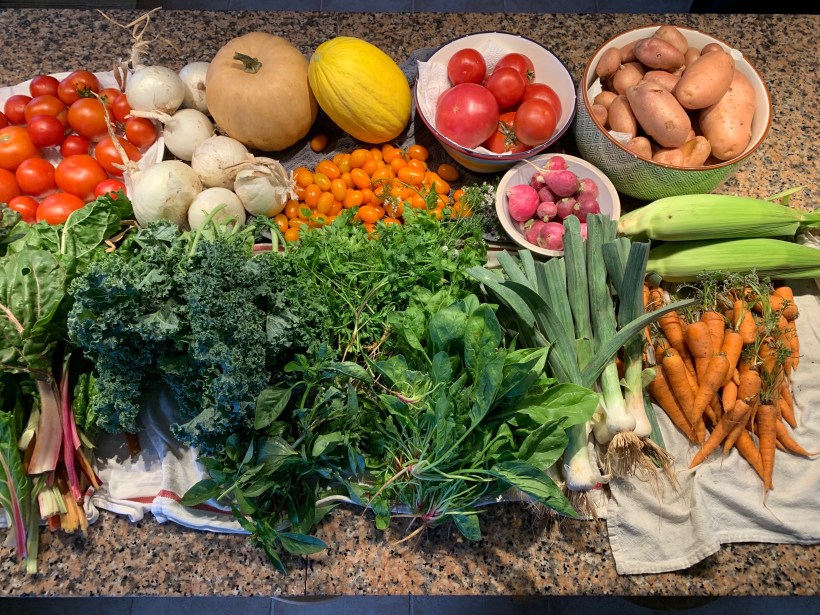
We let our amazing house-helper Tourea know it was coming so that she could hand off the 200 MAD note and collect the basket (actually a three cubic foot plastic crate).  She did…and more. When we got home, Tourea had washed all the just-picked produce, put a drawfull of zucchini and peppers into the fridge, and laid the rest of it out on the counter for us to marvel at the bounty.  Potatoes, carrots, onions, winter squash, radishes, turnips, parsnips, leeks, corn, several different kinds of tomatoes, spinach, basil, cilantro, melons, and two things we have rarely seen in Morocco – and NEVER as beautiful as in this basket – chard and kale.

Kale!

Our vegetarian daughter, a kale fanatic, came back to visit us and make kale chips.  (Of course we know she loves us, but we also know that visiting us was an excuse to have kale.)  This haul of organic beauty would have cost at least five times as much in a U.S. grocery store, and not with farmers market freshness.  Even at Carrefour Gourmet in Casablanca we would have paid three or four times as much. We could not contain our excitement. We also could not find enough meals in the course of the ongoing week to eat it all.  So at the end of the week, anticipating the next basket’s arrival, we gave away what we had left (nearly half the basket!) to folks connected to the school who could put it to use.

Of course, we also posted a picture of the haul…and people began to inquire right away about how we had procured the load.  Before we knew it, interest piqued and people at school were talking about sharing baskets (knowing there was no way they could use an entire basket themselves).  This weekend we received our third delivery, and in addition to our own there were three more that came to our apartment as “delivery central” with each additional basket split between at least a couple people.  Meanwhile, Audrey is in Produce Heaven going through her Saturday morning ritual of combing through cookbooks to plan meals for the week (her de-stressing activity) before we do our Saturday shopping. No longer needing to buy veggies at Carrefour Gourmet, our Saturday grocery bill has dropped considerably thanks to the 200 MAD we give to La Ferme Bleue each Friday, and what used to be an hour-long shopping adventure has shortened by nearly half that time since we do not have to battle crowds moving slowly around les fruits et les légumes.

Suffice it to say that we have boosted our foodie resources in Casablanca considerably with the discovery of La Ferme Bleue.  We can plan meat and other meal elements around vegetables instead of vegetables around meat, which is how things should be.  Brian, a deeply devoted carnivore with midwestern roots in “brown and beige” meals, as a University of Virginia graduate school alumnus nonetheless likes to quote UVa Founder Thomas Jefferson in saying that meat should be a condiment.  After just three weeks, we feel more healthy already, and our counters and our refrigerator have never looked so good!

On your mark, get set, here we go!

Starting Year Four

This summer, as temperatures soar across so much of the globe, Casablanca has graced us with delightfully pleasant weather.  Deep down, we hope that is a good omen for what we anticipate will be a wonderful fourth year here.

Most expat staff and many Moroccan staff scoot out for a good bit of the summer break between one school year ending and the next one beginning.  While administrative responsibilities prevent us from decamping for too long, we disappeared for two weeks to meet up in northern Italy with some fellow foodie friends from our Cleveland days.  We basing one week in Torino and another in Bologna – with day trips to Lago di Como, the Barolo valley, Modena, and Parma to take full advantage of the scenery, the wines of Piemonte, and the regional foodie fare of balsamic and prosciutto – and spending one spectacular day at the Culinary Institute of Bologna mastering hand-rolled tagliatelle with true Bolognese sauce, deboning chickens to make authentic cacciatore, building an exquisite eggplant parmesan, and making tiramisu with hand-made mascarpone and soaking ladyfingers in Alkermes instead of in coffee.

We really tuned out from school during our much-needed two week vacation, and enjoyed the abbondanza to the fullest.  But it was hot…really hot…like, “When we got to Turin we searched for fans for days before finding a shop not sold out of them” hot.  Three years ago when we first arrived in Casablanca on July 21 we stepped out of our airplane onto the tarmac of Mohammed V Airport near midnight and got walloped by over 100F degrees and humidity to match.  Temps seemed not to change for three weeks as we sweated through each night lying in bed with a meager fan blowing on us from atop a dresser across our bedroom. Not so this year. When we returned to Casablanca, to GWA, and to work following our hiatus, we found our temperate coastal climate offering – egads! – temperate coastal temperatures, cool breezes rolling up the hill from the shoreline less than a mile away in our 180° ocean view, and the most hospitable summer we have experienced since moving to Morocco.

Whether spurred by such a hospitable summer or some other catalyst, we have shared with each other our thoughts about how over the last three years some things in our Expat Expedition have changed and how other things have stayed the same.

In a broad sense, the more things change the more they stay the same.  For example, while faculty frolic around Morocco and in places around the globe, our devoted maintenance and cleaning crews always spend the summer months preparing the campus for the coming year.  The cleaning staff – dubbed our “ninjas” in GWA’s recently rededicated Instagram postings – once again have been scrubbing the campus buildings from top to bottom, washing all the classroom rugs and furniture, and flipping campus apartments vacated by departing staff to prepare them for new staff choosing to live on campus.  Meanwhile, the maintenance crew typically crams a year’s worth of projects into the summer break that this year is truncated to about five weeks. Among them, the dozen-year-old kitchen that has served well over 1,000,000 meals is getting a facelift. Moreover, having inaugurated our Library-Media-Technology Center in September 2017, the MakerSpace and Robotics programs featured prominently on the middle “Technology” floor of the building have outgrown their spaces there.  So this summer our crack maintenance crew has converted a four-bedroom apartment in one of our on-campus residence buildings to serve as the new MakerSpace and Robotics program areas. With residents moving out of the other apartments in the building, we have expanded our visual arts program by moving Upper School art up the hill into Middle School and High School multi-room art studios, which then lets us turn the former Upper School art space over to the Lower School in order to anchor the Elementary School art program that has been homeless for several years.  And our revitalized Parent Club is getting a studio apartment in the building as space of its own to facilitate the important partnership we have with our parent community.

And yet, some change brings newness to our lives as we gear up for Year Four.

Three years ago we looked at the fields on either side of Boulevard Abdelhadi Boutaleb as one approaches GWA’s entrance and mused how someday they would all disappear as Casablanca development continued to reach out toward us.  Little did we know how soon that would happen. Those beautiful fields, where sheep used to graze and wildflowers bloomed each February, are going away quickly as housing developments and shopping malls seem to rise from the ocean surf over the beachfront almost overnight.  Just as the scenery has changed, so has our presence here as we move into the more senior tenure group of veterans. But as much as these easy to mark changes stand out, we have two big changes that make our start to this year so different from how we started our first three years here.

First, with Charlotte’s graduation in June we have become empty nesters.  Yet her graduation is only a piece of our life adjustment. Even more significant is that she and her boyfriend of two years decided to get married, and rather than go to school in the U.S. she plans to stay in Morocco.  She has already found a job working in a nursery school and is preparing for further studies that will allow her ultimately to teach English in a Moroccan school. Zak, our son-in-law, is a wonderful young man with a caring and kind family.  After their marriage this Spring, Charlotte stayed with us through graduation to make going to class easier. Since June, though, she has lived with Zak on their floor of the family’s multi-story home that has three generations of Zak’s family living together.  After we gave them a “gradu-wedding” party the day following her GWA graduation, with both families and a number of friends celebrating their marriage, two different sets of Charlotte’s “Moroccan Mamas” also threw her two more wedding parties and Zak’s family did the same for their extended family.  Quite the cultural experience for us! Then, as she continued her adjustment to her new life, she let us know that she was converting to Islam and began covering in public with a hijab. It certainly was not something we expected when we first announced to our girls 3 ½ years ago that we were headed to Morocco; but Charlotte has grown into the independent and confident young woman we raised her to be, making decisions and understanding the responsibility that comes with them, and knows without question that we love her deeply for who she is.  And now we love Zak (and his family) as well. Our hope is that Zak will get a tourist visa to visit the U.S. so that they can travel with us in December and we can give them one more party in Washington State that lets Zak meet Charlotte’s extended family.

Second, at the same time we adjusted to Charlotte’s revised life plans, we also wrestled with what direction we wanted our post-children life to take.  After much prayer, discernment, and discussion on the topic, we ultimately decided that this will be our last year in Morocco and we will start the next phase of our Expat Expedition when our contracts expire at the end of the 2019-2020 school year.  That will make each step through this year special, starting with the arrival of newbie expat faculty this week and the kickoff of new faculty orientation with a bbq next Sunday afternoon. While we have interviews for what comes next for us, we will balance that excitement with the twin excitement of continuing to build GWA toward our vision and preparing to hand off leadership of our beloved school to those who will steer that continuing mission after this year.  One thing we know is that we will miss our ocean sunsets viewed from our apartment balcony, and that will make each one we witness over the next 11 months a true gift.

What has not changed is how much we love living in Morocco and being at GWA, even as we get set to launch our last year here.  Screening back our view, and as we look forward to celebrating our 23rd wedding anniversary right in the middle of new faculty orientation, all this reminds us what an adventure our life together is and has been, and even when we cannot see what lies around the corner for us we know that whatever it is we will engage fully, appreciate the excitement of the opportunities we find, and discover how we can make that piece of the world around us better.  That is what we do.

On your mark, get set, here we go!

Rounding Out Year Three

We have not posted on our blog in months.  Typical of the workload calendars we have experienced as heads in our previous schools, we are right on track with this year stretching our personal and institutional bandwidth as we forge ahead with continuous improvement efforts.  Our first year in Casablanca, with Brian in his current Director of Curriculum & Program Development role but before Audrey moved from Upper School Principal to Head of School, saw concentrated efforts focused on moving the academic program forward.  Last year, when Audrey assumed the HOS role and wrapped institutional advancement under the “program development” half of Brian, we expanded that program focus to include the school’s admissions, marketing, and alumni activity. This year, the focus expanded further to update the operations and HR elements of running a school while furthering and solidifying the previous years’ efforts and keeping the school on track with its ambitious School Improvement Plan being implemented in our current accreditation cycle.  Oh, and the daughter who came with us to Morocco three years ago will graduate next week after a senior year full of senior year things integrated into our daily lives.

Needless to say, though it seems we say it all the time, we have been busy.

But, with no shortage of potential post topics jumping to mind, busy-ness does not explain fully our lack of posts this Spring.  The less-evident but nonetheless stronger influence on the paucity of posts emerges from our status as third-year expats who continue to evolve in our expat experience and our interaction with the host culture in which we live.

Moving to Morocco three years ago brought much change as life bloomed with new experiences.  In our second year, those blossoms grew into new fruit that brought even greater excitement for our life here.  This year, it has ripened as our expat life continues to mature. Lots of things seem different this year, and that has affected us in many – mostly positive – ways.

Perhaps easiest to note, after hosting exactly one guest through our entire first two years – she coming to stay for a couple days just weeks after we arrived – our 25-month drought of guests ended as we moved into Year Three.  Brian’s Auntie Lisa and Uncle Dan Hall started the new flood last October when they finished a month making their way through Europe by ferrying across from Tarifa (Spain) to Tangier. We picked them up there, showed them the Caves of Hercules (where long ago Hercules rested before stealing the Golden Apples of the Hesperides as his 11th Labor), and stayed overnight in Tangier to tour the Medina and Kasbah the next day.  We then shot across the north coast of Morocco to Ceuta (one of two Spanish dots in Morocco, with Gibraltar and Spain visible due north across the Mediterranean) to pick up some meds for Charlotte not available here. We spent less time actually in Ceuta than we did sitting at the border beyond Spanish passport control waiting to re-enter Morocco, giving our travelers the experience of watching long lines of Moroccans walking through enclosed foot-traffic channels from Ceuta across the border back into Morocco laden with bags and packages…even saw a guy hauling the front bumper/grill of a car tied on the back of his scooter until he stopped in the middle of a traffic lane, got off, untied the enormous chrome, carried it across five lanes of waiting vehicles and hoisted it over the chain-link barrier fence to his buddy waiting for it on the other side.  On we went to “the Blue City” Chefchaouen for an overnight, marveling at the beautiful blue walls and art while declining politely the enthusiastic offers of hashish, then drove down from the north Atlas Mountains through agricultural lands and back to the Atlantic coast at Kenitra to head south to home for a couple more days in Casablanca. It was a short visit, capped with an obligatory tourist trip to Rick’s Cafe and its homage to Hollywood’s classic “Casablanca” (which really was about Tangier and had not a single scene shot in Morocco), but it was so good finally to have visitors again.

Two months later we hosted Brian’s college friend Lyle Frink (whom we had not seen in 20 years) and his family visiting Morocco from their home outside Prague, including a day-trip to the Roman and Arabic ruins at Chellah in Rabat.  Two more months later Brian’s parents arrived at the peak of Spring colors for a three-week stay that included exploring Morocco (reversing the Chefchaouen/Tangier stops) before ferrying across the Mediterranean for a couple days in Granada and a couple days in Sevilla.

Now, as we get set for Charlotte’s graduation in another week, a load of Graduation guests will arrive, including our girls’ former au pair Emma Kleinschnitz coming from the Canary Islands for our first time together in 10 years, and Brian’s Capitol Hill soulmate (and daughter Margaret’s godfather) Bob Castro and Brian’s goddaughter Grace Castro stopping off for Charlotte’s graduation on their way back from home in Oman to the U.S. for a couple summer months.  At the end of this month Charlotte’s godparents Sharon and Ken Forziati will join us with their children (including Charlotte’s godson Cono) for a few days on the tail end of their tour of Spain and Morocco. Finally on the docket are more of Brian’s college friends Nic and Kathryn Nelson and two of their children starting a multi-week tour of Morocco and Spain with a few days in Casablanca in July. (Of note, though not in Morocco, also is the first half of July that we will spend in Italy meeting up with good foodie friends from Cleveland John and Barb Savage.  Prosciutto and wine await!) Enjoying hosting people as much as we do, it heartens us finally to have people join us in Morocco to see our life here.

But what is different is more than finally having visitors.  Perhaps it is good that people waited to visit us here, because the Audrey and Brian introducing them to Morocco now are very different expats than the ones who hosted Scottsdale friend Annie Groth not two months after we first arrived.

Then everything was new, and we prided ourselves on being quick experts about everything in our small bubble of life in Casablanca.  Annie good-naturedly got the brunt of our freshmen fascinations with how people drive, how Morocco Mall stores advertise with western-friendly optics, how produce changes in souks by seasons, how people dress, how people drive carts the wrong way down busy streets, how commonly one can see a sheep ferried in the back seats of a BMW on its way home for Eid al-Adha, how people do whatever they do differently here than what we would see in our stateside lives…all “mastered” with the fresh eyes of newbie expats adjusting to our new lives by celebrating overtly adjusting to all we found new in our new lives.

During our new staff orientation three years ago, we said over and over, “It’s not bad; it’s just different.”  That strategy for managing culture shock loses intensity, though, when things just do not seem different any more.  We have learned better how to navigate the pathways of life in Morocco. We have routines. Things that may fluster new expats now do not fluster us as much, if at all.

For example, this week we finished our third holy month of Ramadan.  We remember how we began our first Ramadan two years ago with a mix of eagerness, intrigue, and serious intimidation.  We talked with others in our newbie cohort about “preparing” for Ramadan. Wanting not to offend our fasting Muslim colleagues, we wondered if we should hide away in our offices to eat lunch instead of going to the cafeteria as usual, and what other adjustments we should make to demonstrate what culturally-sensitive expats we could be.  Knowing that all sources of alcohol purchases would be closed from a few days before the sliver of moon marked the start of Ramadan until a few days after the next moon sliver marked its close and the start of Eid al-Fitr, we calculated carefully how much wine and other such supplies we should buy in advance to preserve our good hosting practices while entertaining friends without curtailing our own personal supply during the month.  Having heard about raucous streets full of grumpy people who had nothing to eat or drink all day careening down roads in their vehicles to get home before sunset, we wondered if we should venture out in our car.

As our third Ramadan rolled around, we did not think about the potential for insanity on the roads; we just knew to avoid driving before sunset if possible, and waiting until just after sunset (during ftour or iftar when people break the daily fast) meant owning the roads for an hour or so.  We know folks who this week took their children rollerblading and skateboarding at sunset in one of Casablanca’s largest intersections – at the Kenzi Towers, like Casa’s own Times Square in NYC – to enjoy the wide open space without a single vehicle anywhere in sight during the ftour that launched Eid al-Fitr and brought Ramadan to an end.  Overall, the extent to which we “prepared” for Ramadan this year dealt pretty much with ensuring proper logistical alignment for GWA’s schedule to account for the change in time:  abandoning Daylight Savings Time for the month, as happens nationwide, and delaying the start of school for an additional hour as a pragmatic acknowledgement that many parents – and even many students – stay up most of the night.  Oh, and once again we stocked up on alcohol…so we can be good hosts, of course.

Beyond that, now we find Ramadan a good time for reflection even for us non-Muslims, with the extended calls to prayer reminding us gently of things greater and more important than ourselves.  We tell stateside Christian friends and family that it is like Muslim Lent (as we also explained earlier this Spring to Muslim friends that Lent is like Christian Ramadan). We enjoy invitations from friends to join them in their homes for ftour, feasting on their good company and heaping plates of dates, eggs, almonds, chebakia, slou, chourchouka, zaalouk, msemmen, baghrir, khobz, roasted meats and vegetables, and mountains of fresh fruit, all washed down with Moroccan mint tea.  Contrasted with “preparation” for our first Ramadan, the hardest part of this third Ramadan for us will be starting school after the Eid break next Monday two hours earlier than what our body clocks have relished for a month as clocks in Morocco “spring forward” back to Daylight Savings Time and our school day begins again at the regular time instead of with an hour’s Ramadan Schedule delay.

As one major GWA graduation requirement, Charlotte conducted a capstone project with independent research into how acculturation strategies and sociocultural adaptation impact the ethnic identities of adolescent TCKs (“third culture kids”) in which she explored through interviews with current teenage TCKs and adult former TCKs  their “home culture” vs. “host culture” ethnic identities; self-efficacy of sociocultural adaptation; “vacation” vs. “living” modes of acculturation; and their prospective use of assimilation, integration, separation and marginalization as acculturation strategies. Applying this back to Charlotte, after living three years in Casablanca we see her as having adopted with great comfort the home culture of Morocco and acculturated easily into “living” mode as a TCK who seeks to “embrace the confusion, embrace the culture, embrace the richness of it all” as she finds herself not fully at ease with either American or Moroccan culture.

Charlotte’s adaptation exceeds ours greatly, and we have not yet progressed to the point of thinking of Morocco as a permanent home where we plan to retire.  (High on our list of retirement considerations is some Umbrian town in Italy, but we have many years of running schools ahead of us before that point.) Yet, as maturing expats we have moved past “vacation mode” to embrace the lives we are building here for as long as we stay at GWA.  We have family back in the U.S. that we like to visit, but we do not think like some expats we know of going “home” to the U.S. while we base our lives here. We have not assimilated, but daily life here is daily home here instead of everything being new, curious, and generally different.  Meanwhile, the strong relationships we have forged with Moroccan friends serve as interacting variables that both influence and result from our evolving “expatness.” These relationships with Morocco’s people and land alike make it less easy to see things and describe them in ways that stand out as, literally, remarkable.  Our desire to share posts remains strong, but we have not finished recalibrating our approach to doing so. We promise to continue our efforts and share this exciting expat expedition as it keeps steering us in ways we could not imagine three years ago. Meanwhile, stay tuned…

On your mark…get set…here we go!

Christmas in Expat Life: It’s a Small World After All

Through 22 years of marriage, we have always made Christmas a big deal. Typically we travelled to visit extended family or extended family traveled to visit us. We decorated the house – inside and out – to make it seasonally festive. (And, yes, said decorations sometimes stretched from one season to another as we occasionally put up a Christmas tree and took down an Easter tree.). We had big feasts with lots of cooking and pies. We continued family traditions tracing back to our childhoods, and even to previous generations, and built or modified traditions in our own immediate family of Brian, Audrey, Margaret, and Charlotte.

In all families, these things change over time, especially as children grow up and start their own lives. We always expected that. But expat life brought its own changes to our practice of Christmas. First, Margaret stayed in U.S. to get her GED and start college a year early instead of joining us in Morocco for her Senior Year of high school, so we entered our first holiday season abroad making plans to see her in the Pacific Northwest, where we would fly from Morocco and she would fly from Arizona. Second, that trip itself came as fulfillment of a promise Brian made to his mother – who was not keen on our moving overseas – that he would come back in December to see her and spend time joined in extended family revelry. So in December of our first year abroad the three of us – Brian, Audrey, and Charlotte – flew from Casablanca to Charles de Gaul Airport for an overnight that gave Charlotte her first time setting foot in France, then on to SeaTac Airport for grandparents to welcome us when we emerged from Baggage Claim with suitcases stuffed with typical “First Christmas Back From Morocco” presents we bought for the extended family at the Habbous (inlaid boxes, hand-carved trays, and poofs – round camel skin ottomans than Moroccans stuff with old shirts to “poof” then out), Jellabas we had handmade for Brian’s mother and sister that they could wear as nightgowns, and a Casablanca Harley-Davidson t-shirt for Brian’s Harley-riding stepfather. We had traveled farther to get there, we had brought gifts we could not buy in the U.S., and we loved having Margaret join us so we could see her for the first time since June before we left for Morocco. Still, Christmas had not changed all that much from the previous range of scenarios established in our prior two decades of married life.

Last year that changed as we established a new model option that took advantage of the small world in which we live our expat lives. Brian returned again to the Pacific Northwest, as promised to his mother. But Audrey and Charlotte took advantage of Morocco’s proximity for easy travel to Europe and had their own Christmas expedition to Amsterdam, including visits to the Anne Frank House, to a Gouda factory, and to a working windmill in the countryside. Margaret, who was working in Arizona, could not head north to join Brian with the rest of the extended family. We wished we could all be together for Christmas, but we also were happy to be able to have Christmases that met our desires otherwise among the opportunities available to us in this small world.

This year we repeated that option, with just how small this big world is reinforced repeatedly.

Brian again kept his promise to his mother to return in December, the best time to catch as many extended family as possible when three generations of aunts, uncles, and cousins gather for Christmas. It began with both small and not-so-small world experiences. Taking off from Casablanca’s Mohamed V Airport on Saturday, GWA faculty and staff represented a good proportion of passengers on the TAP flight to Lisbon, Portugal. Lisbon served as a stopping point for some, but for most was a gateway to Christmas destinations around Europe – from Prague to England to Scandinavia. When Brian purchased the flights for his trip, he THOUGHT he had set it up to fly a most reasonable route from Casa to Montreal to Vancouver. Yet, after hitting the “purchase tickets” button his itinerary had somehow switched to a first leg from Casa to Lisbon, twiddling thumbs through a 12-hour overnight layover, then departing at 5:00 am for Frankfurt, then having less than an hour to get to go through Passport Control and get to a new gate to depart from Frankfurt for a 10-hour flight to Vancouver, all before trekking through the Peace Arch at the U.S.-Canada border (complete with three-hour wait in a barely-moving line of cars at the border) and heading into Washington State. As small a world as we have, the 36 hours between a mid-afternoon departure from Casablanca to arriving in the Cascade Mountains town of Skykomish emphasized to him how big our small world remains. Still, he enjoyed small world reminders everywhere along the way. As one example, long hours aside, the comfort of traveling from one country to another with confidence and ease stands as a quiet reward of expat life. As another, flying to Lisbon he sat next to seven-year-old Inez, an energetic girl who flipped the window shade up and down 793 times and pushed all the buttons around her 10,285 times in the first five minutes of taking her seat; yet, by the time they landed Inez had become Brian’s new buddy, being silly and having fun together while eating the in-flight meal and taking turns making moves in a wood puzzle game on Brian’s iPad. Her mother asked Brian from across the aisle, “How are you communicating with her? She speaks no English.” Brian responded, “With a little French, less Darija, and lots of gesturing. Besides, I work for a school: I speak Kid.” Indeed, kids are kids across the globe. As one more, switching from Casablanca life to small town Christmas in the Cascades of the Pacific Northwest comes easily, taking in the scenery of snow-covered mountains and snow plows on Highway 2, going to the Skykomish Community Church on Christmas Eve, and popping over to the Whistling Post watering hole to visit with town friends of his parents before heading to the family cabin for this year’s practice of pizza and birthday cake – a Christmas Eve tradition that has continued in his family for 50 years. Finally, technology makes the world flatter and closer. Despite missing Audrey and Charlotte in Europe and Margaret in Arizona, he talked with them all daily, shared/received pictures of Christmas taking place in all three spots on the globe, and wished them all Merry Christmas on Christmas with love sent through WiFi.

Meanwhile, Audrey and a Charlotte took off on Char’s “Last Hurrah” traveling in Europe before she graduates next Spring and returns in eight months to the U.S. for college. As Brian prepared a couple months ago to buy tickets for Christmas in Washington, Charlotte said, “Why would I want to spend Christmas in Washington State when I will be there for the next four years in college, if instead I can hop up to Europe and get a few more stamps in my passport from countries I have not visited yet?” So she and Audrey planned a trip to Munich, Prague, and Budapest – including some travel by train, Char’s favorite mode of transportation. They have packed much into their time – a Christmas Village and a trip to Dachau Concentration Camp in Germany; arriving in Prague on Christmas Eve Day, exploring the historic city as Audrey begins to think it may rival Italy as a prospective retirement palace for us, and Charlotte attending Christmas Day Mass at the big, old, beautiful St. Vitus church; and then on to Hungary to see the Blue Danube and eat Hungarian bread and Dobos Cake. Small world reminders come not only from the simple feasibility of hitting pieces of Germany, Czech Republic, and Hungary in a short period of time, but also from the encounters they have had. One day on the street they ran into a George Washington Academy teacher who had flown with Brian to Lisbon before making a connection to another European Christmas destination. On Christmas Eve they had dinner with friends from our Virginia days whom we had not seen in 15 years, but who now live in Italy and happened also to be in Prague for Christmas. And on Christmas Day they visited Brian’s college friend Lyle – who came to Czech Republic nearly 30 years ago to visit a friend and stayed – and his Czech family who live a short commuter train ride outside Prague, and who we had not seen in more than two decades until they visited us in Casablanca two weeks ago amid their family tour of Morocco.

What a blessing to live in a world where it is all so easy…not without challenge, but very feasible when opening up to the possibilities that abound. Merry Christmas and Happy New Year!

On your mark…get set…here we go!

Cultural Case Study: Navigating “Inshallah”

Moving to Morocco meant lots of adjustments in our lives. One particular cultural change: discovering what “Inshallah” means in theory versus in practice. “Inshallah” translates as “If Allah wills it,” or, more generally, “God willing.” The idea brings God into even the small things in life, and imbues daily living with piety. In practice, people attach “Inshallah” to everything in ways that reflect how God’s plan and our expectations may not sync as we would like. If you make plans to meet up with someone tomorrow and then say how much you look forward to seeing them, “Inshallah” comes as the likely response. Yesterday we bought a new mattress, and in confirming the scheduled delivery date the salesman finished with “Inshallah.” Anything expected to happen in the future lies in the realm of “Inshallah.”

For two weeks we have lived “Inshallah” daily while relying for transportation on a teeny Fiat speck of an automobile. Our regular wheels ride on a Honda Pilot with room enough to match our three-bedroom apartment. As happens with vehicles well past a decade old, though, the Honda has needed engine work that we have put off for a while. Over the summer, we managed without the car for a few weeks while a mechanic took apart the engine to find the source of an oil leak, ordered a key part to fix the leak, and waited for the part to arrive. We managed fairly well, but eventually needed to get the car back (particularly after Charlotte returned from her stateside visit with family and friends and wanted mom and dad to chauffeur her to her social obligations). With the part still not received, the mechanic put the engine together and sent the car back to us in the same slow-leak condition in which he received it. We knew we would again need to turn over the car some time after the part came in, but agreed that whenever that happened we needed to get a rental car.

Fast forward a few months, after Brian’s visiting relatives have returned to the U.S. and we can make due with a smaller vehicle for a time. The person facilitating our auto repairs also set up a rental car for us so that we could still get around, shop, make off campus appointments, chauffeur Charlotte, etc., telling us that the mechanic would need the car for 10 days…Inshallah. Our monster of a vehicle (that Moroccan parking lines can barely contain) disappeared, and in its place the Fiat materialized…Well, in a small fraction of its place…a very small fraction of its place.

We actually did not have cause to drive it for several days after it arrived. Then last weekend, the end of the first of two weeks we expected to have it, we drove to Rabat for a Commissary run (see our post, from approximately two years ago, after our first Commissary run). Audrey said that when the Fiat got delivered she was told it would need gas, and it could probably benefit from putting air in the tires. Oh, and the driver-side window does not go down. No worries, we can manage such challenges. We got in — with Brian adjusting posture with lopsided shoulders and knees running a snug fit under the steering wheel — and fired it up to see that we probably had enough gas in the tank to get to a gas station, but not much more than that. Before we headed to get gas, though, Brian had to figure out how to drive this hybrid: not a gas/electric hybrid motor, but a standard/automatic hybrid transmission. The car has no clutch, but it has a stick that can go into neutral, reverse, higher gears (+) or lower gears (-), as well as slide off to the side to a spot marked “A/M” to run in automatic transmission mode (with no reverse in A/M, only in manual mode). We learned quickly that sometimes it takes a few times trying before it goes into Reverse, and that going into automatic mode requires holding the stick in the A/M spot for a while before it clicks in and the dashboard reads “auto” to indicate hands-free gear-changing success. Once Brian coaxed it into Reverse, we headed to the gas station and on to Rabat to buy Tostitos, pinto beans, bacon, and other expat delicacies.

The route to Rabat has two tolls along the way (again in reverse heading home). Because the driver’s window does not work, each time we came to a garde de péage (toll booth) Brian had to fix our trajectory in such a way that he could open the driver’s door without smashing it against the toll booth and with enough space to lean out and hand the 10 dhs or 23 dhs tolls to the toll-takers, but not so distant that he could not reach the far-outstretched hand of said toll-takers (who watched the laborious spectacle with perplexed expressions) even after unbuckling his seat belt. But we discovered the windshield wipers work very well, inshallah, because we have skipped Autumn and run straight into Winter’s rains that dumped buckets several times during our trip to Rabat and back. On the other hand, during yesterday’s mattress-buying quest, we discovered amid a suddenly and unexpectedly warm day that the red light indicating the fan’s air conditioning mode provided the only difference from mere blower mode because the air conditioner emitted no conditioned air. Audrey enjoyed rolling down the passenger window, but Brian endured the sun baking him through the driver window that does not go down.

We look forward to getting our gigantic Honda Pilot back with a leak-free engine, with ample space for shoulders and knees, with the ability to put down windows on both sides of the vehicle, and even with the option to leave windows closed and blast conditioned cold air out of the vents while driving on a warm day (even though Moroccans tend to eschew a/c, insisting that it makes people sick). Yet, we also know the expectation of such things is a luxury, and we are most fortunate to be able to enjoy them when we have them, inshallah. Meanwhile, unlike the shoehorning we have to do trying to park the Honda either on the curb or within the lines of a parking lot or garage not meant for so large a vehicle, we can park the Fiat pretty much anywhere. It reminds us to keep our expectations in check, that everything carries a mix of both more and less desirable qualities, and that whether those qualities seem more or less desirable often comes back to our expectations. Something GWA emphasizes with new expat faculty and staff during our newbie orientation is the line, “It’s not bad; it’s just different,” when encountering things here unlike how things exist in life somewhere else.

The Fiat speck-of-a-car came to us for 10 days…Inshallah. As we neared the end of Week Two, Audrey inquired as to when we might get our giant Honda back.

One more week…Inshallah.

On your mark…get set…here we go!

Our First Family Visitors: Triumph of the Parking Guardians

Recently some friends in this year’s cohort of new faculty asked us what purpose Morocco’s parking guardians served and if they actually did anything beyond directing you how to parallel park in a space half the size of your vehicle to earn the few dirham people pay them. Beyond referring them to our blog post on the subject from our first year in Morocco for more details, we gave our friends examples from the last two years of parking guardians protecting our car from hooligans and from people trying to put a tire boot on our vehicle when we forget to buy a ticket at the ubiquitous parking machines for two dirham (a whopping 20 cents). In case those reasons were not enough to convince our new friends, we will have to revisit the conversation with them in light of our Fall Break experiences this week, giving us two great “Triumph of the Parking Guardians” examples of why they are a great feature of living in Morocco.

While the photo accompanying this post highlights our first family members to visit us in Morocco, a long-awaited and much-anticipated time in our expat lives, in truth their visit serves to give an expansive backdrop to the two-act parking guardian drama we enjoyed with them.

As prologue, we should note that when we announced to family in the Spring of 2016 our intention to be expats in Casablanca working at GWA, the news met with various reactions. More than two years later, we continue to encounter various family reactions to our ongoing expat lives, ranging from expressed desires to visit for an exotic vacation to bewildered curiosity to active disinterest in reading our blog in order to learn what our lives here are like. People thinking of moving abroad, let alone moving to Morocco, should prepare themselves for such an array of reactions from friends and family. Some people close to you and with whom you want to share the exciting things you encounter in your expat experience will show great interest in how your life differs in some ways and not in others from theirs; others will want to know if you are happy and if life is good, but will have difficulty sustaining interest in details that stretch too far beyond the borders of their own life experience; still others will not hide their disinterest, and in some cases even resentment. As much as these latter sentiments may stifle your excitement to share your expat experience, it is important to remember that some close to you may not realize the hurt you feel from their reaction because they, in turn, take your departure as your choice to move further from their lives, not only geographically but in other ways as well. So all three of us – Audrey, Brian, and Charlotte – have looked forward for months with great anticipation to the arrival of Brian’s Auntie Lisa and Uncle Dan during GWA’s weeklong Fall Break as our first family visitors.

Last Saturday we left Charlotte in Casablanca to earn money pet-sitting for several GWA folks heading out of town for the weeklong Break (Morocco’s high unemployment rate making it practically impossible for teenagers to find jobs for extra cash, since working at McDonald’s can be an adult-level career move). For 4 ½ hours we drove north and then east along Morocco’s Atlantic and Mediterranean coasts to enter Ceuta, Spain. Ceuta exists as one of two historic Spanish enclaves on the Mediterranean’s African coast that Morocco claims are remnants of colonialism and seeks for Spain to return to Moroccan control. For expats in Morocco needing to leave the country every 90 days while waiting to receive their residency paperwork, Ceuta offers a way to enter Spain without paying for round trip ferry tickets to Tarifa or Algeciras in Iberian Spain. For us, Ceuta provides a means of Charlotte getting a Spanish prescription for meds unavailable in Morocco. After two years of effort, we finally got a Moroccan doctor to prescribe the medication she had in the U.S., only to discover that pharmacies in Italy, France, and Spain (and presumably the rest of Europe) would not honor the Moroccan prescription. So last month Brian took Charlotte to a Spanish doctor in Ceuta who wrote prescriptions for six months. They brought back a one-month supply from a pharmacy, and now we headed back to get more after coordinating a pickup day with the pharmacy by email.

The only problem was that after arriving mid-afternoon in Ceuta and going to the pharmacy before checking into our hotel, we discovered that the pharmacy from which we had ordered the meds had closed at 1:30 pm and (with Spain as a Catholic country) would remain closed on Sunday and not reopen until Monday…but we had to pick up Auntie Lisa and Uncle Dan in Tangier on Sunday to begin their Moroccan expedition. Oops.

We enjoyed an evening in Ceuta, shopped at Ceuta’s giant Carrefour megastore for supplies not available in Morocco (dried pinto beans and black beans, canned poblano peppers, Sweet Baby Ray’s BBQ sauce for us, Ken’s Steakhouse Honey Mustard Dressing for Char, a particular juice for which Char begged, roasted-salted sunflower seeds for Brian, a couple high-end bottles of bourbon and rum, and…FINALLY…light bulbs for ceiling fans!), and called Auntie Lisa and Uncle Dan in Sevilla (their last stop after a month in Europe before ferrying from Spain to Morocco) to gauge their interest in comparing Iberian Spain with Moroccan Spain…in order for us to make a second effort at getting Char’s meds. Thankfully, they were intrigued by the idea, including experiencing the border crossing from Morocco to Ceuta and back again. After our breakfast on Sunday of Iberian ham and Manchego cheese toasted on a baguette, we headed back along the Mediterranean coast to Tangier to meet them at the ferry terminal.

We had a brief blast with them in Tangier, though Auntie Lisa came down with a bad cold that she picked up in Spain and which depleted her energy for too much Moroccan exploration. On the Atlantic coast just outside Tangier we visited the famous Caves of Hercules, where legend has it that Hercules rested before undertaking his 11th Labor to steal the Golden Apples of the Hesperides and more recently Def Leppard gave a concert in 1995. In the evening we walked from our hotel through the Medina and up a steep climb to the Kasbah for a spectacular dinner. On Monday morning, while Auntie Lisa rested we went with Uncle Dan on a Medina tour. Setting it up through the hotel Concierge, Audrey wisely specified that we did not want any high-pressure sales stops in Medina shops; we just wanted a great tour and were willing to pay our guide more for it. That was exactly what our tour guide Abdelmajid gave us, rich with detail and history (from visiting an historic synagogue in the Jewish sector to dropping in to Café Baba where the Rolling Stones used to hang out). The highlight was touring the American Legation house, given to the U.S. by Sultan Moulay Suliman in 1821 as a symbol of the historic friendship between Morocco and America (dating back to 1777, when Morocco became the first nation to recognize the newly declared United States of America), which served as a legation and consulate for nearly 140 years and remains U.S. property inside Tangier’s Medina walls.

Following lunch, we hopped back in the car and drove east for Ceuta Run #2, crossing the border, picking up Char’s meds, and heading back across the border again. Heading back from Ceuta to Morocco at the end of our mini-excursion took considerably longer with both foot and vehicle traffic backed up quite a distance. From the perch of our car, Auntie Lisa and Uncle Dan got to view the parade of pedestrians and drivers loaded with boxes and bags and blankets and more blankets and virtually anything else one could imagine (including an auto’s front end someone carried on his scooter until – apparently not wanting to go through Moroccan customs inspection with it – he untied it, left his scooter in a vehicle line while hauling his parcel to the border fence, then heaved it over the fence to his confederate on the other side to scurry away with it while he returned to his waiting scooter).

Finally through the border and back in Morocco, we headed off to our next stop of Chefchaouen, the famous “Blue City” in Morocco’s northern Atlas Mountains. Our Ceuta detour and border crossing delay meant we did not arrive in Chefchaouen until well after dark. Then we had to find the owner of the Booking.com apartment Audrey had rented for the night (more below). By the time we settled into our low-brow 39€ “You (almost) get what you pay for” somewhat disappointing apartment, all the cafés and restaurants were closed. Uncle Dan and Brian ventured out into the Chefchaouen night as hunter-gatherers to pick up some yogurt, fruit, chips, juice, and Moroccan cookies from hanouts around the apartment and bring them back as something somewhat resembling dinner. In the morning, with Auntie Lisa’s cold getting worse we packed up our things and hauled them through Chefchaouen’s beautiful blue streets, taking lots of pictures along the way, and stopping to eat a Moroccan buffet breakfast at a hotel just outside the blue Medina. Trudging on to our car, we bid Chefchaouen adieu and continued touring Auntie Lisa and Uncle Dan from the mountains down through agricultural lands and a rain-soaked farmers market as we moved toward Kinetra, then headed southwest on the A1 highway to Casablanca.

Once in Casablanca on Tuesday afternoon, we made our apartment at GWA home base. While Auntie Lisa continued to rest up, Audrey made chicken soup for dinner and Charlotte got to visit with the folks she knows and refers to as GAL and GUD (Great-Auntie Lisa and Great-Uncle Dan). On Wednesday morning, we all went to the Habbous neighborhood to shop for mementos GAL and GUD could bring home from their Moroccan adventure, stopping at the olive souk for some local flavor. From the Habbous we moved to Rick’s Café for culinary flavor, the admitted tourist spot with great food and service that was high on their list of things to see and which we are always happy to have an excuse to enjoy. After another early night, we got up Thursday morning, walked down the hill to print out boarding passes and do a quick tour of GWA’s Library-Media-Technology Center, and headed to Mohammed V Airport so GAL and GUD could bring their trip to a close and wing back to the U.S. after gracing us with their wonderful visit.

What does this have to do with parking guardians?

Twice during the Great Family Visit adventure, parking guardians came to the rescue to keep the trip from falling into chaos. First, after picking up our guests at the Tangier ferry terminal we drove to the El Minzah hotel where we had made reservations. That morning we received a text from the El Minzah confirming the reservation and wishing us a happy stay there. Yet, when we arrived at the El Minzah, we discovered the door locked and the place dark. A beggar sitting on the curb kept saying, “fermé” (“closed”). Initially we thought she meant it would open later in the afternoon, but slowly we realized she meant it was just CLOSED! Puzzled, perplexed, and looking silly standing on a busy Tangier street with luggage and no place to take it, a parking guardian appeared and explained in French that the El Minzah had been closed for several months for renovation, during which time all El Minzah reservations move automatically to its sister hotel several blocks away. He then helped us load the bags back into the car and told us to follow him in the vehicle while he ran (in his flip-flops) several blocks down one street and up another to lead us to the Grand Hotel Ville de France, where he then explained to the hotel staff that we were El Minzah transplants. For his great help, as well as his flip-flop marathon, Brian gave him a 20 dirham note (about $2 USD). We marveled through the end of the trip days later how he saved the day.

Second, the next night as we approached Chefchaouen on a dark and windy two-lane road with oncoming traffic that often crossed the center line on sharp turns, Audrey called the owner of the apartment she had reserved through Booking.com. He spoke no English, and she had trouble following his French but agreed to call him once we actually arrived in town. Pulling into Chefchaouen and finding what seemed to be a public square, we parked so that she could call him again. He gave vague instructions for us to drive toward the Medina, find a place to park, and call again to meet up with him. Following signs for the old city with parked cars lining both sides of the road as we drove, we finally found a underground parking garage run by a pair of teenage parking guardians, one wearing what looked like a high school letterman’s jacket from the U.S. and the other in a t-shirt, jeans, and flip-flops. While Letterman Guardian told Brian that it cost 50 dirham ($5) to park overnight, Audrey called the apartment owner to see how and where we could meet up with him. As she still struggled getting helpful details from his French, Flip-Flop Guardian grabbed Audrey’s phone and started talking with the apartment owner, negotiated a meet up spot, then grabbed a couple suitcases and started to lead our troop through a drizzly night uphill on a rough-stoned sidewalk. After several blocks, he somehow located the apartment owner and introduced Audrey. Following the brief introduction, the apartment owner grabbed a bag and continued moving rapidly uphill and into the Medina, turning along different streets and alleys and not paying heed to the tired and sick Americans in his wake. Brian finally called to him, “Monsieur, s’il vous plaît, ma tante est malade!” (Sir, please, my aunt is sick!) Rather than abandoning us to our new leader disappearing into the night, Flip-Flop Guardian continued after him – two bags in tow behind him – intent on seeing us through to our destination. As the apartment owner continued deeper into the Medina, Flip-Flop Guardian ran behind him close enough to follow where he went while stopping and looking back that to ensure that we did not get lost bringing up the rear. Not only did he deliver us to our destination building, but he helped haul our bags up the multiple sets of stairs to the actual apartment and made sure we were set before heading back to his parking garage with an appreciative tip from Brian in his pocket. The next morning when we returned to the car for our drive to Casablanca, the guys seemed nowhere to be found until Brian discovered them sleeping on cots in a small office with the window cracked just enough for Brian to reach through and leave 50 dirham for parking on a desk without disturbing their slumber.

We loved hosting our first family visitors in Morocco, and we look forward to more coming to see our lives here and spend enough time – whether a few days or a few weeks – to explore Moroccan culture enough to see why we love living here. When they do, as part of that understanding we certainly will show them what great assets parking guardians are for making life here enjoyable.

On your mark…get set…here we go!