Transition: Life in Purgatory

When Brian served a decade ago as the Head of two schools in Baton Rouge (Louisiana) affiliated with the Redemptorist order of priests and brothers, now and then Brother Clem walked a few blocks from the St. Gerard’s Parish rectory to visit Brian in his office in the high school building.  On one such occasion, they talked about their favorite prayers.  Brother Clem made an impression on Brian with what he shared:  “Lord, thank you for letting me be where I need to be when I need to be there.”  Since then Brian has applied it to find purpose in whatever challenges he undertakes as he follows his “Go where God calls you!” personal mission.  But since we landed back in the U.S. on July 15, our relative self-quarantine time has allowed a different appreciation for Brother Clem’s prayer.  We did not look forward to spending two weeks in self-quarantine 10 minutes from Dulles International Airport.  Unexpectedly, though, we found the change in scenery and setting from this purgatory stage between Morocco and Panamá where we needed to be when we needed to be here.

Following our repatriation flight from Casablanca, we checked into a residential hotel suite reserved on Bookings.com and settled in to see as few people as possible until we could continue on to Panamá.  We chose the location carefully:  a quick shuttle ride from/to the airport, friends in the area upon whom we could call for help if we need it, and an easy 15-minute walk to a Giant grocery story that let us satisfy any cravings for things on which to snack or things to cook in our “kitchen” of a stovetop, a frying pan, and a microwave.

We actually have done quite well preparing meals, marked most notably by the grand total of 25 ears of steamed corn we have eaten together since arriving two weeks ago.  Morocco’s list of heavenly produce does not include good corn, ergo we have missed it and wanted to maximize its consumption while here.  When we do not cook, we take advantage of a delivery service that brings food from area restaurants.  Between near-daily walks to Giant and restaurant deliveries, our gluttony satisfied “back in the USA” cravings for fried chicken, ribs, cheeseburgers, pork chops, ham steak, kielbasa, pizza with “real” pepperoni, tortilla chips and “cheese crack” (our family name for Tostitos Salsa Con Queso), mint Oreos, Claussen dill pickles, pita chips and hummus, celery and peanut butter, and more.  One sad thing about arriving in Panamá:  we will unpack our scale and have to get on it.  If we planned to remain here longer, we would have conducted our culinary activity differently; but with the hope of staying in purgatory only briefly, we opted for temporary decadence.

Despite plans to see as few people as possible in order to minimize exposure that might keep us from continuing on to Panamá, Brian’s longtime friend Doug Gray invited us to visit a couple hours away in Richmond.  We hoped to take him up on his offer, but the combination of Audrey’s work schedule and the need to be proximate to Dulles in case we suddenly got approved for a flight to Panamá kept us in our small world between hotel room and grocery store.  So instead of catching up with friends, we fascinated ourselves with things we rediscovered in suburban Northern Virginia like shopping carts with fixed-direction back wheels (making them easy to turn without counter-shifting full body weight), American toilets, sidewalks along grassy greenscapes, people conscientious about social distancing and wearing masks when passing or being around others (a lesson many elsewhere throughout the U.S. need to learn as well), a relative absence of litter, large multi-lane intersections with pedestrian buttons at crosswalks, green trees clumped closely together (i.e., “woods”), reliable internet, the ground floor of buildings as Floor #1 instead of Floor #0, and air conditioning.

On our first day here we celebrated Audrey’s birthday by ordering dinner from P.F. Chang’s (and discovered from their fortune cookie messages that the restaurant we used to enjoy in Scottsdale was their original one).  As we dined on our hotel table, the beautiful sunset we saw through our room’s windows gave us comfort with a view different from what we enjoyed from our Casablanca balcony for four years but still under the same sky that connects us to the people we know and love back in Morocco.

It also was Audrey’s first day of full-time work at ISP, something much easier to fulfill just one hour ahead of Panamanian time instead of the six hour time difference in Casablanca that governed the hundreds of transition meetings and interactions she has had over the last several months.  She has thrown herself completely into her new role as School Director of the International School of Panamá, leading the school’s reconception of online learning as they prepare for classes to start online on August 20.  Despite very long hours already, even in this virtual atmosphere, she feels in heaven with her new school.  In her first board meeting yesterday, she marveled at how they had a clear agenda, stuck to it, stuck to the prescribed times, and accomplished a tremendous amount in just 2 ½ hours.  Like school administrators around the world right now, she has an incredible amount to do leading up to classes starting; but she could not be more pleased to have joined the ISP community.

Even though we have yet to arrive physically, Brian also has enjoyed the ISP community already, glimpsing what lies ahead from our current place in purgatory.  In addition to faculty and administrators reaching out to welcome him and starting to get to know each other through Facebook posts and messages, the “small world” factor has kicked in as old friends scattered around the world let him know that they have friends with children at ISP, leading to more outreach and useful information as we seek to set up life there remotely for when we arrive.  One big help was ISP sending someone to our soon-to-be house across the street from the school to receive our container shipment that sailed across the Atlantic Ocean and cleared customs before we have been able to arrive ourselves.  We brimmed with excitement on Friday when Audrey’s phone pinged with pics sent to show everything boxed and ready for us to enjoy Christmas in July when we get there, opening up all the packages and putting things in their new spots in our Panamanian home.  Another help has been an ISP neighbor offering to receive a grocery delivery for us and take it to our house.  So over the weekend Brian built a grocery order at Riba Smith, a top Panamanian grocery chain, to be delivered just before we arrive.  He discovered, not surprisingly, the superiority of searching for items in Spanish rather than using Google’s auto-translate function, because the first item that came up for “soap” was Brillo Pads, and the label for a picture of fresh mint in the produce department translated as “good grass.”  But our kitchen will have food in it as we begin the mandatory two week home quarantine that Panamá requires once we arrive.

Thankfully, that will start tomorrow!  We decided to leave Morocco without knowing when we could finish our journey to Panamá after weighing a number of factors.  First, while Morocco had done relatively well containing COVID-19, we worried that large numbers of people ignored social distancing and other prudent (and considerate) public health protocols and, consequently, that the number of novo coronavirus cases would start to go up.  (Indeed, since we left that exact thing has happened, prompting the government to begin tightening controls again.)  Second, we hoped that our connections in the powers that be could help us get to Panamá from the U.S., whereas they could do nothing to help us get there from Morocco.  Indeed, that ended up being the case as a team of lawyers, ISP-connected people, and other advocates began working to get us the permission we needed from the Panamanian government to allow us onto a repatriation flight from Dulles to Panamá City.  As days passed, we learned that Copa Airlines had seats reserved for us on the July 29 flight, but we could not actually buy those seats until we had permission from the Panamanian government in hand.  That finally came this weekend, so right away we called Copa to buy our seats and shift our purgatory thinking from “someday” to “next Wednesday” for when we finally could go home for the first time.

So today, while Audrey had meetings all day, Brian has worked to reshuffle how bags are packed in order to fit the different weight limits than we had for our Casablanca-to-Dulles flight two weeks ago.  The luggage scale we bought a couple years ago has proven one of our most practical purchases ever to load bags down to the last ounces or grams.

Purgatory has been unexpectedly good to us, with very hospitable circumstances for just the right amount of time.  We have been where we needed to be when we needed to be here.  Tomorrow we will bid adieu to our purgatory home and shuttle back over to Dulles, prepared for another exceedingly long process of checking in and boarding.  If all goes well, we will take off around 4:00 pm East Coast time and land around 8:15 pm Panamá time.  But expectations are everything in such travel, so we will be happy just to get to Panamá at some point, work our way through Passport Control, get our bags, connect with our ride, and get home at whatever time we get there.

Meanwhile, it is good to know that we can experience sunsets even in purgatory, and we look forward to experiencing them in Panamá as well.

On your mark, get set, here we go!

Transition: Leaving Morocco

Last Wednesday we left Morocco, six days shy of a full four years since arriving at Casablanca’s Mohamed V Airport at midnight in hot and humid July.  The warm and sticky air that whallopped us that night as we emerged from the plane to descend the mobile stairs and shuttle from tarmac to terminal proved a physical representation of crossing a symbolic threshold into expat life with much change in store for us.  Since then we have learned much, grown much, made friends for life, and given our daughter to this beautiful country and its magnificent people.  We had planned to title our final Morocco post “Moving to Panamá.”  That plan had just one flaw:  We departed Morocco on Wednesday, yet we still do not know when we actually will arrive in Panamá; so we focus in this post on leaving Morocco and the mix of emotions it contained, and save arriving in Panamá for a post to follow our actually getting there.

We left also just days shy of Charlotte and her husband, Zak, presenting us with our first grandchild.  With her actual due date approaching quickly, we had hoped still to reside in Morocco for that event; but in the Age of COVID-19, making prudent plans and calculations does not work as it used to work.  Likewise, we had hoped airports in Morocco and Panamá would open from their respective quarantine closures at roughly the same time so that we could route from Casablanca to Panamá City with just one or two layovers, depositing us in our new home just a day’s travel after leaving our old home.  That, too, did not happen.  So, after waiting two weeks past our originally-planned departure date to see (1) if Charlotte would pop and (2) if both airports would open, we opted to exit Morocco on a repatriation flight, arranged by the U.S. Consulate in Casablanca, to Dulles International Airport and to twiddle our thumbs outside Washington, D.C., until we can make the second half of our transition journey to Panamá.

Through our last month in Morocco we had much time to prepare for our departure mentally, emotionally, practically, and logistically.  We organized our apartment into things movers would pack on June 1 and ship in a container to Panamá; GWA-owned things staying where they were; things we would give to Charlotte and others; things we would sell; and things (weighed to the last ounce) for us to pack into the two suitcases each allotted to us for commercial international flights.  Still, with mental, practical, and logistical preparations made and remade to adjust to revised pre-departure circumstances – first, when it became clear we could not leave at the end of a June; then, when we reached the tipping point of deciding we should take the State Department repatriation flight with hopes of getting to Panamá soon – emotionally our departure day hit us hard as we left a school and community to which we have given our full devotion for four years.

We had a tremendously hard time saying goodbye to the people of GWA.  Typically we close the school year in the large Multi-Purpose Room with an all-staff celebration that recognizes each academic and operational division’s team members; lauds individuals marking their five/ten/fifteen/twenty year employment milestones at GWA; says goodbye to staff members departing at the close of the year; and with great applause echoing through the big space accompanying each part of the celebration.  Instead, as the end of school drew near with Morocco’s quarantine ongoing, we often stood on our on-campus apartment balcony and looked forlornly out over the empty campus feeling deeply our impending separation…made stronger still by the physical separation we had all endured since Morocco’s quarantine began in mid-March.  Since we never returned to on-campus operations after starting online school, the HR office replaced that physically-present MPR celebration with an online video that simply could not substitute fully for the bizous, hugs, and good wishes from the Housekeeping, Maintenance, Kitchen, Groundskeeping, Bus Driver, HR, Finance, and other academic and operational teams that fill about half the time of the usual closing celebration.  Not being able to say goodbye to the hundreds of people with whom we worked to move GWA’s Vision Statement forward made us deeply, deeply sad.  We did, though, at least enjoy one final gathering of our on-campus apartment “neighborhood” in a socially-distanced goodbye picnic that culminated with the viewing of a surprise farewell video featuring goodbye messages, photos, and video testimonials from dozens of teachers, TAs, administrators, and staff.  (You can watch it on this link and see if you bawl through all 34 minutes and 8 seconds of it like we did. https://drive.google.com/file/d/12GP5QDsLzTqc0wyzkstOEAp6uqKwBKPM/view?ts=5eecebcb)

Saying goodbye to friends also proved almost completely impossible under the quarantined circumstances, even after Casablanca started opening up slowly, because we kept such a low profile to minimize exposure that might end up keeping us from traveling to Panamá once airports opened up.  We did get to see a number of women at a baby shower for Charlotte that friend and GWA teacher Tanya organized with Audrey a week before we left.  Brian also got to see most of his Admissions & Marketing team at a farewell dinner that they organized for him.  And on the morning of our departure, friends Rachid and Nisrine shared a quick but delicious Moroccan breakfast with us in their home before we rushed to the airport.  But we felt terrible for not being able to say goodbye to so many friends, whether from GWA or around Casablanca.

The hardest goodbye, of course, was to Charlotte and Zak.  On the Friday before we left, we went to their Oulfa neighborhood to share couscous with them and Zak’s family.  (Friday couscous in Morocco is like high family time Sunday dinner in the U.S.)  Spending time with Zak’s family embodies for us the expat experience, with warmth, laughter, and understanding between Zak’s dear parents (not able to converse in English) and us (not able to converse in Darija or French) thanks to translation by Charlotte, Zak, and Zak’s siblings, and to basic human-to-human interaction between us all.  Through our closing weeks we spent lots of time with Charlotte, who regularly visited or spent the night in our GWA apartment or in the Bookings.com rental where we went after leaving our campus home, and Zak, who sometimes accompanied her on daytime or overnight visits.  Such time never seemed enough, though, while preparing for the real goodbye approaching us.  We practiced a soft version of empty-nesting over the last year, finding Charlotte back with us regularly from her new home 10-minutes away for an afternoon, an overnight, or several days as she took advantage of our internet bandwidth and our bathtub; but leaving Morocco would mean real empty-nesting with Margaret launched in Arizona and Charlotte starting her own family in Casablanca.  So many emotions coursed through us and Charlotte, and in our closing days together we all agreed to back away from getting too mushy with each other for fear of the dike bursting and inconsolable tears flooding our remaining time.  Thankfully we live in an age when we can text and talk and video chat any time with either of our girls wherever any of us may be in the world, shrinking slightly the knots in our stomachs over how much we miss them.  Still, talking daily with Charlotte since we left does not undue the great sadness of driving away from her on our way to the airport.

Apart from the emotions of goodbyes, the weeks leading to our departure provided strange times, great stress, and the opportunity to hone 21st century pedagogy skills:  maximizing flexibility for nimbleness; practicing grit; seeking comfort with ambiguity over leaving Morocco and departing to Panamá; and utilizing digital literacy to stay abreast of all that is happening in our daily life craziness and the craziness that seems to engulf the U.S. and the world.  Meanwhile, Audrey kept meeting virtually with her new staff and board at ISP as they continued preparations for classes starting this fall, and we spent time processing the often-Kafkaesque craziness of our final months at GWA.

After waiting for airports to open to let us leave on our schedule, then recasting expectations for when airports would eventually open to let us transition easily from Morocco to Panamá, we finally recast them once again as we reached the tipping point of taking a repatriation flight to the U.S. without knowing when we will proceed to Panamá.  That meant having to replan our travel packing from the two bags each we could take on a commercial flight to the single bag each we could take on the embassy-organized flight.  (Zak quickly offered for us to store the suitcases we could not take with us in his family’s house for Brian to bring to Panamá when he returns, once airports open this fall, to see our new grandson.)

Our charter flight out of Morocco ended up being an extremely long travel day.  It took nearly four hours to check in and board, even with seven counters open for a flight with about 300 passengers.  The Consulate General staff were out in force.  Passengers experienced a slow but fairly standard procedure for checking in and boarding our flight; but our Foreign Service staff in charge of the chartered flight followed a protocol more like an evacuation, ensuring that everyone supposed to be on board was actually on board before pulling back from the gate.  We had lots of time to talk with State Department friends as we worked slowly through the long check-in line.  Upon seeing us, more than one consulate staff member said different versions of “Hmmm, I don’t see your name on the manifest…guess you’ll have to stay” or just “Nope…sorry, we’re not letting you leave,” making us feel, in our final moments as Moroccan residents, one more nod of appreciation for what we have done over the last four years.

Despite signage to the contrary all over the airports, we experienced only minimal social distancing at best, whether in Casablanca’s airport, on board the flight, or after arriving and deplaning at Dulles.  A basic tally of people around us at any point revealed roughly one third of people not wearing their masks properly…if they made any effort at all.  The most common annoying mis-mask was “nosehanger” people with masks covering their mouths but leaving their noses completely uncovered.  Why even bother or pretend?

Our 2:15pm flight finally took off at 3:45pm, and London-based cargo carrier Titan Airways whisked us across the Atlantic Ocean.  The flight – with every seat sold – was definitely “no frills” and without social distancing.  Seats did not recline and looked more like bus or metro seats, but they were not much more uncomfortable than seats in many airlines we have flown recently as they seek to cut costs any way they can.  We had bag meals with bottles of water waiting for us in our seats, and no other food or beverage service throughout the eight hour flight; so with no airport vendors open past security to sell us water before boarding, we rationed our water carefully.  But the plane was clean, maintained well, and kept at a comfortable temperature throughout the journey, and the flight crew were very nice despite not rolling beverage carts through the aisles during the long flight.  How happy we were when Audrey pressed the call button just on the off chance that they might have more water available if we asked, and they actually brought us each another cold bottle.  The least enjoyable aspect of the flight – other than being thirsty – was the large number of little ones flying with us.  Maybe it just seemed like a large number because every small child we could see within a few rows of us (which totaled at least eight) was doing its appropriate job to make lots of noise, produce attention-grabbing smells, kick seats, and scream at the top of his or her lungs for extended periods.  It was like “the nightly canine social hour” at twilight, when one outdoor dog starts barking and then another joins in and another and another throughout the neighborhood.  In our case, one baby would start screaming and then another would join in and another and another throughout the plane.  And it was not baby social hour; it was baby social eight hours, with a near-constant handoff of high-pitched screaming from one cherub to another from takeoff to landing.  In such circumstances – when one has no way to quench a thirst or to stop babies from crying, the best thing to do is try sleeping, even in the flying bus seats that do not recline.  So that is what we did in order to make the flight seem to pass more quickly.  And we read on our iPads.  And we looked at the virtual map on the flight’s online app, AirTanker Entertainment, trying to will the flight further along by putting a finger on the map’s virtual airplane over the ocean and moving it toward Dulles…to no avail.

Eventually we landed at Dulles outside Washington, D.C.  Then it took the better part of an hour for us to deplane because they let only 50 people off the plane at a time before waiting for the lone tarmac-to-terminal bus to do a round trip for its next group of passengers.  Then, with reduced staffing to fit the small number of international flights, it took more than 90 minutes to get cleared by Customs & Border Patrol for re-entry to America.  Then, thankfully, our checked bags were waiting for us and we had only a brief wait for our hotel shuttle to take us ten minutes away to our self-quarantining home until we leave for Panamá (whenever that will be).

We have kept even further under the radar here in Northern Virginia than we did during our closing weeks in Casablanca, going out only to walk to a grocery store 15 minutes away for supplies.  When we do not cook in our residential hotel suite, we have DoorDash deliver from area restaurants.  We have working internet and can get whatever we need with relative ease, letting us survive this cloister easily enough.  But we feel stuck in purgatory between Morocco and Panamá more than we feel like we have returned to the U.S., expats not quite fitting with native culture even here while we wait to finish the transition to our new Panamanian home.

We know that once we get to Panamá, our call to international education will continue to enrich our lives in fulfilling ways.  Rarely can one find a profession that provides evenings like a dinner last year with GWA’s external International Baccalaureate consultant and our IB development team gathered around a long restaurant table with at least four languages flying back and forth and switching out as best fit different conversations.  More broadly, in international education we seek to make the world a better place one student at a time.  We have great excitement for what lies ahead in Panamá once we finally get there.  Audrey has started working full time virtually in her new role as Director of the International School of Panamá; Brian has started transitioning from school administration into writing and other long-neglected projects; and together we have started transitioning from the professional team relationship that dominated both our work and home lives at GWA back to the marriage team supporting each other’s separate professional pursuits that we have had for two and a half decades.  Nonetheless, we had…we still have…a hard time saying goodbye to our wonderful Moroccan home and everyone in it.  That stands perhaps as the greatest downside of international school educators living as expats:  each year, whether among those staying or leaving, you have to say goodbye to people for whom you care.

As we left our Moroccan home on July 15, we barely noticed that the air once again was warm and sticky.  Certainly, it paled in comparison to the warm and sticky rain forest air that awaits us in Panamá.  That much we know.  What we cannot know, but look forward with great anticipation to discovering, is what adventures Panamá has in store for us.  Longer term, we have excitement for what lies ahead once the world can move beyond the upheaval that started months ago and appears intent to continue disrupting everything for who knows how long.  Practicing what we preach about 21st century skills, we are ready to step forward, deeper into ambiguity, buoyed by the support and affection of friends and family from our years in Morocco, and ready to enjoy the thrills that this roller coaster ride of life gives us while we move, together, along the track.  A friend posted on Facebook that a theme park in Japan has discouraged screaming on roller coasters to hamper the spread of the Coronavirus.  Instead, it says, “Please scream inside your heart.”  With our hands stretched out as far as they go, eyes wide, and wind tossing our hair while we plummet down the track, we feel the excitement and are screaming inside our hearts.

We thank you, Morocco, for all that you gave us during our time living there.  We love you, and we will return soon.  We not only have left pieces of our hearts there; we must come back to see our flesh and blood.  Charlotte captured us in a photo looking wistfully at the last sunset over the Atlantic Ocean that we watched from our on-campus apartment’s balcony.  We think it portrays well our hope, inchallah, that this is not goodbye; it is only à bientôt and bislama…We will see you soon.

On your mark, get set, here we go!

Missing Our House Helper*

(*To respect our house helper we do not share her name here.)

Yesterday GWA celebrated the Class of 2020, like so many schools worldwide right now, with an online commencement ceremony.  In the coming week faculty and staff will close out the school year, packing up classrooms with social distancing.  Like yesterday’s graduation, the all-staff celebration held typically on the last day – when everyone comes together one final time to wish bonne vacances to those not returning until the fall and bon courage to those heading to new adventures – shifted to a prerecorded format which the HR department instead shared early and online with faculty and staff last week.  As usual, it recognized the academic, administrative, and operational divisions; spotlighted people who have given 5, 10, 15, and 20 years of their lives to GWA; and acknowledged those leaving GWA at the close of this year.  Alas, just as the timing of its release felt off from the norm, the bisous and hugs that usually mark this wonderful annual event with warm humanity, could not translate to the online format.

A few weeks ago Audrey hosted a synchronous all-school staff meeting with 146 people online to talk about how we would close out this school year.  It was the first time in more than two months that so many GWA people had interacted together, even virtually, with so many others.  It felt so good to see many faces we have not seen for so long.  Typical of Morocco, the first 20 percent of the meeting was spent with a gaggle of sound and faces lighting up the screen like the grand finale of a fireworks display as people greeted each other in hundreds of long-overdue mini-conversations about health and family and wellness with many hamdullahs.  We have a close community, and we all miss each other.

That feeling does not go away completely even when we see people who have come to campus for a designated purpose, because the masks we wear and the social distancing we practice force the bisous and hugs that punctuate normal interaction into unsatisfying long-distance gestures while eyes say, “I wish I could hug you and kiss your cheek.”  Of all that Morocco offers to expats who accept the invitation to join the Culture of Marhaba, our relationships with the people who have entered our lives and let us into theirs stand at the top of the list.  Depriving us of them since mid-March leaves an emptiness in us, especially as we try to make sense of the missing resolution that results from remaining engaged at full speed in our GWA responsibilities to the very end while preparing mentally and emotionally to leave Morocco and our family and friends here.

Throughout the quarantine, one person has topped the list of people we have missed:  the woman who helps in our house.

She joined our lives as a house helper three years ago.  Quickly we realized how pivotal she was in our lives.  With her unable to come to us since the quarantine began in mid-March, we have survived without her because we are capable, functioning adults.  Yet, in the last three months we both have exclaimed repeatedly, “Oh, I miss her!”

We arrived in Morocco four years ago with no expectation of having someone help in the house.  Brian’s family comes from Minnesota farm stock that focused on self-sufficiency instead of paying someone else to do what one could do for oneself.  Brian considered it bad parenting to raise our children without showing them the basic survival skills of how to clean a toilet, load a dishwasher properly, do laundry, make a bed, and sweep the floor.  Brian’s Grandmother Elsie set the standard for that ethic throughout her life.  Having cleaned other people’s houses, done their laundry and ironing, cooked and baked for them, and generally make life easier for them since she was a girl, she cleaned her own house through her 80s – not only moving her oven and refrigerator by herself to clean behind them, but waxing them so that they looked as shiny and new as when she had bought them decades before.  Even after moving into assisting living, she continued to clean and vacuum her apartment until her mid-90s.  But at the start of our expat life in Morocco many expats told us the same three reasons we should get someone to help in the house.  First, even with the big pay cuts we took to come to Morocco our income was sufficient to hire someone to help at home.  Second, relying on open windows and doors to bring in fresh air and to cool the apartment, Moroccan dust would accumulate everywhere in no time without regular cleaning.  Third, most important, and most challenging to Brian’s upbringing in the realm of self-reliance, was that for expats with sufficient incomes to do such things for themselves instead of hiring someone to help could be seen as taking a job away from someone who needs it.  How much of that last factor is actually true and how much is expat mythology we still do not know, but we agreed to find someone to help.

The first was a dear woman who lived in a poor neighborhood a short walk from GWA’s campus.  Her husband is the imam for the neighborhood mosque, chanting the Call to Prayer from its minaret multiple times a day, and her sister works on GWA’s housekeeping staff.  Our hearts broke when she died suddenly in January of our first year.  The second started with us soon afterwards, but we always felt uncomfortable with her in the house, and after a while we noticed little things disappearing.  Though we never found clear evidence of wrongdoing, we decided to replace her when we learned that our current house helper would have a couple days available each week after one family with whom she worked left Morocco in June of 2017.

In any industry, people of quality have positive reputations that precede them.  Such is the case in the community of women who have found a niche taking care of GWA families in their homes on and off campus.  No different than in the U.S., they receive far too little recognition as a stakeholder group in GWA’s broader community, yet both individually and as a group they contribute significantly to the quality of life and community here.  This wonderful woman stands at the top of that group.  She accomplishes more in a few hours than would take others far more time to do, and does it with incomparable work ethic, determination, and even ability to anticipate our household needs even before we know what they are.  And, even with her having not much English or French and us having not much Darija, she does it communicating a warmth and caring underneath the tornado-like seriousness with which she goes through each day.

Soon after she came into our lives, we came to understand that we do not live in our house.  We live in her house.  She reorganized our cabinets, drawers, closets, countertops.  Countless times we have looked for something only to find that she has moved it to a location she thought made more sense than where we had it.  Usually she was right.  Sometimes we dared to move it back to where we had it previously.  The next time we would look for it we would discover it moved again to where she wanted it.  At some point we hit the “I Accept” button and put things where she thought they should be.  For weeks after the quarantine started we commented to each other when emptying the dishwasher, “That’s not where You Know Who wants it.”

Before Charlotte moved out last year, she took particularly good care of her.  When Charlotte’s bedroom was in a special state of teenage mayhem, we would close Charlotte’s bedroom door and tell her not to bother cleaning the mess inside it.  She never listened, and Charlotte would come home from school to find a clean room with fresh bed linens; clothes cleaned and stowed away properly in the dresser or closet; and food containers collected, washed, and put away in the kitchen.

When we had a problem with an entire brigade of ants marching one by one into our apartment from outside our bedroom, Brian smeared fruit jelly laced with boric acid around their entry points around our bedroom’s sliding door and in Audrey’s closet.  The ants loved it and feasted.  The next day, she did not.  She cleaned up the jelly smears, bought a can of ant spray, and left it subtly-not-subtly in prominent view.  When Brian smeared again upon the ants’ reemergence the following spring, she went further by re-caulking the cracks around the sliding door.  We have so many other anecdotes about her care for us, from reorganizing the plants in Brian’s balcony garden to letting us know what cleaning supplies have run out by leaving the empty containers of vinegar or Ajax or dish soap in the spot on the dining room hutch where we would leave her pay.

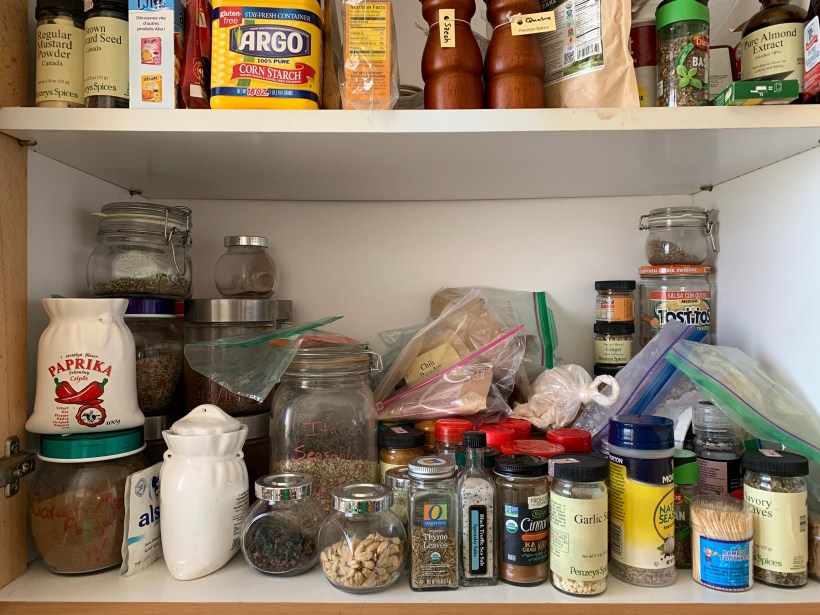
Throughout the quarantine when she has not been able to come, we have taken care of all the things that she did to make our lives easier, but we have felt her absence as much as we felt her presence before all this craziness hit.  If she saw the current disorganization of our spice cupboard, our pantry shelves, and other things as we have kept them since mid-March, we are sure she would quietly set to putting them all back the way they are supposed to be.  We still hope that before we leave we can tell her face to face how much we appreciate her and have loved her as part of our family in Morocco.

On your mark, get set, here we go!

Taking Stock of Things:  Pantry, Freezer, Cabinets, and Wine

Our Spring Break started on Friday, and with it started Ramadan.  We loved having Charlotte and Zak stay with us for the first month of Morocco’s quarantine.  Then they left a few days before Ramadan began to hunker down through the Holy Month and for the remainder of the quarantine back home with Zak’s family 10 minutes away in the Oulfa neighborhood.  We will miss quarantining with them, but we are happy they can celebrate Ramadan in a house filled with family to celebrate with them.  We wish all our Muslim family and friends Ramadan Mubarak Kareem!

With their departure we have resumed empty-nesting, albeit the quarantine version.  We cook for two instead of juggling various palettes of world foodies, carnivore halal, and vegetarian halal.  We remember how much easier it is to keep up with dishes and kitchen mess with just two people.  Audrey has “her” bathroom back as Brian reclaimed “his” bathroom that Charlotte and Zak used while they stayed with us.  Instead of wondering if we can make it two weeks without shopping, Brian thinks we can make it at least three weeks before going out again.  And, at the same time, we miss having them here while also appreciating the simplicity of having fewer schedules, needs, and idiosyncrasies to balance.

Two nights ago we left open the sliding door to the balcony so that we could enjoy fresh air while we slept.  In Morocco, fresh air is deemed a cure-all while Moroccans consider conditioned air to be very unhealthy.  The COVID-19 pandemic and its resultant quarantine cannot keep Spring from coming, and we now have weather perfect for opening up windows and doors to let in the ocean breeze that rolls up the hill from the beach.  But while we slept, an unseasonal storm intruded on the peaceful night and sprayed its shower through the open balcony door.  By the time the claps of thunder woke Brian, we had a small lake extending from the door across the dining area floor of our common room.  Rather than mop it up in the middle of the night, he just closed the door and left the lake to dry.  By morning the tile had dried pretty well.  That resembles our lives right now:  something seems okay, then unexpectedly it turns on its end, then with discernment and patience it works through to being okay again.

Spring Break allows us some cognitive dissonance from the craziness that has surrounded us for weeks.  Of course, we cannot travel anywhere, but even after just a few days we feel our tanks starting to refill from this treat of a staycation.  GWA’s Online School continues to go well; the spirits of people in our school community remain positive, even with people here and there showing signs of weariness from monotony, routine, and cabin fever.  Our HR team has organized a rich assortment of Spring Break quarantine activities that people can join to remain connected with community and find distraction from the rigors of Online School.  Having a week to turn off constant attention to leadership, letting regular email check-ins suffice, has proven invaluable for us.  Yet, one thing always hovering is a cloud of surrealism fogging our days, as in the backs of our minds we try to reconcile excitement from planning to move across the ocean with the daily reality of both Morocco and Panama remaining resolutely under quarantine.

To be sure, we feel well-blessed in our quarantine situation.  To allow some absurdity, we started rewatching “The Walking Dead” on Amazon Prime.  Before moving to Morocco we used to watch weekly episodes as a family.  The zombie element appealed to Audrey and the girls, all horror movie fans.  Brian, a fan of neither horror flicks nor zombie things but a political scientist by academic training, connected with the show’s inherent manifestations of political philosophy with themes of the the state of nature versus civil society, virtue, communitarianism, aristotelian concepts of good versus bad government, and more.  Upon first-run watch, the outlandishness of TWD’s post-apocalyptic dystopia let us think, “That’s so crazy.”  However, rewatching episodes in the present (we have binged through five seasons since the quarantine began) gives us a different perspective as now we see it in a new light and think half-jokingly, “We’re so glad things are not THAT bad.”

As the most obvious impact on our planning, injecting a pandemic into our prep work had us jettison the six-month, easy pace, no-stress approach we envisioned originally.  To set the stage, understand that we are professionals at moving:  In nearly two and a half decades of marriage we have moved – whether across town, across a state, across the country, or internationally – no fewer than 10 times, seven times in just our first decade together.  For our seventh move, Brian even created a sophisticated labeling system to help movers know in what rooms to put boxes upon delivery and to help us know box contents during unpacking after movers put them in the wrong rooms.

Ramping up for what we hope will be our last move in a long time, true to form we started so organized.  We planned very well.  Coming back in January from spending Christmas with extended family in the Pacific Northwest, together we constructed a “Relocation Planning” spreadsheet complete with tabs for things like questions Audrey should ask the International School of Panama to help us plan; a running list of items to sell or give away; information about shipping companies to carry our things across the Atlantic; and a master calendar that marked when we would make two transition trips to Panama (now not happening), when family and friends would take advantage of their last chance to visit us in Morocco (now not coming), and other key events scheduled through Spring (also cancelled).  Indeed, we took the photo for this post in February when we first thought we would write about our rational, disciplined, organized plan to eat through our food and use our other supplies before moving at the end of June.

People plan; God laughs.  

Not to say that pandemics are amusing, or that God observes the current world circumstances with a flippant attitude.  But our sticking to such a deliberate and intentional course of action amid the global pandemic would reveal it as merely contrived and not strategic.  Suddenly, instead of continuing to whittle down our supplies, we bought more to ensure a provisioned home for four adults facing a quarantine of unforeseeable length.  Then, for a month we resupplied to maintain our stock.  However, now our footing has changed and we must reposition again.

We have dwindled from four people to two.  We know better what to expect for the duration of Morocco’s quarantine.  We feel more confident that Morocco will begin to relax restrictions after passing the May 20 extension of its state of emergency.  As best as we can tell, flights out of Morocco will likely resume in time for our departure at the end of June.  Likewise, Panama also seems likely to open to flights in by the time of our planned entry.  So, now with just two months instead of six to implement transition plans, we again have taken stock of what we have in our pantry, our freezer, our cabinets, and on the closet floor that serves as a makeshift wine cellar.

Simpler meal-planning also allows for better leftovers planning.  A big pot of spaghetti sauce, soup, or chili gives us dinner one night and breakfast or lunch for days after.  This week we contemplated a soup exchange, with breakfast entaling Audrey eating leftover sausage and kale soup and Brian eating leftover turkey and wild rice soup, then switching for lunch.  Brian messed it up by eating leftover chicken stir-fry instead for a late brunch, but at least Audrey held to the plan.  The bottom line imperative is that we keep eating what we have in stock, which we are doing well.  Due to Brian’s quarantine buying of tomato sauce, tomato paste, and pasta that comprise roughly a quarter of our pantry space, we might as well pull out Strega Nona’s magic pasta pot (shout out to our elementary educator friends!) to maintain the near-constant option of pasta and sauce.  In the cupboards we have several pounds each of dried black beans and pinto beans, plus different kinds of rice and lentils, a chef’s collection of dried herbs and spices, not to mention oils and sauces and vinegars that let Brian utilize the Comice Pear and Blueberry balsamic vinegars to create a superb pear-blueberry sauce to accompany a duck breast he pulled out of the freezer to pan-sear two nights ago.  In our standing freezer inventory conducted over the weekend, in addition to a large bag of Amoud baguettes and msemmen made by our wonderful housekeeper Tourea (whom we have missed dearly during the quarantine, and about whom we plan an upcoming post) we noted chicken breasts, chicken brochette, a whole chicken to roast for one dinner and provide makings for chicken stock and soup, ground beef, filet mignon, beef brochette, tagine beef, a few packs of bacon, a pork tenderloin, several packs of mild and hot ground Italian sausage, and a few packs of Ballpark beef hotdogs.  Add to that the upright freezer’s supplies of homemade refried beans, roasted tomato sauce, sliced rhubarb waiting for a pie or crisp, and various other things to build into an inventory consumption plan.

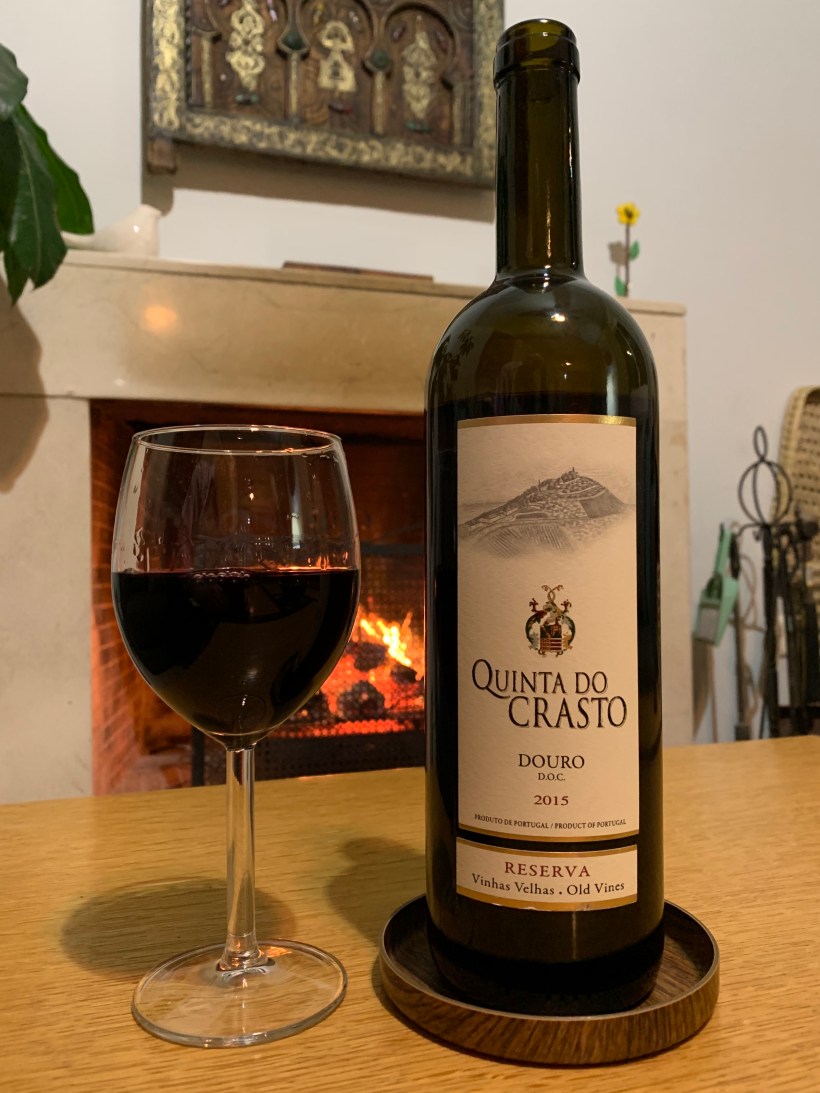
Then, of course, we have the wine.  For four years we have enjoyed fully the easy and affordable access to European wines that allowed us to stay stocked.  Not only did we make regular acquisitions at Grand Sud Import, our favorite place to buy wine in Casablanca that let us buy fabulous Bordeauxs, Burgundies, and Chiantis for prices that turn our stateside oenophile friends green with jealousy, but we typically have returned from travels to Europe with native wines in tow (minding the two-bottles-per-adult customs limit for entering Morocco):  Portuguese ports (LBV, 30-year, and 40-year) and wines from the Douro Valley; Brunellos from Montalcino and Barolos from the Piedmont traveling in Italy; Bergeracs and Bordeauxs from the month we lived in the Dordogne region of France.  One delightful task when preparing to move is having to drink the cellar.  In our Cleveland home we converted a ramshackle basement pantry into one with custom shelving for kitchen appliances; platters, trays, and other supplies for large-scale fancy entertaining; and a wine rack that held up to 144 bottles.  Audrey and the girls preceded Brian to Louisiana by a year so he could finish transitioning successfully his turn-around school there, so he had to rely regularly on friends to help him take care of the cellar stock before joining the rest of the family in Louisiana.  We had to be more creative in our Louisiana and Arizona houses that did not have basement cellar racks because they had no basements, but we still managed to maintain good inventory, whether to entertain or simply to enjoy a nice bottle together.  Each time we moved, we delighted in addressing the same “problem” in the weeks and months leading toward the departure date.  Once again, now, we must make due with having to eliminate our wine stock.  Brian inventoried what we have on hand and, now looking at the two-month mark, delights in backwards planning consumption of the list from best-bottles-last to “What should we have with beef stir-fry tonight?”

The stretch processing all this scenario planning requires makes our brains elastic.  The addition of doing it juxtaposed with the surrealism of our cognitive dissonance between planning and our current quarantine status stretches them further, to the point of being hypnagogic if being on Spring Break did not allow us to sleep in and nap as we wish.  With luck, we will have everything on track by the time Online School resumes next week.  Par for the course:  something seems okay, then unexpectedly it turns on its end, then with discernment and patience it works through to being okay again.

On your mark, get set, here we go!

Starting the New Normal…However Long It Lasts: Part Three

And so, with the blink of an eye, we find ourselves one month into quarantine.  On March 19 the Moroccan government announced the State of Emergency and declared it would take effect on March 20.  In the weeks leading up to it we got GWA ready and transitioned student learning to an online platform, and prepared ourselves at home as best we could for whatever twists and turns of life we might experience under the inevitable quarantine.  Then it began, and the four of us – Audrey, Brian, Charlotte, and Zak – began to establish routines and to discover how to live as a family of adults together in one apartment during a world pandemic.

An immediate adjustment for us, as we presume everyone globally in these circumstances also has made, came with the need to reconceive space professionally and personally.  With three of us involved in GWA’s Online School (Audrey and Brian as administrators, and Charlotte teaching her two-year-old Nursery students online), we had to find the balance between divvying up individual working space and sharing limited real estate (and internet signal) in the apartment.  Informally we each staked ground at our dining room table, evolving into small but clearly-established territories that let all three of us work next to each other as long as not more than one person had a virtual meeting at a time. In our first Crisis Management Team and Senior Leadership Team meetings, we both joined from the table with Brian muting his mic and turning off his sound to avoid feedback echoing into the meeting from Audrey’s on-his-right computer.  But this had the strange effect of Audrey’s sound-activated but non-speaking image hitting everyone’s Google Hangouts or Zoom screens whenever Brian spoke in meetings from his seat to Audrey’s left. So Brian started relocating from the joint “office” dining room table to our bedroom to join our joint meetings in that wifi-deprived room, using the hotspot on his phone to connect his computer.

For those meetings with just one of us on at a time, not only do we have to check schedules with each other so we do not double-book (or so that the double-booker has to go to a bedroom for their meeting), but when working quietly next to someone in a virtual meeting we have to respect the meeting’s invisible “office walls” to prevent jumping into each other’s meetings just because we are proximate.

Personally, having four people in a three-bedroom apartment (with stocked kitchen and pantry, balcony, roof, and neighbors with whom we can socialize distantly) provides more than adequate space.  Still, after nearly a year of Charlotte and Zak living in his family’s Oulfa home and us enjoying empty-nesting, we all had to renorm to respect each other’s needs, preferences, desires, and even idiosyncrasies.  At the same time, we enjoyed the cultural mixing that occured, perhaps represented best by the chicken and vegetable tagine Zak prepared for dinner one night, spiced with garlic salt and Tony Chachere’s Creole Seasoning that entered our family life during our years living in Louisiana.

We have also enjoyed how social distancing has leveled the playing field of socializing (distantly) as time zones have stood out as the only thing that distinguishes people not inhabiting the same abode.  During Holy Week, Brian followed the same digital resource prepared by the Diocese of Phoenix that his church choir friends back at our Scottsdale parish used and watched the same online sharing of music that they watched, leading him to comment that in a strange way the social distancing keeping us all in our respective homes made him feel closer to them.  Even more digitally cool was when Brian was FaceTiming with his sister in Washington State while Charlotte did the same with our former au pair in the Canary Islands off the coast of Africa, leading sister and au pair to catch up screen to screen via Casablanca as Brian and Charlotte held the phones up to face each other.

The new normal we are living still allows for things and routines in our lives from before, but often with new distinctly COVID-19 twists.  We shop for supplies; but “we” now means Brian, and weekly shopping on Saturday mornings now means supply runs every two weeks preferably not on a weekend day in order to have fewer people around.  Shopping preparation does not start with Audrey planning out menus around which to build shopping lists; now it means adding to a running list kept on the refrigerator door of what we hope Brian will find at the store.  Mostly things remain well-stocked: on one trip he finds no mushrooms or garlic, and on another trip no broccoli or Audrey’s favorite peach-mango tea. Stores restock, though, so he usually can find later what he could not find when he first looked for it.  Except for limes. Brian has seen no juicy, fresh, imported limes – begging to join their friends tequila, Cointreau, and Grand Marnier for a fiesta in a pitcher – since shortly after Morocco’s borders closed. That goes for other imports as well. Barilla pasta, shipped from Italy, was as common here as in the U.S. until Italy blew up with COVID-19.  Then pasta made in Morocco increased its market share on grocery shelves to fill space Barilla’s absence left empty. We have no shortage of TP, other paper products, and additional staples of life, though; so we suffer mainly from First World Problems in our Second World Country, compared to the perception we have of Third World challenges about which people keep posting they are suffering back in the U.S.  Another big change in shopping prep is that before Brian brings our bags and baskets down to the car he gears up like a CDC researcher heading into a BSL-4 containment lab (the highest level of protection) with gloves, mask, the same jeans and jacket he wears only for shopping, and a generous supply of disinfecting wipes for the shopping cart, his hands, his phone, and anything else that may need wiping down.

Another tweaked similarity of the new normal to the old normal is deliveries.  Before we did not order restaurant deliveries, so their closing with the quarantine did not affect us.  We wondered if we could still get our weekly organic produce delivery from Le Ferme Bleu on Friday afternoons.  No problem! Better still, we discovered that Amoud Boulangerie et Patisserie delivers during the quarantine, so we have fresh baguettes and croissants.  And our favorite place to buy wine in Casablanca, Grand Sud Import, sent out their list of available wines by email so that Brian could put together a group order with others in the apartments wishing to join in a delivery before stores stop selling wine for Ramadan.

Much of our adjustment to quarantine life comes with the need to plan for contingencies.  We both have participated in webinars and virtual meetings with international school leaders around the world discussing every aspect of the COVID-19 impact one can imagine.  One webinar we both joined this week noted that in typical times schools plan through Strategic Planning, but in times like this schools cannot lean on such clear plans defined narrowly; instead, they must plan through Scenario Planning to accommodate a broad range of possibilities that allow institutions to move into any circumstance as nimbly and effectively as possible.  Such is the state of our lives as well in this new normal.

Professionally, how long Online School will continue and what adjustments we will need to make through the end of the school year stand as overarching themes.  While the Moroccan government recently extended the State of Emergency from its first-projected April 20 ending to a new target of May 20, even lifting the nationwide quarantine on May 20 would still require decisions about when we actually get back on campus and how we manage social distancing and other factors once everyone returns.  For months the master skill from the panolpy of 21st Century pedagogy has been comfort with ambiguity as exploring the range of possible scenarios resembles predicting the path of a hurricane that could head north up the east coast or dogleg around Florida to make landfall in Alabama.  Even if the May 20 date holds, we need to determine what that means for MAP, WIDA, AP, and other testing we typically do near year’s end; for restarting our After School Activities program; for our senior class graduation events; for final exams; for returning textbooks, library books, and technology devices checked out from the school; for closing out the year with our staff; and for myriad other things that in any other year happen with near-automaticity.

The professional impact has also affected our upcoming transition from Morocco to Panama at the end of this school year.  Last week Audrey was supposed to fly to Panama for several days of transition meetings at the International School of Panama with people across the ISP community from the current Director and staff, to the leadership team she will inherit, to students and parents, and to the board.  Needless to say, that never happened because both Morocco and Panama remain in quarantine with no flights in or out. Instead, ISP set Audrey up with daily virtual meetings that she joins after finishing her GWA workdays. Together we were supposed to return to Panama again in May to find a place to live and for Audrey to have more transition meetings.  That also will not happen. On the bright side, though, now Brian will be able to have one more birthday in Morocco before we move.

“Before we move” is the big “comfort with ambiguity” challenge we face personally.  Morocco and Panama have run fairly tandem in COVID-19 circumstances. Panama started its quarantine just five days after Morocco’s launch, and as the number of confirmed cases grow daily in both countries, Panama consistently stays a little under 1500 total cases ahead of Morocco.  In order for us to move at the end of June as planned, we need both Morocco to open up to flights so we can leave and Panama to open up to flights so we can enter. Current projections are that we should be able to do that, but only time will tell. So for weeks we have wondered about a new challenge for international educators:  What do people do when their time is up in one place – job, housing, etc. – but they cannot yet go to their new place? Another challenge is in trying to set up shipping of our things from Casablanca to Panama City. We were in the process of arranging for a container shipment, with pickup in early June and drop off in early July, when the world went crazy.  The company with which we were dealing suddenly stopped responding to our outreach, then finally offered a feeble, “Our shippers currently cannot give you an actual quote or make a contract with you.” They told us we would have a quote in late-April. Now that we are in late-April they are telling us late-May…Oh, and do we still want an early-June pick up?  We think now that we will likely get rid of the bigger things we were going to ship, save money (because even before this hit the cost of container shipping was much more than we had expected), and arrange extra parcels to fly with us to Panama once we actually can go.

So we live our repetitive routines like Bill Murray in the movie Groundhog Day, hoping that each retread day lets us learn better how to achieve our ultimate goals.  Indeed, we have taken a few lessons to heart:

In quarantine, days move at a slower pace, yet time seems to fly by each day.

Food exchanges with neighbors, especially our downstairs friends Rachid and Nisrine, bring bright smiles to faces both of those receiving and those delivering.

While our conscious selves have adjusted to quarantine life fairly well, our subconscious selves still wrestle with underlying angst as we have weird dreams…even weird dreams about weird dreams.

We enjoy sunsets each night because we are home instead of staying late at school, 300 steps away from the celestial artwork that now brings a curtain call to each of our days.

Most important, we have renewed appreciation for simple things in life, with a renewed feeling of being blessed with all we have instead of mistaking what we merely want for things we think we need.  Blessings come to us in the most unexpected ways. Hamdullilah. Deo gratias. Thanks be to God.

On your mark, get set, here we go!
Starting the New Normal…However Long It Lasts: Part Two

Picking up from where we left off in Part One, with the successful start of Online School on March 18, we had no time to rest on our laurels.  As in so many corners of the world, things changed daily for us in Casablanca and across Morocco. On Thursday the 19th the government declared that a State of Emergency quarantine would take effect the following evening, Friday the 20th, at 6:00 pm.  After Friday morning’s Crisis Management Team meeting, Audrey messaged out to parents and staff that we would relax Online School activity that day so families and GWA staff could provision themselves for an uncertain quarantine of undetermined length.

We spent the next few hours coordinating with school teams to keep Online School on the rails while providing flexibility for people to get what they needed, and working with the HR team to answer questions from staff as best we could.  Meanwhile, Charlotte made plans to visit us from her Oulfa house 10 minutes away so we could see her before the quarantine started, and so Brian could take her with him to the local pharmacy to get meds we might need resupplied over the coming weeks.  When she arrived, she told us that she and Zak were not sure if they wanted to weather the quarantine at their home with Zak’s family or shift over to her old room in our apartment, a scenario we had offered previously. It made us happy to think they considered it, but we presumed they would prefer to stay at home with Zak’s family.  Then, while Audrey kept working with HR to manage pre-curfew issues arising for staff, Charlotte and Brian went to the pharmacy at 3:00 pm in two cars so that she could return to Oulfa and he could go to the Marjane grocery store in the nearby Morocco Mall for final pre-quarantine supplies.

After getting meds for Charlotte, Audrey, and Brian, they said goodbye.  Talking through the open driver’s window of Charlotte’s car, Brian stood on the street outside Pharmacy Badiaa and felt a knot of helplessness in his stomach as he thought how surreal things had become, and how this simple goodbye meant not knowing how long it would be before he would see our daughter again.  Then he climbed into our car and they drove off in different directions.

Arriving at Morocco Mall, the beachside shopping center that is Africa’s largest mall, Brian thought the gray sky and stormy waves across the sand fit the suddenly-changed aura of the moment as mask-wearing people hurriedly pushed heavily-loaded carts toward the parking lot.  Entering the mall, security had put up cattle gates to block anyone from going anywhere except Marjane. Understanding intellectually this pandemic’s place in history differs from registering the experience existentially. For a moment, things slowed down for Brian as he processed the scene.  Then, checking his watch and seeing it was just 4:00 pm, he felt assured he could shop, pick up some extra things for Charlotte and Zak, drive to Oulfa to drop off their provisions, and get back home before the 6:00 pm curfew with plenty of time to spare.

Having brought disinfecting wipes, Brian wiped down the shopping cart handle and inside, then pushed it into Marjane.  Having read about bare shelves in stores back in the U.S. due to hysterical people hoarding supplies (and others seeking to take advantage of the times as profiteers trying to sell thousands of bottles of hand sanitizer online through Amazon, Ebay, etc.) and having heard from a Moroccan during a Carrefour supply run a few weeks before (see our March 22 post “Dealing with Pandemics:  COVID-19 Comes to Morocco”) that before too long Morocco’s stores would be as crazy as those in the U.S., Brian found Marjane to be rather well-stocked and not terribly over-run with people. We have noted through blizzard and hurricane hysteria from years living in areas prone to such, that people in the U.S. shopping for armageddon often tend to hit ailes with toilet paper, bread, milk, chips and other snacks, frozen food, and meat; Americans find security in grabbing prepared foods and things they can put in the freezer.  Moroccans appeared to prepare for the sky falling by clearing out staples they can prepare like flour, sugar, and oil – all empty aisles – with a rather decent hit on produce and the butcher as well. Brian rolled through aisles and got the supplemental stock he sought for him and for Charlotte, then went to check out. As the clock kept ticking toward 6:00 there seemed more people queued at the cashiers than were roaming the aisles. Still, most people’s carts did not overflow with five-year supplies of everything. Everything and everyone operated in a pretty orderly fashion.

Brian paid and rolled the cart through Morocco Mall’s oceanside doors and along the walkway to the parking lot, checking his watch again while noting a few more daring people – some masked and some not – passed in the opposite direction to start their pre-curfew shopping as the clocked ticked to the one-hour mark.  Getting to our car, he pulled out the key and hit the fob’s “unlock” button.

Nothing happened.

He pushed it again, holding it down because the fob’s old battery had been wearing down over time.

Nothing happened again.

We had encountered this before, so Brian knew that sometimes it took a few presses before the doors would finally unlock.  At the same time, he also knew that if it did not work he had a problem. The 15 year old black Honda Pilot we drove for the last few years as the Head of School car had recently moved into automotive assisted living, and we had been driving another school vehicle – another 15 year old white Honda Pilot – to get us through our departure to Panama at the end of the school year.  This other Pilot, in addition to having an old fob battery, had an engine key but no door key…which increased significantly the importance of the fob’s “unlock” button working.

And now with a pandemic-initiated curfew and quarantine starting in less than an hour, the importance of the fob “unlock” button working raced well beyond a merely significant increase.

Brian pressed once more…twice more…many times more.  Not that he started feeling frantic at all; just a little bit frenzied…okay, a lot a bit frenzied…but not panicked.  He could, after all, call Audrey and she could take one of the vehicles designated for apartment residents to come get him and the groceries; then they could worry about getting the car some time when the quarantine rules (still unclear how much clamp down we would encounter after 6:00) would allow.  The detour to Oulfa was out, but he could get home and work on some way to get Charlotte’s groceries to her subsequently when circumstances allowed it.

He called Audrey to put that contingency plan into action.

She answered and said, “Brian, I’m in the middle of dealing with a mess right now and can’t talk.”  Click.

Now he felt a little frantic…still not panicked, but definitely a smidgeon frantic.  Oh, and his phone battery was dying. Not the best time for that.

He texted Audrey to tell her what was wrong, that the fob’s battery was dead, and asked her to please call him ASAP.  In another minute, she called. Signal was bad, hard to hear each other and kept cutting out, but Brian laid out what he needed her to do.  Despite holes in the conversation, Audrey said she would get on it and get back to him shortly.

Brian waited.  Brian looked at his watch:  5:15 pm…45 minutes until curfew and who knew how serious authorities would be about people still out after 6:00 pm.  As minutes ticked by, he left the cart by the car and walked to the edge of the parking lot to look out at the ocean. The stormy waters and gray sky that had foreshadowed things on his way into Marjane now signaled clearly that it was about to rain.  Hmmm…locked car, cart of groceries, and rain do not play nicely together. Brian called Audrey again as the first few drops started to fall.

“I’m on my way with Abdellah,” she said, referring to GWA’s Transportation Manager, “And he wants to know if you have jumper cables in the car.”  Since this was a regular call, not FaceTime, Audrey could not see the befuddled look on Brian’s visage. “We don’t need jumper cables,” he told her.  “I can start the car if I can get into it, but the battery in the fob is dead.”

“I couldn’t really hear you, but we’ll be there shortly,” she assured him as their conversation continued to chop in and out.

Tic tic tic tic…

Normally it is five minutes from our apartment to Marjane, and at least 10 minutes had passed.  Just as Brian was about to call Audrey again with his diminished phone battery and remind her that it was only due to luck that the raindrops so far had been only scattered, he saw the black Pilot – recalled from its furlough for a grand rescue mission – leading the cavalry as it coasted down the ramp from the road and across the parking lot to where Brian stood with the cart behind the white Pilot.  In the black Pilot with Audrey was one of GWA’s bus drivers, and behind the black Pilot was Abdullah in his own car. Abdullah and the driver hopped out and asked Brian again if he had jumper cables in the car. Apparently the bad phone signal had let Audrey hear only “dead…battery” instead of “dead fob battery,” so they thought all the white Pilot needed was a jump instead of needing keys to get into it so Brian could drive it away.  After a moment to explain that it was the fob’s battery instead of the car’s battery that was dead, Abdullah suggested we just load the groceries into the black Pilot and we head back home while he and the driver go back to school, get the other set of keys (that actually had a door key and working fob) from the HR office, bring them back to the white Pilot, and drive the white Pilot back to campus before heading home themselves to start the quarantine.  We transferred the cart contents into the black Pilot, passed police on the streets on the way home, and drove through the gates of GWA with 20 minutes to spare.

On the way, Audrey told Brian that Charlotte and Zak had actually decided to spend the quarantine with us after all.  So Brian’s extra shopping for them would not be for nought. When we got home and started bringing up groceries though, we found they had not yet arrived.  We lugged everything from the back of the car up three flights to our apartment, and Brian looked at his watch: 5:52 pm. Just as he started to text Charlotte to tell her she had eight minutes to arrive before the curfew started, she and Zak walked through the front door with clothes and some other supplies to stay for the long haul.

So much had happened over just a couple days, and we had so many questions about what would happen going forward and how long it would all last.  Still, we were safe, we had provisions, and we were together. We looked forward to having time to bond as an extended family with Charlotte and Zak living with us instead of in the home where they have lived since last June.  And we were ready to discover what life under quarantine would be like for us, and for our school and the good people of the GWA community.

On your mark, get set, here we go!

Starting the New Normal…However Long It Lasts: Part One

We had plans to write our next post on a different topic, then Morocco’s handling of COVID-19 changed our plans and those across the Kingdom.  Let us state at the outset that we support the actions of the government to “flatten the curve” here, taken while Morocco’s count of confirmed cases remained relatively low, and think the staged implementation we have seen over the last three weeks has, for the most part, moved us all to where we need to be in reasonable steps that allow everyone to prepare for the long haul.  That said, our lives – like so many millions upon millions around the globe – have altered significantly until further notice. We have started a “new normal,” however long it lasts.

On Friday the 13th (we should have known from the date that craziness would come), amid Act One of the GWA Drama Department’s closing night performance of “Aida,” cell phones of people in the audience started buzzing with reports that – with 17 confirmed cases nationwide, one death, and one recovery from COVID-19 – the government would close public and private schools across the country after the weekend.  Audrey crafted quickly a brief statement, read to the audience and cast after the closing curtain, acknowledging the news and promising to have more information out to parents over the weekend.

Assuming the government’s decisions to close schools would happen at some point, it actually could not have come at a better time for GWA.  We long before had scheduled Monday and Tuesday as in-service days to do all-school professional development with the faculty and TAs. Along with the planning and training we had done over the previous weeks, after some quick repurposing of this time it gave us two additional days to prepare for Online School before launching it with students and families on Wednesday.  We felt good about our position and preparation academically. Still, GWA’s Crisis Management Team met on Saturday after the government’s announcement to work out more details for broader school operation in case we went from a campus with no students but adults able to work from classrooms, to one with no students and a minimal staff, to one with only a couple administrators on site and other key personnel on call.

Meanwhile, word spread that Morocco was closing off air travel between Morocco and most of western Europe.  This kept one administrator from joining the CMT meeting as he sought valiantly to return to Morocco from a week of professional development training abroad.  Changing planes in Amsterdam, the flight’s crew announced it was the last flight heading to Morocco, so anyone not wanting to be stuck in Morocco for a long time should get off.  After half the passengers disembarked around him, our administrator was able to fly home to Casablanca and slip in under the wire. Likewise, our in-house translator had been in France for a few days on family business and, after she translated communications remotely that Audrey had written to GWA parents and staff and emailed to her in France, she rushed to Paris and ran through Charles de Gaulle Airport to get on the last flight leaving for Casablanca.  A third staff member was not so lucky, and got stuck in Germany where she waits while our HR team still explores options to repatriate her.

With all the planning, preparation, training, and communication of the preceding weeks, we both felt fairly confident about starting Online School on Wednesday the 18th.  As expected, the day brought technology issues from older students and from parents of younger students needing assistance to log on and follow the learning plans teachers had laid out.  All in all, though, implementation went pretty smoothly. Teachers, parents, and students provided overwhelmingly positive feedback, especially compared to anecdotes shared with us about things happening at some other schools in the area.  (We heard that one school did absolutely no training of teachers, and another school communicated nothing to parents other than sending out invoices for the fourth quarter tuition payments.)

As Wednesday came to an exhausted close, Audrey said she felt like she had given birth to this Online School platform:  fatigued deeply, but proud of what resulted. Brian – never having given birth, but having grown up in the Apollo generation with memories of rockets launching from Cape Canaveral – instead compared it to the launch scene of every Apollo drama and documentary when the countdown finishes, the engines ignite, and “We have liftoff!”  At that point, in either her scenario or his, the adventure has begun and all you can do is keep moving forward with what you have started.

Of course, we had little time to rest on any laurels as the Moroccan government continued to tighten its controls on people across the country.

[To be continued…]

On your mark, get set, here we go!
Dealing with Pandemics:  COVID-19 Comes to Morocco

[Note:  We published this as a blog page instead of as a blog post two weeks ago.  We are moving it over to our posts now, but the content from two weeks ago has not changed.]

Today we dressed to do our weekly grocery shopping and for Audrey to have her Sunday afternoon Spanish tutorial session.  Before that, we slept until we woke up: Audrey around 8:00 and Brian not until nearly 10:30. He was not being lazy; it was the last stretching tendril of yesterday’s therapeutic Pajama Day.

Yep, yesterday we achieved the normally-unthinkable-but-occasionally-mandatory accomplishment of not changing out of pajamas between opening our eyes in the morning and closing them at night.  Be assured, we brushed our teeth; we just did not get dressed all day. Brian napped early in the afternoon. Audrey napped later in the afternoon. We played games of cribbage (all of which Audrey won, including a ripe skunking of Brian in the last game).  Brian made a delectable spaghetti sauce, pasta, and garlic bread for dinner. All fairly normal activity, but in PJs. We did not merely want it; after the past week, we needed it. Need, as in restoring sanity after a week that seems more like at least a month instead of merely seven days.

We cannot believe that a week ago we were at the tail end of GWA’s Winter Break, set to enjoy its last two nights at home together in a relaxed “vacation from the vacation” state.  Brian had spent Saturday-to-Saturday in Prague with college friends Nic and Lyle. They both had visited us in Morocco separately with their families last year, but the three of them had not been together in nearly 24 years, when they were groomsmen in our wedding, and the three of them had not hung out together without wives or fiancées since graduating from Claremont McKenna College 31 years ago.  They saw touristy things in untouristy ways, and – geeky guys that they are – they texted pictures to their wives of them being wild and crazy in various libraries from the last 500 years scattered around town.

Meanwhile, at Brian’s insistence Audrey escaped campus life by taking one last mama-daughter trip with Charlotte, this time just an hour southwest along the Moroccan coast to the resort Mazagan, halfway between Azemmour and El Jadida.  They lounged around Mazagan, sat by the pool reading, went to the hamam, took advantage of every spa service available, shopped in El Jadida for a Moroccan lamp that Audrey has wanted for us to take to Panama when we move, and enjoyed time together without Brian living up to his skinflint reputation.  In the days that Audrey was home alone, she relished not only the quiet of the campus on holiday, but also the culinary treat of not having to avoid cooking seafood with allergic Brian or Charlotte around. She dove deep into preparing and devouring a Thai shrimp and vegetable rice dish; salmon with maple-mustard glaze, asparagus, and rice; scallops with a beurre-blanc sauce over rice; and garlic shrimp with gritz smothered in green onions and cheddar cheese.

But it was not the vacationing that drained us.  That time fueled us back up after what proved to be a very strenuous seven weeks between starting back to school in January and heading out for Winter Break at the end of February.  Instead, what drained out tanks started not on Monday when school resumed, but on Sunday when we had planned to enjoy one final day of Winter Break relaxing together at home. Alas, it was not to be.  Coronavirus stole it from us.

With the global frenzy over China’s novel coronavirus growing into a pandemic (despite the World Health Organization changing its previous definition of a pandemic so it could avoid applying that label to this outbreak), we and the rest of GWA’s Senior Leadership Team members followed closely developments from our respective Winter Break locales.  By Sunday morning, Audrey decided we needed to put out another communication to parents, and circulated a draft to SLT members soliciting our comments and suggestions. Then, at noon, the Crisis Management Team met to talk through all the issues relevant to protecting our community when everyone returned to campus after the break – like whether staff and students should self-quarantine (or at least stay off campus) for 14 days if they had traveled during the break to COVID-19 breakout locations; what locations globally we would include on that “hot spots” list; and how to get a health survey out to all GWA employees (including those without email accounts) to screen before 7:00 am on Monday morning for people who might need to stay off campus for an incubation period – we then had the task of communicating out the protocols we were putting into place effective the next morning.  Of course, that meant having to translate communications and then send out the communications while our in-house translator and marketing staff were still on break. Instead of relaxing on our last day of Winter Break, we both were on the clock for at least 10 hours. It was not how we had envisioned for the end of our recuperation week. Such is the life of school administrators, particularly in a world in which COVID-19 hysteria comes knocking on your door. And this was all before Morocco announced its first confirmed case of COVID-19.

Somehow all the division heads succeeded in getting responses to the health survey from all GWA employees in time for school to start.  That said, some people traveling over the break had, indeed, gone to breakout areas and had to start 14-day “quarantine” periods with clocks starting on their respective last day of potential exposure.  Between people on the quarantine list and people just calling in sick (not for COVID-19 reasons) we had about 20 teachers out on Monday, making our Lower and Upper School academic administrative teams do logistical calisthenics to move teachers around during prep periods to ensure every class was covered.  Audrey also initiated daily Crisis Management Team update meetings each morning at 8:15 so that we could keep up with developments and adjust our protocols as needed.

The biggest question for us was at what point we would have to close our campus due to having an insufficient number of faculty at school to cover classes.  The SLT had created a rubric weeks before outlining protocols for when the first case of COVID-19 would be confirmed in Morocco, in Casablanca, and at GWA respectively, along with several other variables and circumstances.  Also, our technology integrationist had worked hard for some time building the structure for initiating the “online school” model currently employed in China, South Korea, and other places around the world hit hard by COVID-19, so we were prepared fairly well to ratchet up the intensity of the challenges we faced.  But we had not yet had the chance to train all our faculty for the possibility of closing the campus and transitioning to the “online school” model. Through incredible efforts of our academic administrators and staff, by Wednesday we had trained everyone and could breathe a collective sigh that, while time to provide more support would help, we could make a fairly seamless transition to “online school” if circumstances dictated it because of staffing realities or if the government declared a general lockdown.

Apart from real challenges of planning and training, the biggest issue in this COVID-19 environment is the impact of hysteria.  Morocco confirmed its first case on Monday, with news of the announcement spreading on Tuesday like…well, like the outbreak of an infectious disease.  A second case was confirmed later in the week. Broadly, we hear all sorts of conspiracy theories. Some people like to emphasize “confirmed” in previous reports of no confirmed cases, suggesting COVID-19 had been in Morocco for weeks before the first case was confirmed last Monday.  Even before the news hit, some parents decided school was too dangerous a place for their children and kept them home. One expat family even withdrew their student, telling the administration of their plans to take the student back home – to a country identified by the CDC and WHO as an outbreak country – to be safe.  Even before news of the first confirmed case, a few students arrived on Monday morning with face masks adding to their fashion attire. Particularly chick were those with mask straps looped around their ears but pulled down under their chins, apparently to avoid the annoyance of having the mask over nose and mouth while keeping it close at hand to pull up in case someone wearing an “I have COVID-19” sign came too close to them.

Brian actually had explored the possibility of bringing some masks back from Prague.  None were to be found there, even though at the time no confirmed cases had appeared in the Czech Republic.  (In the past week, that number has gone from zero cases to 32 confirmed cases.) What Brian did see in Prague were plenty of people speaking Mandarin, Italian, Korean, and Japanese as he traveled around the region by bus, tram, subway, and train.  Paired with the global hysteria and actual global expansion, seeing those people amid everyone else on the public transport reinforced for him the challenge of walking the line between discrimination and prudence: the reality today is that anyone on a bus or metro or tram or train or airplane could be infected and not know it.  One administrator told Audrey that it had taken the entire Winter Break to begin to relax and refuel, and by Wednesday of last week his tank was already empty again.  When Audrey shared this with Brian, he said that the same was true for him, except that his tank was empty again just after Sunday’s marathon work and the entire week back to school has run on fumes.

Having spent last week exhausting ourselves with preparations for contingencies, as our next big challenge we must adjust to this emotionally and energetically volatile new normal, whether temporary or long-term.  Each morning the Crisis Management Team meets for updates and potential adjustments. Meetings may last a few minutes or much longer. We sent out several parent updates last week, though our tracking of those communications shows a portion of our parents simply do not read what we send out, even after messaging through multiple tracks and media.

COVID-19 has claimed some other collateral victims as well.  Virtually every professional development conference planned for this spring has been cancelled by their organizers.  Our entire Arabic department had planned to travel to Jordan last week for the Teacher Skills Forum at the Queen Rania Teacher Academy in Amman.  That and many other PD trips are all being rescheduled for later in 2020 (fall or winter). In some cases we can get refunds on airline and hotel reservations; in others, not.  Also, we have for the foreseeable future cancelled all field trips and sports competitions, impacting adversely our students’ extracurricular experiences. Even the Wednesday night staff soccer game on GWA’s mini-turf field that has taken place unfailingly for longer than we have been at GWA, and which we enjoy watching from our balcony, has taken a hiatus.  We do not like this new normal, but it is what it is.

Because Brian had planned to shop last Sunday when we instead worked all day on COVID-19 preparations, he headed to Carrefour on Tuesday afternoon to buy some supplies on which we were low.  Not the hoarding fiascos about which we read taking place in Costco stores in the U.S., but restocking our depleted water supply (our standard week’s worth) and toilet paper supply (two big packs – not atypical for us who prefer to buy in bulk) to be safe, along with some other staples we had run down before Winter Break.  While stopped to weigh some carrots, onions, and potatoes (here one must bag produce and have store staff weigh it and slap a sticker with the price onto the bag), a Moroccan man sized up Brian’s cart, smiled, and asked him knowingly, “Getting ready?” Brian smiled back and said, “Of course!” The man responded saying, “I’ve got a brother in Los Angeles.  He went shopping for toilet paper and water and couldn’t find any at any store.” It brought flashbacks of living in Louisiana with hurricane predictions and in Cleveland with blizzard predictions. Then he told Brian, “Give it a few days here and this place will be a total madhouse.” So far that is not the case. Time will tell.

So here we are in our new COVID-19 world.  A world in which the stock of our Education Technology, Information Technology, communication, and nursing staff soars.  A world in which the daily volatility of the stock market cannot match that of people trying to assess how to stay safe while going about life as they always have known it.  A world in which schools operating as if we have indeed entered the third decade of the 21st Century share contingency plans with peer institutions around the world to further best practices, and have a distinct advantage over schools still operating – at best – in a solid 20th Century context…and in which the latter face the potential of simply having to shut down because they have neither the infrastructure nor the know-how to operate amid the new normal this pandemic may present.

But also a world in which levity can still exist.  The photo with this post comes from inside GWA’s elevator, made by the Orona company (whose website advertises that one out of every 10 new elevators in Europe is an Orona).  Some witty soul “vandalized” it with humorous graffiti, taping a “C” in front of the company name on the control panel so that it reads “corona” for anyone slick enough to notice.  If we can’t laugh…

Finally:  WASH YOUR HANDS…WITH SOAP!!!  It remains the single best action you can take to avoid catching or spreading not only COVID-19 but any such disease.  Besides, not doing so is just yucky. Ewww.

On your mark, get set, here we go!

The Changing Landscape:  Craning for a View in Casablanca

We did our weekly grocery shopping at the new Carrefour Hypermarche in Dar Bouazza.  With no traffic, it takes 10 minutes for us to shoot down R320 (named Boulevard Abdelhadi Boutaleb), the main road at the base of the hill where GWA resides, and travel from GWA to this nearby suburban location…much quicker than the 20-30 minutes it takes to shoot up R320 to reach our Carrefour Gourmet default location downtown.  The appearance this year of this convenient Walmart-ish superstore, co-anchoring a new strip mall alongside a Dar Bouazza location of the Home Depot-ish Mr. Bricolage, marks a turning point in Dar Bouazza’s development from quiet village to a “location, location, location” spot for residential and commercial development.

Sealing the deal on Dar Bouazza’s developing status, for better or for worse, is the recent opening of a big new McDonald’s at the big rond point (traffic circle) intersection of R320 with P3012, the road leading to the Crazy Park mini-amusement park just before it bends left and runs alongside a stretch of popular beaches on the Atlantic shoreline.  The McDonalds is so new that Google Maps has the McDonald’s name pinned in the right location, but the satellite imagery shows the land as just the big, empty area it was before grading and construction began.

Along the fairly short span of road between GWA and Dar Bouazza there is so much active construction that we see cranes everywhere.  Each night as we watch the sun set over Dar Bouazza and the Atlantic from our balcony, in addition to beautiful fields lush with green from the winter rains, and beyond them buildings – homes, mosques, barns, and more – that seem to have been there for ages, we see cranes standing at attention over the new neighborhoods they are building.  This is not unique to Dar Bouazza. The Casablanca metropolitan region, from Dar Bouazza (south) to Bouskoura (east) to Mohammedia (north), is having a construction boom. Cranes, cranes, and more cranes everywhere! We wonder how there can be such demand for housing with all this development. A couple weekends ago while making a final visit to the Commissary before our membership expires at the end of February, Brian drove from GWA, up the Rocade Sud-Ouest (Southwest Ring Road), and out to the A1 autoroute (highway) to loop around Casablanca’s east side and then north up to Rabat.  As he drove just the 12 kilometers from our apartment at GWA to the entrance to the A1, he actually counted the cranes he could see and got to 48 cranes…48 CRANES before he gave up counting!

The pattern in this developing country really is no different from such development in the U.S. in the second half of the 20th Century.  With a developing middle class, families who can afford to move from their urban homes to the suburbs move to outlying towns that swell with new transplants.  We encountered the impact of that on what gets left behind in the cities when we ran schools in Cleveland. Perhaps that same impact will strike Casablanca in the coming years.  Perhaps not. Time will tell.

“For better or for worse…”  That really is the key to weighing what we have seen happening around us in the greater Casablanca metropolitan area since we arrived in July 2016.  During our “newbie” phase we had veteran expats tell us of how things had changed just in the several years they had lived here. We arrived to encounter a major road construction project underway to widen and improve Boulevard Abdelhadi Boutaleb.  At the time, one of those veteran expats told us amid a conversation about the road construction, “Just wait…You will see things change quickly here.  I remember when, not too long ago, Boulevard Abdelhadi Boutaleb was called Route d’Azemmour.”  Indeed, GWA still includes on business cards and letterhead its Route d’Azemmour address in parentheses after its Boulevard Abdelhadi Boutaleb address because so many people in the area still refer to R320 by its former name.

With all the change we have encountered in four years, there is quite a mix of plusses and minuses.  For example, since opening Africa’s first bullet train in November 2018, for less than $20 passengers can travel 321 kilometers (201 miles) from Casablanca to Tangier in two and a half hours instead of the more than five hours it used to take.  Pretty convenient.  And all the residential development also brings commercial development, like with the Carrefour and Mr. Bricolage in Dar Bouazza.  Many, especially the new transplants in these locations, think of such development as great progress, and for the expats among them it makes adjusting to their new lives here easier.  The cost, though, is the loss of what was there before, both visually and culturally. Thinking about our first year in Morocco, we loved driving down R320 and seeing long stretches of fields, growing grasses and wildflowers painting them with color this time of year, and sheep grazing happily in them with their shepherds tending them the way shepherds have tended their flocks for millennia.  Each new neighborhood and strip mall consumes more and more of these fields. The other day we looked out from our balcony to the beautiful ocean view we have enjoyed for four years and Audrey said, “I’m really going to miss this view when we move.” Brian replied, “If we stayed, it wouldn’t be too long before we would lose a lot of this view anyway.”

Since our own newbie year, when each new batch of newbies arrive we have been among the veterans who tell them how much things have changed, and each year we see more and more change.  What the new newbies take for granted and build into their cohort’s baseline understandings of Morocco as a developing country, we instead appreciate as change – whether as progress or other – compared to the “I remember when…” conditions we know from before they came.  Earning the “I remember when…” merit badge does not require anything special; it just takes staying long enough to have stories of how things used to be different to tell to people arriving after our baseline understanding of Morocco changed.  And, of course, our non-expat friends have so much more “I remember when…” that they can share, and deserve great thanks from us expats for their endless patience with the continuous arrival of new expats who have to go through the same evolution from newbie to “I remember when…”

Just in our time, we have seen much change in Morocco and change in Casablanca.  At GWA we would like to think that we not only have seen change, but that we have worked hard to help bring change here.  And, perhaps most important, in our time here we also have seen change in ourselves. Morocco and its wonderful people have shaped us in ways that will stay a part of us long after we move on to Panama next summer.  Moreover, as we begin to think about our transition to Panama, we look forward to returning to Morocco to spend time with Charlotte and the family she is starting here. Regardless of what future changes shape us going forward, it pleases us greatly to know that no matter where we go Morocco and our friends-who-are-family and family-who-are-friends here will always be in our hearts, and we will look forward to each return we make as life continues to unfold.

On your mark, get set, here we go!

Another Greening of Morocco

When Thomas Jefferson, third President of the United States (1801-1809), gave instructions on what to put on his gravestone, he left out any mention of the presidency and instead dictated that it should read, “Here was buried Thomas Jefferson, author of the Declaration of American Independence, of the Statute of Virginia Statute for Religious Freedom, and Father of the University of Virginia.”  Renaissance Man that he was, Jefferson valued many things beyond his public service, among them his scientific interests. Visitors to Jefferson’s famous home, Monticello, outside the Virginia town of Charlottesville (where we met, got married, and our girls were born before we started moving around the country and the world) can learn about Jefferson’s scientific instruments and the daily weather observations he kept for over 50 years regardless of whether he resided at Monticello or his more remote Bedford County retreat Poplar Forest; in Paris as the U.S. Minister to France; or in Philadelphia, New York, or Washington, D.C. as he filled various political roles stretching from the Continental Congress through his presidency.  Describing the daily ritual of keeping his meteorological diary, he said, My method is to make two observations a day, the one as early as possible in the morning, the other from 3. to 4. aclock, because I have found 4. aclock the hottest and day light the coldest point of the 24. hours. I state them in an ivory pocket book. . . , and copy them out once a week.  But this weather fascination went beyond mere fancy.  He included a chapter on climate in his 1785 book Notes on the State of Virginia that he published to demonstrate the superiority of America over stodgy old Europe; and, after taking daily readings during the five years he lived in France, he had no doubt that America’s “cheerful” sunny climate exceeded that of Europe.  [Thanks to Monticello’s website for the useful Jefferson details.]

All of that is to say that people, who read through our collection of posts and note that weather and climate seem to capture our focus as much as any other topic as we endeavor to share our expat experience, should know we are in good company when it comes to making weather an essential element to understanding our life in Morocco.

Back in July, our Starting Year Four post included a photo showing the view from our apartment’s balcony looking across fields toward the Atlantic about a mile away.  The picture reveals just how brown everything gets as the dry season progresses from Spring through late-Fall. In February 2018, our second year in Morocco, we wrote in Alyiali:  Waiting for the Warming, or Just for the Dang Cold to be Done about how we start each new calendar year in Casablanca with a continuous streak of cold, wet, gray days and blustery winds that make it colder inside our concrete buildings than outside them.  That “dang cold” streak ran especially long that year, especially when compared to the burst of color from wildflowers blooming that we highlighted in a post at the same time the year before in our “Winter:  The Growing Season” post.

Which brings us to now, when we have moved from wondering earlier in the week how long we would have to ration our limited supply of firewood to heat our apartment to the almost spring-like weather we have enjoyed since Mother Nature flipped a switch midweek.  Coupled with December also being less cold and wet than in some years, we have enjoyed an early greening of Morocco to start 2020. The first wildflowers have peaked out in the last few days, with a rainbow of color soon to come if the weather does not turn cold again for more than a few days at a time.

And today, just one-third of the way through January, we looked out from our balcony at that same view from last July to see quite a different scene.  The winter rains have replaced last summer’s unified barren brown with vivacious hues of green that welcome back cows and sheep to feast happily instead of pawing brown clods in hope of turning over a few bites of dried grass.

We bear no illusion that cold, wet, gray days have disappeared for good.  More will come through January and February; but the streak of them that continues unbroken for weeks seems short-lived this year.  Even our balcony garden, highlighted in our post The Balcony a couple weeks after the Alyiali post in February 2018, has declared its desire to jumpstart the growing season that has brought clementines and oranges and has started to bring nectarines, peaches, and all sorts of berries to produce sellers.  As temperatures began to cool last Fall, Brian decided to drop basil seeds into some of our balcony boxes in hopes of having winter basil. After the first seeding failed to sprout he tried and failed again, and then again before giving up and figuring we would have to buy cut basil until plants would be available at Arborescence and other nurseries in late-Spring.  This week, though, our balcony garden surprised him with the long-forgotten basil seeds sprouting to life.  The seedings had not failed; they simply refused to respond to too-cool temperatures and chose to hibernate instead.  Now we have little basils popping up all over, promising a hearty supply once the two-leaf sprouts mature into fragrant plants waiting to be cut.

This is our favorite time of year in Morocco.  Knowing that after this year we might enjoy it only as visitors returning to see Charlotte and her family, we relish that it has come a little early and hope it will stay a little late.

On your mark, get set, here we go!